
Zirconia Disc Compatibility & Milling Machine Guide: 98mm, 95mm, 71mm & Block Sizes Mapped to Every Major Brand
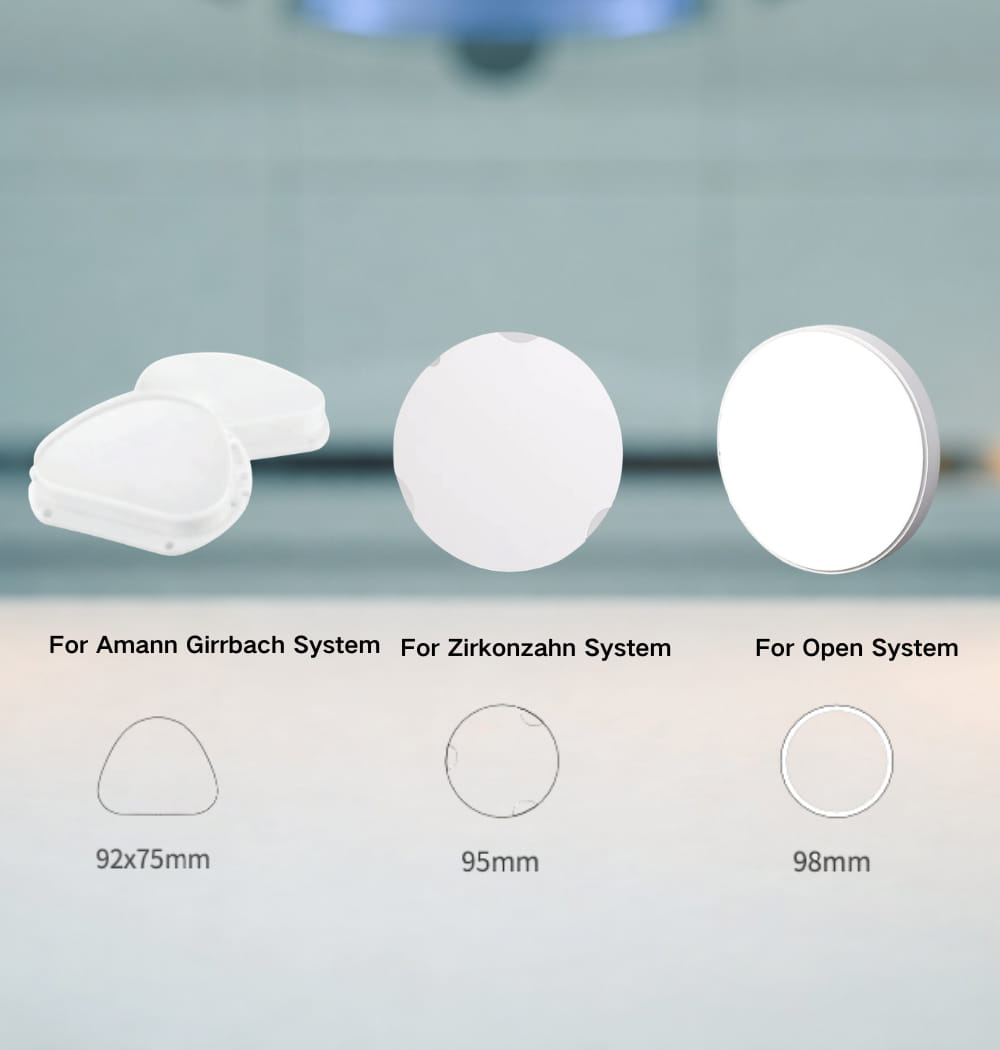
You ordered a box of 98mm zirconia discs — and they don't fit your mill. It happens more often than any lab manager wants to admit. The disc diameter is wrong, the pin layout doesn't match, or the holder clamp won't close. Now you've got $300 in blanks sitting on a shelf and a case due tomorrow.
Disc diameter, holder pin configuration, and thickness vary across every major manufacturer, yet nobody has published a single resource that maps disc sizes to compatible machines. Labs either waste money on wrong-size inventory or get locked into overpriced closed-system blanks because they don't know their options.
This zirconia disc compatibility milling machine guide is the reference sheet your lab's been missing. Below: a full compatibility matrix by disc size and machine brand, a thickness selection guide by restoration type, bur pairing by zirconia grade, and the sintering shrinkage math that ties it all together.
Open System vs Closed System Zirconia: Why It Decides Your Disc Options
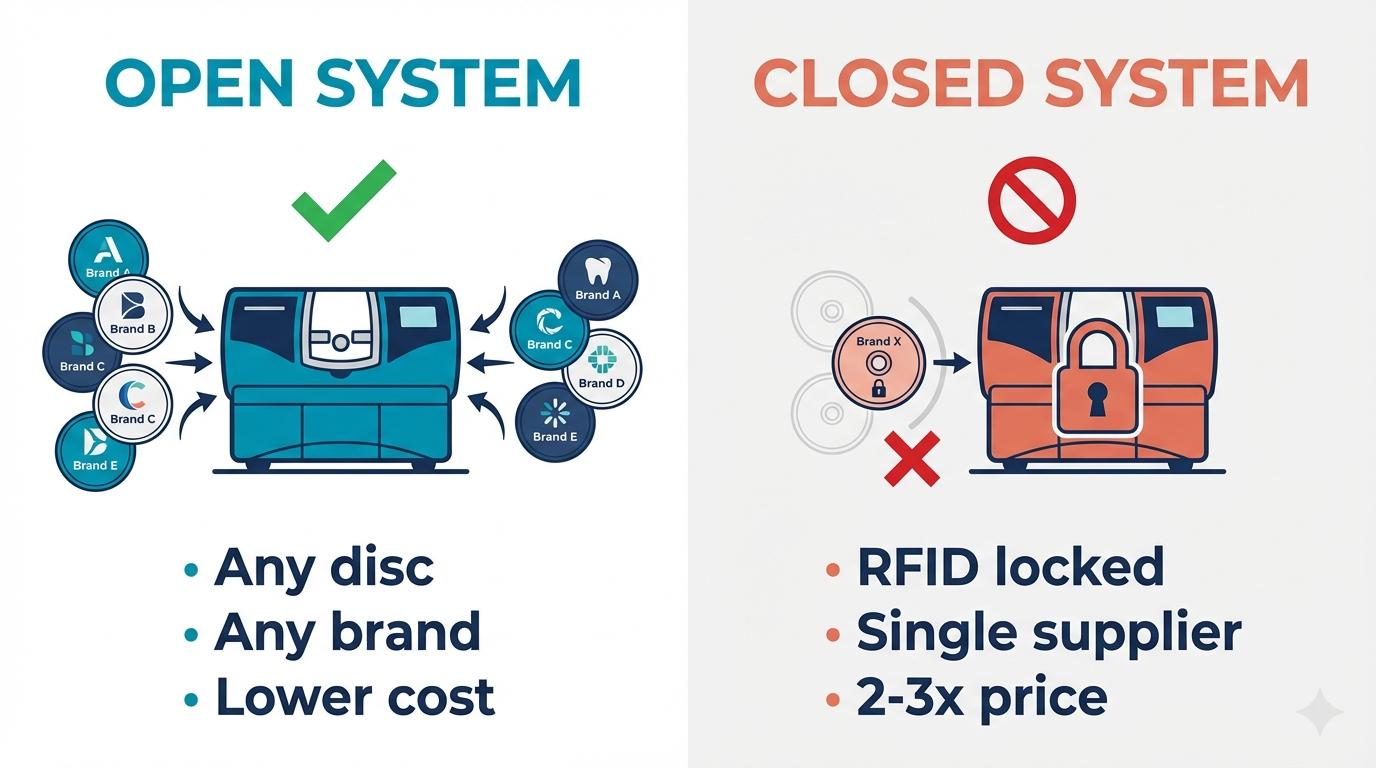
Before pulling up a disc catalog, know which category your mill falls into — it determines whether you can shop freely or you're stuck with one supplier.
Open system: The mill accepts any third-party disc that physically fits the holder. No RFID scan, no barcode check, no proprietary lock-in. Roland, VHF, and Imes-icore are all open. Buy from whoever offers the best price and quality for your workflow.
Closed system: The machine validates blanks via RFID chip or barcode before milling. Sirona CEREC and early Planmeca models are the clearest examples. If the blank doesn't pass the scan, the mill won't run. Material choice is limited to what the OEM or its licensed partners sell — and those blanks typically run 2–3× the price of open-market equivalents.
The cost gap is real. A 98mm × 12mm open-market zirconia block from a reputable manufacturer runs roughly $18–35 depending on grade and brand. The equivalent closed-system blank from a proprietary supplier can hit $60–80 per unit. For a lab milling 20+ cases a week, that difference compounds fast.
The Hybrid Reality
Not every “closed” machine is fully locked. The Amann Girrbach Ceramill Motion 2 is a good example of a semi-open system — it ships with Amann Girrbach's own material library, but labs can import third-party material parameters and run open-market discs with the right adapter ring. Some Planmeca PlanMill models can be configured for open mode depending on firmware version and regional distributor agreements.
If a machine is listed as closed, check with the distributor before assuming you're locked in permanently. Adapter rings and firmware unlocks exist for several models.
When Closed Makes Sense
High-volume single-supplier labs with warranty concerns and no appetite for material testing sometimes prefer closed systems — one vendor, one support line, predictable results. For a small chairside practice milling 3–4 units a week, the simplicity can be worth the premium.
For any lab milling more than 10 cases a week across multiple materials, open system vs closed system zirconia is a straightforward calculation: open wins on cost and flexibility every time.
Zirconia Disc Size Compatibility Matrix: 98mm, 95mm, 71mm & CEREC Blocks by Machine Brand
This is the table most labs are missing. Bookmark it, print it, tape it to the wall next to the mill.
| Disc Format | Compatible Machines | System Type | Notes |
|---|---|---|---|
| 98mm | Roland DWX-52D / 52DC | Open | Standard holder; confirm pin layout for third-party discs |
| 98mm | VHF S1 / S2 / Z4 | Open | Direct fit; no adapter needed |
| 98mm | Imes-icore CORiTEC 350i / 450i | Open | Standard 98mm holder included |
| 98mm | Amann Girrbach Ceramill Motion 2 | Semi-open | Requires adapter ring for third-party discs |
| 98mm | ZirkonZahn M5 | Open | Accepts 98mm; verify holder version |
| 98mm | Dental Axess Organical Desktop | Open | Standard 98mm format |
| 95mm | ZirkonZahn M1 / M2 | Open | 95mm native format |
| 95mm | Wieland Zenotec (older models) | Open | Check model year; newer units may differ |
| 71mm | Planmeca PlanMill 30S / 40S | Closed/Semi | 71mm native; open mode varies by config |
| 71mm | Aidite-compatible desktop units | Open | Verify holder spec per unit |
| CEREC Block | CEREC MC / MC X / MC XL | Closed | Barcode-validated; third-party blocks may void warranty |
| CEREC Block | Sirona inLab MC X5 | Closed | Same proprietary block format |
98mm Disc Compatibility
98mm is the industry standard for lab-scale milling. Most 5-axis open mills and a large share of 4-axis open mills are built around this format. The Roland DWX-52D and DWX-52DC are probably the most common open mills in North American labs — both accept 98mm discs directly with the included clamp system.
One detail that catches labs off guard: some 98mm discs are manufactured with a step-down shoulder — 98.5mm outer diameter with a 95mm seating surface. These fit most 98mm holders fine, but not all. Always check the holder spec sheet before ordering a new disc brand. A 0.5mm mismatch at the shoulder can cause the disc to seat improperly and throw off your Z-axis calibration.
VHF mills (S1, S2, Z4) are straightforward — standard 98mm, no adapter, no surprises. Imes-icore CORiTEC machines are the same. Both are popular in European labs and increasingly common in NA.
95mm Disc Compatibility
95mm is a less common format, mostly found on older ZirkonZahn machines (M1, M2) and some legacy Wieland Zenotec units. If the lab inherited one of these mills, sourcing 95mm discs is doable but the selection is narrower than 98mm.
95mm and 98mm are not interchangeable. Three millimeters sounds trivial — it's not. The holder won't clamp correctly, and even if it physically seats, the disc will shift during milling. Don't try to force it without a verified adapter.
71mm (75mm) Disc Compatibility
The 71mm format (sometimes listed as 75mm depending on the manufacturer's measurement convention) is the compact format for chairside mills and small-footprint desktop units. Planmeca PlanMill 30S and 40S are the most common machines in this category.
The trade-off is straightforward: a 71mm × 12mm disc yields 6–10 single crowns versus 20–30 from a 98mm disc. Per-unit material cost is higher. For a chairside practice milling one or two units at a time, that's acceptable — the ROI comes from same-day delivery, not material efficiency.
For dental zirconia disc selection in a chairside context, 71mm is often the only option the machine accepts. Verify before ordering.
CEREC / inLab Blocks (Sirona Closed System)
CEREC blocks are a different animal — not a disc at all, but a pre-cut rectangular blank with a barcode that the machine scans before milling. Compatible with CEREC MC, MC X, MC XL, and the inLab MC X5.
Third-party CEREC-format blocks exist and are priced significantly lower than Sirona's own blanks. Whether they work depends on the machine's firmware and whether the barcode validation can be bypassed or matched. Using them may void the machine warranty — that's a real consideration for practices still under service contract.
Zirconia Block Thickness Selection by Restoration Type
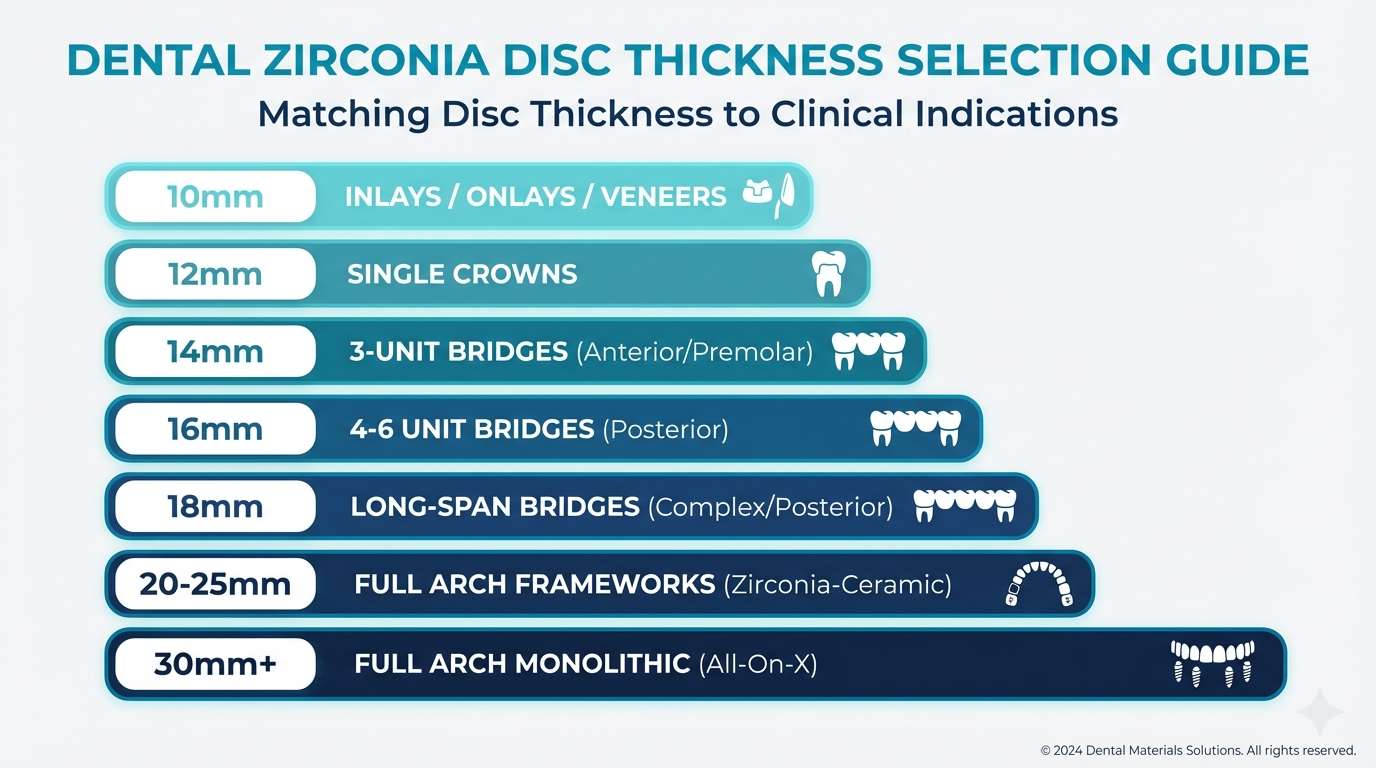
Thickness is the variable most labs get wrong when building inventory. Order too thin and the CAM software can't nest the restoration. Order too thick and you're wasting material on cases that didn't need it.
The rule: always calculate from the sintered dimension backward. A 12mm disc doesn't produce a 12mm-tall restoration — after ~20–25% linear shrinkage, effective height is closer to 9.5–10mm. More on the math in the next section.
| Thickness | Best For |
|---|---|
| 10mm | Single inlays, onlays, thin veneers |
| 12mm | Single crowns (anterior and posterior) — the standard workhorse thickness |
| 14mm | 3-unit bridges, screw-retained implant crowns needing extra connector height |
| 16mm | 4–6 unit bridges, cases with deep subgingival margins |
| 18mm | Long-span bridges (6+ units), implant bars |
| 20–25mm | Full-arch frameworks, hybrid prostheses |
| 30mm+ | Full-arch monolithic restorations with high palatal vaults or deep bite cases |
For most single-unit lab work, 12mm covers 80–90% of cases. Stock it in depth. Keep 14mm and 16mm on hand for bridge cases. 18mm and above are specialty inventory — order per case unless bridge volume justifies stocking them.
Nesting Efficiency
Before committing a thick disc to a case, run the nesting preview in the CAM software. hyperDENT, DentalCAM, and Millbox all show disc utilization before the job starts. A 16mm disc used for a single crown wastes 4mm of material that a 12mm disc would have covered. Over a month of cases, that adds up.
Zirconia block thickness selection isn't just about fitting the restoration — it's about not over-specifying. Match thickness to the tallest restoration in the case, not to a worst-case scenario that rarely happens.
Bur Pairing by Zirconia Type: Match the Tool to the Material
Wrong bur choice doesn't just shorten tool life — it causes chipping at margins, poor surface finish, and wasted discs. The pairing logic is straightforward once you know the material grades.
By Zirconia Grade
3Y-TZP (high-strength, opaque): Flexural strength 900–1200 MPa. Hard material, requires aggressive cutting. CVD diamond-coated zirconia milling burs are the right call — they handle the hardness without premature wear. Feed rates typically 800–1200 mm/min at 15,000–20,000 RPM depending on bur diameter and machine spindle.
4Y-TZP (translucent): Flexural strength 700–900 MPa. Softer than 3Y, which sounds like a benefit until micro-fractures show up at margins from overly aggressive tooling. DLC (diamond-like carbon) coated burs or fine-grit diamond burs are the right match. Back off the feed rate slightly compared to 3Y.
5Y-TZP (ultra-translucent): Flexural strength 500–700 MPa. The softest of the three grades. DLC burs or polished carbide work well. Prioritize surface finish over cutting speed — 5Y is used for anterior esthetics where margin quality matters more than throughput.
Pre-Sintered vs Partially Sintered
Pre-sintered (green state) zirconia is chalk-soft and mills easily with standard carbide burs. Partially sintered (pre-crystallized) material is significantly harder and needs diamond tooling. Most commercial discs ship in the partially sintered state — confirm with the supplier before assuming green state.
Pre-Shaded vs White
Pre-shaded and white discs of the same zirconia grade mill identically. Shade is added during manufacturing and doesn't change the material's hardness, yttria content, or sintering state. Same toolpaths, same burs, same RPM. Don't adjust parameters based on color.
Bur Replacement Intervals
Track units milled, not hours on the spindle. A bur running 3Y-TZP wears approximately 40% faster than the same bur running 5Y-TZP. A bur rated for 60 crowns in 5Y might only last 35–40 crowns in 3Y. Set replacement intervals per material grade, not a single blanket number. For a deeper look at how material choice affects your workflow, see our guide on monolithic vs layered zirconia.
Sintering Shrinkage: The Factor That Connects Disc Size to Final Fit
Zirconia shrinks 20–25% linearly during sintering. In CAM terms, the software applies an enlargement factor — typically 1.20 to 1.26 — to the milled restoration so the sintered result hits the target dimensions.
The exact factor varies by manufacturer. Katana, Upcera, Bloomden, and other major disc brands each publish their own shrinkage coefficient. Using a generic 1.22 when the material calls for 1.245 introduces dimensional error that compounds across a full arch. Import the manufacturer's shrinkage file into the CAM software. Don't guess.
What This Means for Disc Selection
A 12mm disc doesn't yield a 12mm-tall crown. After sintering, effective height is approximately 9.5–10mm. For a case requiring a 10mm-tall restoration post-sintering, a 12mm disc is the minimum — and it's tight. A 14mm disc gives breathing room for nesting and sprue placement.
Work backward: measure the tallest point of the designed restoration in the CAM software, multiply by the enlargement factor, and add 1–2mm for the sprue and disc retention ring. That's the minimum disc thickness needed.
How Many Crowns Per Disc
A 98mm × 12mm disc typically yields 20–30 single crowns depending on nesting efficiency and crown size. A 71mm × 12mm disc yields 6–10. Thicker discs don't increase the number of units — they increase the maximum restoration height. Use the CAM software's nesting preview for exact counts per case.
Recommended Products
Now that you know which disc size fits your machine and which bur grade matches your zirconia, here are the materials to put that knowledge to work.
- 98mm Zirconia Blocks (Open System) — Pre-sintered discs sized for open-system machines like Roland DWX-52D, VHF K5, and Imes-icore 350i covered in the compatibility matrix above.
- 95mm Zirconia Blocks (ZirkonZahn System) — Proprietary-format discs for ZirkonZahn mills, where the 95mm size is the required fit as outlined in the compatibility guide.
- Zirconia Milling Burs — Full bur range covering CVD diamond for 3Y, DLC for 4Y, and DLC/polished carbide for 5Y — matching the grade-specific bur pairing recommendations in this article.
- Roland DWX-52D Compatible Burs — Machine-specific bur sets validated for the DWX-52D spindle geometry, so you're not guessing on shank fit or RPM compatibility after selecting your zirconia grade.
FAQ
What size zirconia disc fits a Roland DWX-52D?
98mm. The DWX-52D uses a standard open-system holder that accepts 98.5mm OD discs with the included clamp. Confirm pin configuration if switching to a new disc brand — most 98mm discs fit, but shoulder dimensions vary slightly between manufacturers.
Can I use a 98mm zirconia disc in an Amann Girrbach Ceramill?
Yes — the Ceramill Motion 2 supports 98mm discs in open mode with the correct adapter ring. Older Ceramill models (Matik, Matron) may require a different adapter or may not support third-party discs at all. Check the specific model's holder specs before ordering.
What is the difference between 98mm and 71mm zirconia discs?
98mm is the lab-scale standard — 20–30+ crowns per disc, compatible with most open-system mills (Roland, VHF, Imes-icore). 71mm is the compact format for chairside and small desktop mills — 6–10 crowns per disc. Machine compatibility differs between the two formats. A mill designed for 98mm won't accept 71mm, and vice versa.
How many crowns can I mill from one zirconia disc?
A 98mm × 12mm disc yields roughly 20–30 single crowns depending on nesting. A 71mm disc yields 6–10. Thicker discs don't increase the count — they allow taller restorations. Run the nesting preview in the CAM software for exact numbers per case.
Does pre-shaded zirconia mill differently than white?
No. Milling behavior depends on yttria content (3Y/4Y/5Y) and sintering state, not shade. Pre-shaded and white discs of the same grade use identical toolpaths, burs, and RPM settings. The shade is baked into the material during manufacturing and has no effect on hardness or machinability.
What to Do Next
Print the compatibility matrix and tape it next to the mill. Before ordering discs, check three things: diameter fits the machine, thickness covers the tallest restoration (accounting for shrinkage), and the bur kit matches the zirconia grade. Get one of those wrong and the disc ends up on the shelf instead of in the sintering furnace.
Browse our zirconia block collection to find the right disc size for your machine.