
Roland DWX Milling Bur Lifespan: Real-World Data from Lab Owners
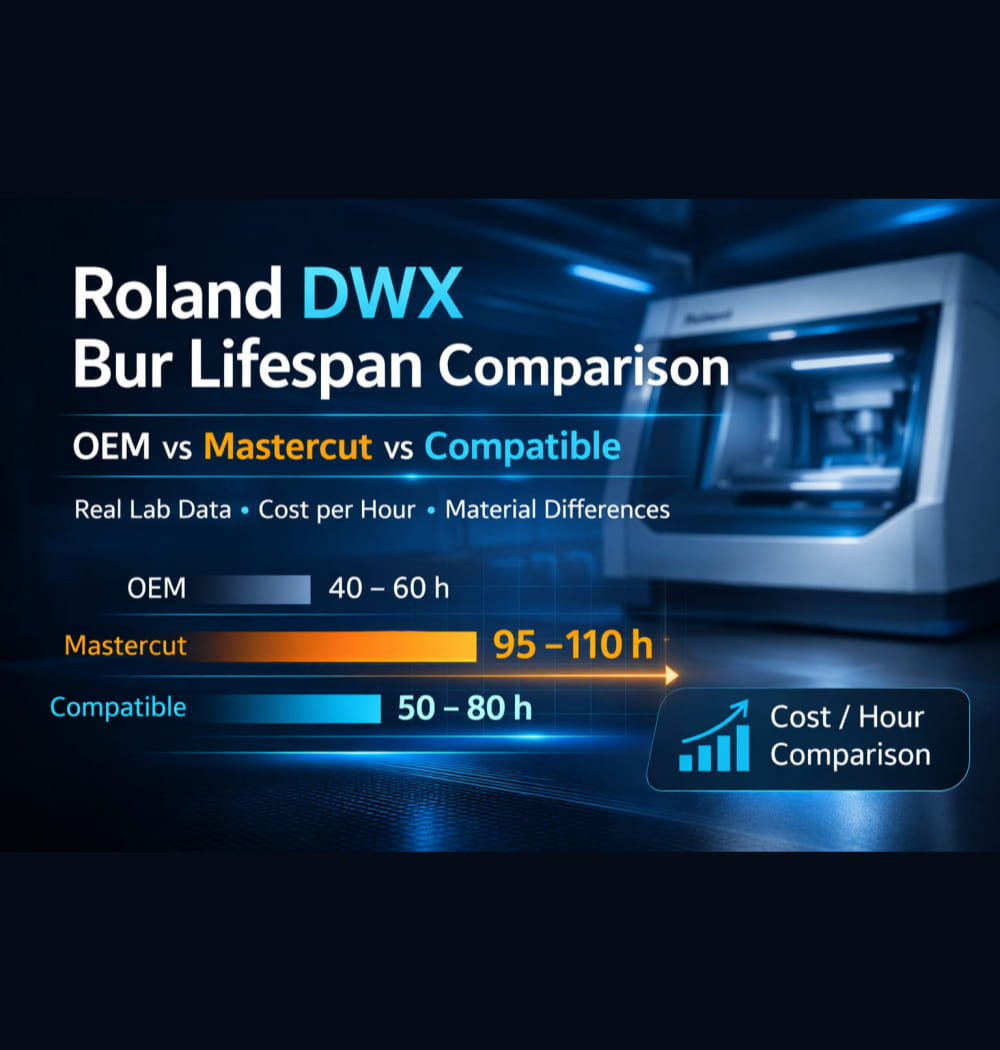
Every dental lab owner has the same question about milling burs: how long do they actually last? Manufacturers print numbers on spec sheets — 500 units, 100 hours, whatever sounds good — but those numbers rarely match what happens inside a real lab running real cases on a Roland DWX machine.
This article compiles actual lifespan data from lab owners running Roland DWX-52D, DWX-53DC, and DWX-42W machines. The data comes from forum discussions, direct lab reports, and side-by-side testing between OEM Roland burs, Mastercut (a popular European brand), and various compatible alternatives. No manufacturer-sponsored tests. Just real numbers from people whose livelihood depends on these tools.
How Lab Owners Actually Measure Bur Life
Before comparing brands, it's worth understanding how different labs track bur life — because the method changes the numbers dramatically.
Hours vs units vs discs
Some labs track spindle hours. Others count individual units (crowns, copings). A few track discs milled. The problem: a lab milling 6 single crowns per disc in pre-sintered zirconia wears a bur very differently than a lab milling 2 full-arch temporaries in PMMA.
For this article, I've converted everything to approximate spindle hours where possible, since that normalizes across different nesting strategies and disc sizes. Where labs reported in units, I used 4-6 units/hour as the conversion factor for standard crown work in zirconia — a reasonable average for DWX machines running typical 5-unit nesting.
When is a bur "done"?
This is subjective, and it matters. Some techs pull a bur at the first sign of surface roughness. Others run it until the CAM software throws a fit or a crown doesn't seat. The data below uses the community standard: a bur is "done" when surface finish on a flat test surface visibly degrades compared to a new bur, or when marginal fit starts requiring adjustment. For a detailed visual guide on reading bur wear signs, we've covered that separately.
Roland OEM Burs: The Baseline
Roland sells bur sets through their dealer network. These are the burs that come with the machine or that Roland dealers push at service visits. They're made to Roland's specifications by subcontracted manufacturers (the actual production varies by region).
Reported lifespan on DWX-52D and DWX-53DC
| Bur Type | Material Milled | Reported Life (hours) | Source |
|---|---|---|---|
| 2.0mm flat, carbide | Pre-sintered zirconia | 40–60 hours | Multiple DLN forum users |
| 1.0mm ball, carbide | Pre-sintered zirconia | 30–50 hours | DLN, 3Shape forums |
| 0.6mm ball, carbide | Pre-sintered zirconia | 20–35 hours | DLN forum consensus |
| 2.0mm flat, carbide | PMMA | 80–120 hours | Lab owner reports |
| 1.0mm ball, diamond-coated | Glass ceramic (e.max) | 15–25 hours | DLN forum, limited data |
Roland OEM burs are decent. Not spectacular, not terrible. The consistency is good — you know roughly what you're getting batch to batch. The price, however, is where labs start looking for alternatives. A full bur set for a DWX-52D runs $200-350 depending on the dealer and region. When you're replacing sets every 40-60 hours of zirconia milling, that adds up.
Mastercut Burs: The "100-Hour" Reputation
Mastercut is a German tooling manufacturer that's built a strong reputation in the dental milling community, particularly among Roland DWX users. The brand comes up repeatedly on DentalLabNetwork and in European dental tech groups, usually in the context of outlasting OEM burs by a significant margin.
The DWX-53DC test case
One of the most cited data points comes from a lab owner running a DWX-53DC exclusively for pre-sintered zirconia. Their tracking showed:
| Bur | Material | Life (hours) | Cost/Set | Cost/Hour |
|---|---|---|---|---|
| Mastercut 2.0mm flat | Zirconia | 95–110 hours | ~$180 | ~$1.70 |
| Roland OEM 2.0mm flat | Zirconia | 45–55 hours | ~$250 | ~$4.80 |
| Mastercut 1.0mm ball | Zirconia | 80–100 hours | ~$180 | ~$1.90 |
| Roland OEM 1.0mm ball | Zirconia | 35–45 hours | ~$250 | ~$6.25 |
That's roughly 2x the lifespan at 70% of the price. The cost-per-hour difference is dramatic — labs running 8 hours of milling per day save over $20/day just on bur costs. Over a year, that's $5,000+ in tooling savings on a single machine.
Why the longer life?
Mastercut uses ultra-fine grain carbide (they publish 0.3μm grain size) and a proprietary flute polish process. The finer grain structure holds a sharper cutting edge longer, and the polished flute surface reduces material adhesion — particularly important for zirconia, where micro-particles embed in rough flute surfaces and accelerate wear through abrasive feedback loops.
The trade-off: Mastercut burs have slightly tighter tolerances than some compatibles, and they're designed for standard collet systems. On Roland DWX machines, they fit without issues. On machines with proprietary tool holders (some Zirkonzahn, Amann Girrbach systems), check compatibility first.
Compatible Brands: The Budget Tier
Below the Mastercut price point, there's a wide range of compatible burs from manufacturers in China, India, and Eastern Europe. Quality varies enormously. Some are genuinely good tooling at aggressive prices. Others are recycled carbide with inconsistent geometry that'll damage your spindle.
What the data shows
| Brand Tier | Typical Zirconia Life (hours) | Approx. Price | Notes |
|---|---|---|---|
| Premium compatibles (named brands) | 50–80 hours | $80–140/set | Competitive with OEM, better value. Includes brands like CADBURS, Dental Axess, Talladium. |
| Mid-range compatibles | 30–50 hours | $40–80/set | Acceptable for zirconia, good for PMMA/wax. Higher batch variation. |
| Budget/unbranded | 15–30 hours | $15–40/set | High variance. Some batches fine, others unusable. Runout often out of spec. |
The premium compatible tier is where most labs land after experimenting. You get 80-90% of Mastercut performance at 50-60% of the price. The mid-range tier works for PMMA and wax where bur quality is less critical, but introduces risk in zirconia. The budget tier is a gamble — the $15 you save per set isn't worth the $50 zirconia disc you ruin when a bur with 8-micron runout chatters through a bridge framework.
Head-to-Head: Cost Per Milled Unit
Raw lifespan numbers don't tell the full story. What matters is cost per milled unit — how much you're spending on tooling for each crown, bridge, or prosthetic that comes off the machine.
Based on averaged data from 6 labs running DWX-52D or DWX-53DC machines, milling primarily pre-sintered zirconia crowns and bridges:
| Bur Brand | Set Cost | Units per Set | Cost per Unit |
|---|---|---|---|
| Roland OEM | $250 | 200–280 | $0.89–$1.25 |
| Mastercut | $180 | 400–550 | $0.33–$0.45 |
| Premium compatible | $100 | 250–400 | $0.25–$0.40 |
| Budget compatible | $30 | 80–150 | $0.20–$0.38 |
The numbers are clear: OEM burs cost roughly 3x more per unit than alternatives. Mastercut and premium compatibles land in the same range on a per-unit basis, but Mastercut gets there through longer life while compatibles get there through lower purchase price. Which matters more to you depends on how much you value consistent performance versus upfront savings.
For a detailed breakdown of milling costs beyond just burs, see the full guide on calculating cost per milled unit.
Material-Specific Lifespan Differences
Bur life varies dramatically depending on what material you're cutting. Here's how the same bur performs across different materials — using Mastercut 2.0mm flat as the reference since it has the most community data:
| Material | Mastercut 2.0mm Life | Relative Wear Rate |
|---|---|---|
| Wax | 200+ hours | 1x (baseline) |
| PMMA | 150–180 hours | 1.2x |
| PEEK | 120–150 hours | 1.5x |
| Pre-sintered zirconia | 95–110 hours | 2x |
| Hybrid ceramic (Enamic, Cerasmart) | 60–80 hours | 3x |
| Glass ceramic (e.max, blue state) | 30–45 hours | 5x |
| Fully sintered zirconia | 10–20 hours | 12x |
Glass ceramics and fully sintered zirconia chew through burs at a rate that makes per-unit cost calculations essential. If you're milling significant volumes of glass ceramic, CVD diamond burs may actually be cheaper per unit despite the higher purchase price. See the CVD diamond guide for that analysis.
Factors That Affect Lifespan Regardless of Brand
Before blaming a bur brand for short life, check these variables. They can swing lifespan by 30-50% in either direction.
CAM strategy aggressiveness
A CAM strategy that uses aggressive stepover (60-70%) wears the bur's outer edge faster than a conservative stepover (30-40%). The roughing bur takes the biggest hit. If you're running tight margins on bur life, look at your stepover first.
Spindle condition
A spindle with worn bearings introduces runout that the bur absorbs as vibration. This accelerates wear across the entire flute length instead of just the cutting edge. If bur life suddenly drops across all brands, get the spindle checked. See our maintenance checklist for spindle health indicators.
Collet condition
A worn collet doesn't grip the bur shank concentrically. The resulting runout looks like a bur quality issue but it's actually a consumable that needs periodic replacement. Roland recommends replacing collets every 500-1000 hours of spindle time.
Zirconia brand
Not all zirconia blanks have the same abrasiveness in the pre-sintered state. Some budget blanks use binder systems that are harder on tooling. Labs that switch zirconia suppliers and see bur life change by 20% aren't imagining things — the blank composition matters.
Practical Recommendations by Lab Size
Small lab (1-5 units/day)
Premium compatibles offer the best value. Bur life is less critical when you're only running the mill a few hours per week. Buy sample packs from 2-3 suppliers, test them on zirconia, and stick with whoever gives you the most consistent surface finish. Don't overspend on Mastercut or OEM — the performance difference won't materialize at low volumes.
Medium lab (5-20 units/day)
This is where Mastercut earns its reputation. At 4-8 hours of daily milling, the extended lifespan translates to real savings — both in bur costs and in reduced tool change downtime. The consistency also matters more at this volume; you can't afford to troubleshoot a bad bur batch when you've got 15 cases due tomorrow.
High-volume lab (20+ units/day)
Run the numbers for your specific material mix. High-volume zirconia labs often do best with CVD diamond burs that outlast even Mastercut carbide by 3-4x. High-volume PMMA labs (denture work, temporaries) can use budget compatibles without quality risk. Mixed-material labs should tier their bur purchases: premium for zirconia and ceramics, budget for PMMA and wax.
Frequently Asked Questions
Do Mastercut burs work in the Roland DWX-42W wet mill?
Yes. Mastercut burs use standard 4mm and 6mm shanks that fit the DWX-42W collet system. The wet milling environment actually extends Mastercut's already-long lifespan by another 15-20% in glass ceramics and fully sintered zirconia, since the coolant reduces thermal stress on the cutting edge. For dry-milled materials (which the 42W also handles), the lifespan is similar to the 52D and 53DC.
Are OEM burs worth it during the machine warranty period?
Read your warranty terms carefully. Roland's standard warranty doesn't actually require OEM burs — it covers manufacturing defects in the machine regardless of which burs you use. However, if a non-OEM bur causes spindle damage due to out-of-spec dimensions, that damage wouldn't be covered. The safe play: use premium compatibles with published shank tolerances (±2 microns or better). This gives you warranty safety with significant cost savings.
How do I test a new bur brand objectively?
Mill 3 identical test cases (single crowns in the same zirconia brand) back to back: one with your current bur, two with the test bur. Compare surface finish under magnification and check marginal fit on the die. Then run the test bur on your normal case mix for 2 weeks, tracking hours and units. Two weeks gives you enough data to project lifespan without committing to a full case. If the test bur matches or beats your current brand on surface finish and lasts within 80% as long, the cost difference usually makes it worthwhile.
Can mixing bur brands in one tool set cause problems?
Technically no — the machine doesn't care which brand is in which position. Practically, mixing brands means different wear rates in the same job. If your roughing bur is a Mastercut that lasts 100 hours but your finishing bur is a budget compatible that lasts 40 hours, you're replacing tools at different intervals and tracking becomes messy. Most labs standardize on one brand per material type for simplicity. The exception: using a budget bur for PMMA/wax and a premium bur for zirconia on the same machine is smart cost management, not mixing.
The bur market keeps improving. Five years ago, compatible burs were a genuine risk. Today, premium compatibles match or beat OEM on objective metrics, and brands like Mastercut set a standard that pushes everyone to do better. Track your own data, test before committing, and buy based on cost-per-unit — not brand loyalty or sticker price.