
Why Do Milling Burs Break in PMMA? Roland DWX Troubleshooting Guide
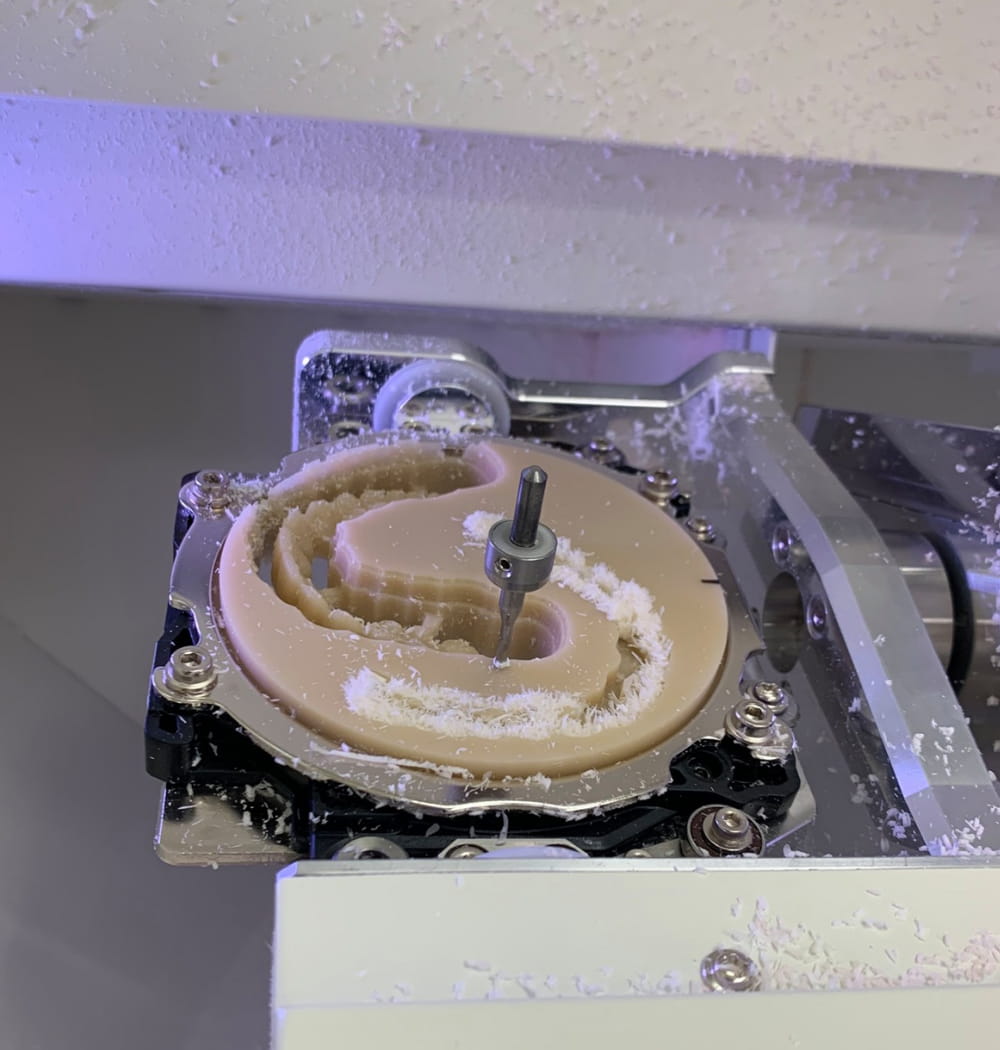
PMMA should be easy. It's soft, it mills dry, it doesn't fight the bur the way zirconia does. So when a lab owner running a Roland DWX-52D posts on DentalLabNetwork asking why they're snapping burs left and right in PMMA — something is wrong. And it's almost never the material.
Bur breakage in PMMA on Roland DWX machines traces back to a handful of root causes. Most of them are fixable in under an hour. This guide covers the common culprits, what to check first, and how to stop burning through burs on a material that shouldn't be causing problems.
Why PMMA Breaks Burs Differently Than Hard Materials
In zirconia or lithium disilicate, burs fail from abrasive wear — the cutting edge gradually dulls until it can't hold tolerance. Predictable, manageable. PMMA bur failures are different. The bur snaps. Clean break, usually at the neck or just above the flutes.
This happens because PMMA doesn't grind — it chips and smears. When chip evacuation fails, melted PMMA re-welds onto the flutes. The bur is now trying to push through a blob of re-deposited material with cutting edges that are effectively clogged. Lateral forces spike. The thin neck of a 0.6mm or 1.0mm bur can't handle the side load, and it fractures.
On a DWX-52D or DWX-53DC, this is amplified by dry milling — there's no coolant to flush chips away from the cut zone. Everything depends on spindle airflow, vacuum suction, and correct feed rates to keep the flutes clear.
Root Cause #1: Wrong Bur Geometry for PMMA
This is the most common mistake. Labs that mill zirconia and PMMA on the same Roland machine often try to use the same bur set for both. A 2-flute bur designed for pre-sintered zirconia will clog almost immediately in PMMA.
PMMA needs single-flute or two-flute burs with large chip clearance and polished flute surfaces. The geometry has to allow the soft, stringy chips to escape upward instead of packing into the flutes. Think of it like the difference between a wood drill bit and a metal drill bit — same concept, different chip behavior.
What to use instead
- Single-flute carbide for roughing. Maximum chip room, zero clogging risk. These are the standard for PMMA on Roland machines.
- Two-flute with polished flutes for finishing. The polished surface prevents PMMA from sticking. Unpolished flutes accumulate resin buildup within minutes.
- Avoid diamond-coated burs entirely for PMMA. The rough diamond surface acts like sandpaper — it generates heat and melts the material instead of cutting it. This is the single biggest cause of bur breakage that forum users report.
Check the PMMA and wax milling burs category for burs specifically designed with the right flute geometry for soft materials.
Root Cause #2: Feed Rate and RPM Mismatch
Roland DWX machines ship with default milling strategies that are conservative. For PMMA, "conservative" often means too slow — and counterintuitively, going too slow causes more breakage than going too fast.
Here's why. At low feed rates, the bur dwells in the material longer per revolution. Each tooth takes a thinner chip. Thin chips don't clear properly — they melt from friction heat and pack into the flutes. The loaded bur then catches and snaps.
The fix
Increase the feed rate by 20-30% from the default PMMA strategy. You want the bur taking a real chip on every revolution — thick enough that the chip breaks free cleanly instead of smearing. On a DWX-52D, typical good parameters for PMMA roughing with a 2.0mm single-flute bur:
| Parameter | Default (often) | Better Setting |
|---|---|---|
| Spindle RPM | 15,000 | 12,000–14,000 |
| Feed rate (XY) | 800 mm/min | 1,000–1,200 mm/min |
| Stepdown (Z) | 0.5mm | 0.8–1.0mm |
| Stepover | 50% | 40–50% |
Lower RPM + higher feed = thicker chips. Thicker chips carry heat away from the cut and eject cleanly. This is standard practice for any thermoplastic milling — PEEK follows the same logic.
Root Cause #3: Insufficient Chip Evacuation
The DWX-52D uses an internal vacuum system to pull chips away from the workpiece. When this system underperforms, chips accumulate around the bur, re-enter the cut zone, and cause the clogging-breakage cycle described above.
Check these items
- Vacuum filter. Open the machine and inspect the filter. A clogged filter cuts suction power in half. PMMA dust is fine and sticky — it blocks filters faster than zirconia dust. Clean or replace the filter every 20-30 hours of PMMA milling, not the generic 100-hour interval that covers zirconia.
- Vacuum hose path. Make sure the hose isn't kinked, cracked, or disconnected. On some DWX-52D units, the hose routing can shift during shipping or maintenance, reducing airflow.
- Spindle air blast. Roland DWX machines blow compressed air through the spindle to clear chips. If this nozzle is partially blocked by dust buildup, chip clearance drops. Clean it with a blast of compressed air (machine off, spindle stopped).
A quick test: mill a single PMMA disc with the vacuum cover removed and watch the chip behavior. If chips are flying clear, your vacuum is the bottleneck. If chips are wrapping around the bur even with open-air milling, the bur geometry or feed rate is the issue.
Root Cause #4: PMMA Disc Quality and Mounting
Not all PMMA discs are created equal. Cheap blanks can have internal stresses from the casting process, inconsistent hardness zones, and poor dimensional accuracy. A disc that's 0.2mm thicker on one side than the other creates uneven cutting loads — the bur alternates between air-cutting and full engagement every revolution. That pulsing load is brutal on small-diameter burs.
Mounting issues
On the DWX-52D, the disc mounts in a holder with retention screws. If the disc isn't seated flat — maybe there's debris on the holder surface, or a screw is cross-threaded — the disc wobbles during milling. Even 0.1mm of wobble at the disc edge translates to significant force variation at the bur tip. Tighten the retention screws evenly and check that the disc sits flat with no gap. Run a hand across the top surface while it's mounted — any rocking means re-seat it.
Root Cause #5: Worn or Damaged Burs That Look Fine
A bur can look perfect to the naked eye and still be worn past its useful life in PMMA. The critical dimension isn't the flute sharpness — it's the flute surface finish. A bur that's been running in zirconia develops micro-scratches on the flute faces. These scratches are invisible without magnification but they act as grip points for PMMA resin, accelerating the clogging cycle.
Rule of thumb for Roland DWX machines: don't reuse a bur in PMMA that's already done significant work in zirconia or glass ceramic. The cost savings aren't worth the breakage risk. Keep separate bur sets by material — label them if needed.
Root Cause #6: CAM Strategy Issues
The milling strategy your CAM software generates can create situations that snap burs regardless of how good the bur is. Two common patterns on Roland DWX machines:
Full-slot engagement in tight areas
When the bur enters a narrow interproximal area, some toolpaths plunge the bur into full-slot engagement — cutting on the full diameter simultaneously. This doubles the cutting force compared to a stepover pass. In PMMA, the sudden force spike plus the lack of chip clearance in a narrow slot is a recipe for breakage.
Fix: In your CAM software (DentalCAM, Millbox, hyperDENT, etc.), enable ramping entry or helical entry for narrow areas. This engages the bur gradually instead of plunging straight in. Most software has this as an option in the toolpath strategy settings.
Retract height too low
If the retract (safe Z) height is set just barely above the stock surface, chips sitting on top of the disc can catch the bur during rapid traverse moves. The bur hits a chip pile at traverse speed and snaps. Set retract height at least 2mm above the highest point of the stock — not the default 0.5mm that some strategies use.
Quick Diagnostic Checklist
When a bur breaks in PMMA on your DWX, run through this list before replacing and restarting:
| Check | What to Look For | Fix |
|---|---|---|
| Broken bur flutes | Material packed in flutes? | Wrong bur type — switch to single-flute |
| Broken bur at neck | Clean snap, no packing? | Likely side-load — check CAM strategy |
| Disc mounting | Disc wobbles in holder? | Re-seat, clean holder, check screws |
| Vacuum filter | Restricted airflow? | Clean or replace filter |
| Spindle air | Weak air blast at tip? | Clean nozzle with compressed air |
| Feed rate | Below 900 mm/min for roughing? | Increase 20-30% |
| RPM | Above 15,000 for PMMA? | Drop to 12,000-14,000 |
When to Suspect the Machine, Not the Bur
If you've addressed all the above and burs still snap, the machine itself may have an issue. On DWX-52D units with high mileage:
- Spindle bearing wear increases runout beyond spec. A spindle with 10+ microns of runout puts asymmetric loads on the bur that no feed rate adjustment can fix. Roland service can measure this.
- Axis backlash causes the bur to momentarily stall and then lunge forward during direction changes. This is most noticeable on the X axis. If you see "witness marks" — small lines on the restoration surface at direction-change points — get the machine serviced.
- Collet wear. A worn collet doesn't grip the bur shank concentrically. Replace the collet — they're consumable items, not lifetime components.
For a full maintenance checklist covering these and other wear items, we've got a detailed walkthrough.
Frequently Asked Questions
Can I use diamond-coated burs for PMMA milling?
No. Diamond-coated burs generate excessive friction heat in soft thermoplastics like PMMA. The material melts instead of chipping cleanly, packs into the diamond surface texture, and creates a cycle of heat buildup that ends with a snapped bur or a melted restoration. Stick with uncoated solid carbide — single-flute for roughing, polished two-flute for finishing.
How many PMMA discs can one bur handle on a Roland DWX?
With the right single-flute carbide bur and proper feed settings, expect 30-50 full-arch PMMA discs before the bur needs replacing. That's significantly more than zirconia (typically 8-15 discs per bur). The actual number depends on nesting density — more units per disc means more cutting time. Pull the bur when you notice surface finish degradation or hear the cutting tone change.
Why do 0.6mm burs break more often than 1.0mm in PMMA?
Physics. A 0.6mm bur has roughly 1/3 the cross-sectional area of a 1.0mm bur at the neck. That means 1/3 the resistance to bending forces. In PMMA, where lateral forces from chip clogging are the primary failure mode, that smaller bur reaches its breaking threshold much faster. If your designs allow it, use 1.0mm minimum for PMMA detail work and save the 0.6mm for zirconia where the failure mode is gradual wear, not sudden snap.
Should I switch to wet milling for PMMA to reduce breakage?
Roland DWX-52D and 53DC are dry mills — no coolant option. The DWX-42W is the wet milling variant. Wet milling does help with PMMA chip evacuation, but it introduces a new problem: PMMA absorbs water, which can affect dimensional accuracy and surface properties. Most labs mill PMMA dry with proper vacuum and chip evacuation and get excellent results. Fix the root cause instead of changing the milling environment.
Bur breakage in PMMA is a solved problem — it just requires matching the bur geometry to the material behavior. Get the right single-flute burs, bump up the feed rate, keep the vacuum working, and PMMA becomes the easiest material in the shop. The DWX machines handle it well once you stop treating PMMA like a harder material that needs slow, careful cutting.