
Monolithic Zirconia vs Layered Zirconia: Which Is Right for Your Lab?
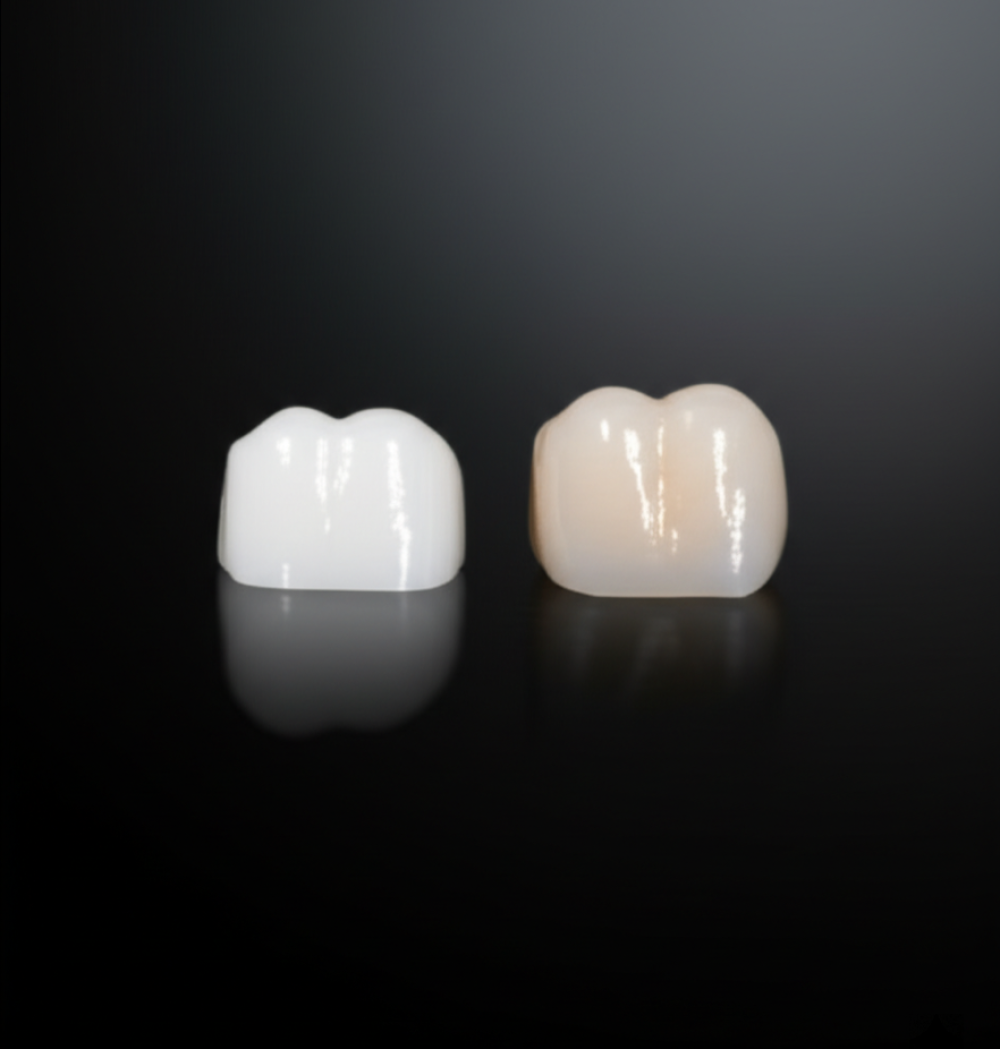
The Real Difference Between Monolithic and Layered Zirconia
When you're deciding between monolithic zirconia and layered zirconia, you're really choosing between speed and aesthetics. Monolithic zirconia is milled from a single block and used as-is. Layered zirconia starts with a coping that you build up with porcelain. The choice affects your milling time, labor costs, strength, and whether the restoration will actually look like a tooth.
Here's what matters: monolithic saves you hours of labor and virtually eliminates chipping. Layered gives you control over translucency, characterization, and natural color depth. Most labs run both, but knowing when to use each keeps your margins healthy and your clients happy.
Material Properties: What the Numbers Actually Mean
The strength difference is real. Monolithic zirconia hits 900-1200 MPa flexural strength depending on the brand. Layered restorations test around 800-900 MPa for the framework, but the porcelain overlay weakens the system. That porcelain layer maxes out at 90-110 MPa, and it's the failure point.
| Property | Monolithic Zirconia | Layered Zirconia |
|---|---|---|
| Flexural Strength | 900-1200 MPa | 800-900 MPa (framework) |
| Translucency | Medium to High (material-dependent) | Excellent (porcelain layer) |
| Chipping Risk | Minimal (<2%) | 5-15% over 5 years |
| Milling Time | 35-50 minutes (full contour) | 20-30 minutes (reduced framework) |
| Total Lab Time | 1-1.5 hours | 4-6 hours |
| Average Lab Cost | $45-75 | $120-200 |
Translucency is where layered still wins for anterior work. High-translucency monolithic blocks have improved, but porcelain lets you build gradient effects and internal characterization that a single-shade block can't match. If you're doing #6-11, that control matters.
Wear on Opposing Dentition
Older monolithic zirconia had a reputation for beating up opposing enamel. That was mostly pre-2018 materials and bad occlusal adjustment. Current-generation monolithic zirconia, when polished correctly, shows wear rates similar to enamel. The key is final polish protocol. If you're leaving it at 600-grit, you're creating problems. Get to 10,000-grit diamond paste or use a dedicated zirconia polishing system.
When to Use Monolithic Zirconia
Monolithic is your default for anything posterior. Molars and premolars take heavy occlusal loads, and patients aren't examining them in the mirror. The strength advantage matters here, and the four-hour labor savings matters more.
Ideal Cases for Monolithic
- Posterior crowns and bridges: Everything from premolar back. The aesthetics are good enough, and the strength is worth it.
- Bruxers and heavy occluders: If the dentist mentions grinding or you see wear facets on the opposing arch, don't layer it. Monolithic survives abuse that would pop porcelain off in months.
- High-volume production: If you're running 20+ units per week, monolithic keeps your ceramist from burning out. One tech can finish 8-10 monolithic crowns per day versus 2-3 layered units.
- Implant restorations: Screw-retained crowns especially. You're already drilling an access hole, so maximizing strength makes sense. The screw channel doesn't compromise monolithic as much as it would a layered coping.
- Long-span bridges: Three units or more. Layered porcelain on a six-unit bridge is asking for trouble. Monolithic gives you predictability.
Milling Parameters for Monolithic
You're cutting full anatomy, so milling time runs longer than reduced frameworks. Expect 35-50 minutes depending on unit size and your machine. Run higher feed rates than you would for layered copings since you're not preserving delicate margins for porcelain buildup.
Typical settings on a 5-axis mill:
- Roughing: 40,000-50,000 RPM, 1.5-2.0 mm/s feed rate, 2.5mm diamond bur
- Pre-finishing: 50,000-60,000 RPM, 1.0-1.5 mm/s, 1.0mm bur
- Finishing: 60,000 RPM, 0.8-1.0 mm/s, 0.6mm bur for occlusal detail
When Layered Zirconia Is Still Worth It
Layered zirconia is for anterior cases where you need aesthetic control. If a patient is paying $1,500-2,500 per crown and it's visible when they smile, the extra lab time is justified.
Cases That Need Layering
- Anterior single crowns (#6-11): Central incisors especially. You need incisal translucency and the ability to match adjacent teeth with internal characterization.
- High aesthetic zones: Canine-to-canine. Some first premolars if the patient has a wide smile line.
- Custom shade matching: When you're blending with natural teeth and the shade tab doesn't cut it. Layering lets you build color depth and mimic enamel-dentin transitions.
- Young patients: Anterior restorations on patients under 40 get more scrutiny. They'll be looking at that crown for decades, and they notice flat, opaque restorations.
The Labor Reality
Layered work takes a skilled ceramist 4-6 hours per unit. That's design, milling, porcelain application (usually 2-3 firings), adjustments, and glaze. You're billing $150-250 per crown to make margin, and you need someone who can actually build porcelain without voids or slumping.
Practical Decision Framework
Stop overthinking every case. Use this framework:
Choose Monolithic If:
- Posterior to the first premolar
- Patient has bruxism or heavy occlusion
- Bridge longer than three units
- Dentist wants fast turnaround (48-hour delivery)
- Price point is under $150 to the dentist
Choose Layered If:
- Anterior to the first premolar and visible in smile
- Dentist specifically requests layered for aesthetics
- Custom characterization needed (white spots, hypocalcification, etc.)
- You have a ceramist with 3+ years of layering experience
- Case price supports the labor cost ($200+ to dentist)
The Middle Ground: Cutback Design
Some labs run cutback designs where you mill a monolithic coping but reduce the labial surface and layer just the front. You get most of the strength with better aesthetics than full monolithic. This works for first premolars and canines where you need some translucency but don't want full layering labor.
Cutback adds about 2 hours versus full monolithic but saves 2-3 hours versus complete layering. The failure rate sits between the two: lower than full layering but higher than monolithic.
What Actually Fails in Practice
Monolithic failures are rare and usually come from prep issues or cement failure, not material fracture. If a monolithic crown breaks, the prep was probably under 1mm reduction or the patient hit something hard. Material failure is under 1% over five years.
Layered restoration failures are almost always porcelain chipping. The zirconia coping doesn't break. You'll see fractures at incisal edges, porcelain delamination, or chips at contact points. This happens in 5-15% of cases over five years depending on location and occlusion.
When porcelain chips, you've got two options: polish the exposed zirconia if it's small, or remake it. Most dentists remake rather than deal with a visible patch. That's a warranty claim and lost profit.
Reducing Layered Failures
If you're running layered work, follow coping design rules:
- Minimum 0.5mm for porcelain thickness, maximum 1.5mm
- No sharp angles or thin feather edges on the coping
- Adequate support for incisal porcelain (extend coping to within 1.5-2mm of incisal edge)
- Proper firing cycles - don't rush the second and third bakes
- Match CTE between zirconia and porcelain (use manufacturer-matched systems)
The Economics for Your Lab
Monolithic makes you more money per hour. A tech producing 8 monolithic crowns per day at $60 average lab cost generates $480 in revenue. Material and bur costs run about $12-15 per unit, so you're at $380-400 margin for one day's work.
That same tech doing layered work completes maybe 2 units per day at $175 each. That's $350 revenue, minus $20-25 in materials and porcelain, for $305-330 margin. You make less money, and you need a higher skill level.
The math favors monolithic for production work. Layered makes sense when you're charging premium prices ($200+ per unit) and have cases that genuinely need it. Don't layer posterior crowns to justify a higher price. Dentists know better now, and you're just adding failure risk.
Equipment Investment
Both options use the same mill, furnace, and sintering oven. Layered work needs porcelain, brushes, firing trays, and a ceramist who knows how to use them. If you're setting up a new lab, start with monolithic. Add layered capability when you have consistent anterior case volume and can hire or train a skilled ceramist.
For reliable results with both approaches, you need quality tools matched to your milling materials. Whether you're cutting full-contour monolithic or delicate copings, the right browse by machine brand prevent chipping and extend your tool life. We cover material-specific tool selection in our guide on wet vs dry milling methods.