
Multilayer Zirconia Block Buying Guide: 3D vs 4D, Translucency & Shade Matching
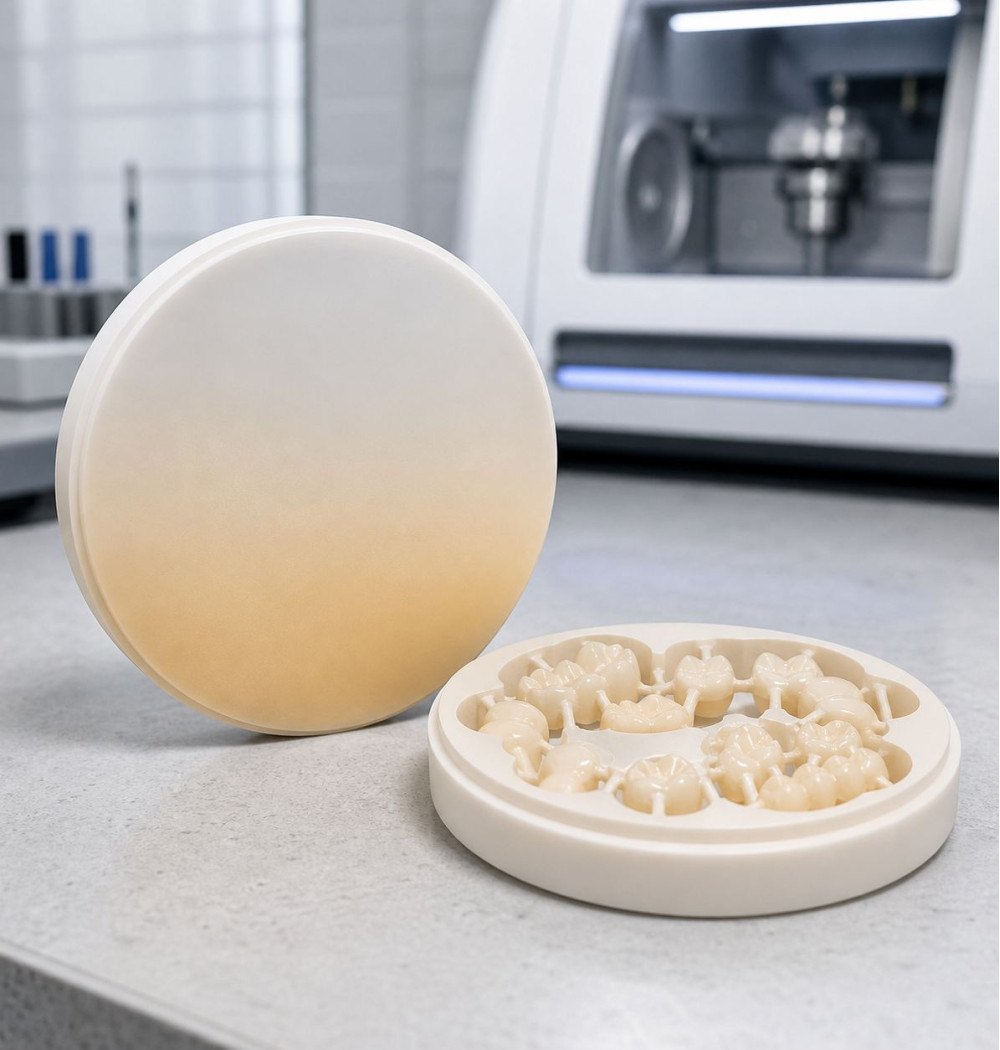
A multilayer zirconia block may be labeled 3D, 4D, Pro, UT-ML, or something equally vague, but those names follow no industry standard. Two discs carrying the same label can have completely different yttria compositions and strength profiles. Buy the wrong gradient type and you will pay for it in poor shade matches, fractured connectors, and remakes.
What "Multilayer" Actually Means (and What It Doesn't)
Multilayer zirconia is a pre-shaded disc made with roughly four to six blended layers. The cervical portion is darker and more chromatic, while the incisal portion becomes lighter and usually more translucent. The purpose is straightforward: mill monolithic restorations with a natural-looking vertical shade transition without dipping, staining heavily, or hand-layering porcelain.
The detail most buyers miss is that cheap multilayer discs may have a color gradient only. The yttria content — and with it translucency and flexural strength — is the same from top to bottom. That is perfectly usable for routine work, but it is not equivalent to a disc with genuine translucency and strength gradients. Ask what changes between layers instead of trusting the product name.
The layers are co-pressed before pre-sintering. In a properly manufactured disc, transition zones blend over a millimeter or more, so you should not see hard bands, seams, or layer-boundary delamination. Visible stripes after sintering usually point to poor powder control, an unsuitable firing cycle, or aggressive staining rather than an unavoidable multilayer effect.
3D vs 4D Multilayer: Decoding the Labels
No ISO standard defines 3D or 4D multilayer zirconia. Every factory can interpret the terms differently. The common convention is that 3D means gradients in color and translucency while using one yttria composition throughout, normally 4Y or 5Y. Strength stays flat across the disc.
A 4D multilayer, also sold as 4D Pro or hybrid multilayer, adds a strength gradient. Its yttria content changes through the thickness: 5Y at the incisal for light transmission, stepping down through 4Y to 3Y in the body and cervical zone for strength. This is a materially different construction, not just another shade effect.
| Specification | Typical 3D multilayer | Typical 4D multilayer |
|---|---|---|
| Gradient layers | Color and translucency; no intentional strength gradient | Color, translucency, and strength |
| Typical yttria composition | Uniform 4Y or 5Y throughout | 5Y incisal, stepping through 4Y to 3Y cervical |
| Incisal translucency | About 45% for 4Y or 49% for 5Y | About 49%, comparable to 5Y-PSZ |
| Cervical flexural strength | About 1,000–1,100 MPa for 4Y; 600–800 MPa for 5Y | About 1,100–1,200 MPa, comparable to 3Y-TZP |
| Best-fit indications | Single crowns and short-span work within the selected grade's limits | Anterior crowns, mixed-esthetic cases, and three-unit or longer bridges when validated |
| Relative price | Lower | Higher |
For reference, conventional 3Y-TZP delivers roughly 1,100–1,200 MPa flexural strength and 40–43% translucency. Typical 4Y-PSZ is around 1,000–1,100 MPa and 45%, while 5Y-PSZ is roughly 600–800 MPa and 49%. These figures vary with test method, specimen preparation, and sintering cycle, so compare like with like.
For single posterior crowns, a good 3D disc is usually enough. Pay for 4D when you need a more translucent incisal zone but still want a strong connector or cervical zone, especially in anterior work and bridges of three units or more. CADBURS stocks a 98mm 4D Pro multilayer zirconia disc for open-system machines.
Translucency vs Strength: The Trade-Off You Can't Escape
Higher yttria content stabilizes more cubic-phase zirconia, which scatters less light and improves translucency. The cost is reduced transformation toughening, the mechanism that helps tetragonal zirconia resist crack growth. You cannot get 49% zirconia translucency and 1,200 MPa flexural strength in the same homogeneous layer. If a seller claims both without layer-specific data and a named test method, do not believe the brochure.
Matching Grade to Indication
- Long-span bridges and bruxers: Use 3Y or a validated 4D product with a 3Y cervical and connector zone. Keep connectors inside the strong part of the gradient.
- Posterior singles and three-unit bridges: Use 4Y or 3D-4Y when the manufacturer's indication and connector dimensions support the case.
- Anterior singles and veneers: Use 5Y or the incisal zone of a 4D disc where esthetics justify lower strength.
- Implant-supported full arches: Use a 3Y-based multilayer. Never use a pure 5Y disc for this indication, regardless of how attractive the unsintered puck looks.
Minimum Wall Thickness
For a 3Y posterior crown, I target about 0.8 mm occlusally even though some manufacturers permit 0.6 mm. For 5Y-class material, give it 1.0–1.2 mm unless the product instructions specify more. Do not apply a 3Y reduction chart to a 5Y crown. Under-thickness, sharp internal geometry, and thin connector areas are the leading causes of fractures later blamed on "bad discs."
Shade Matching With Multilayer Discs
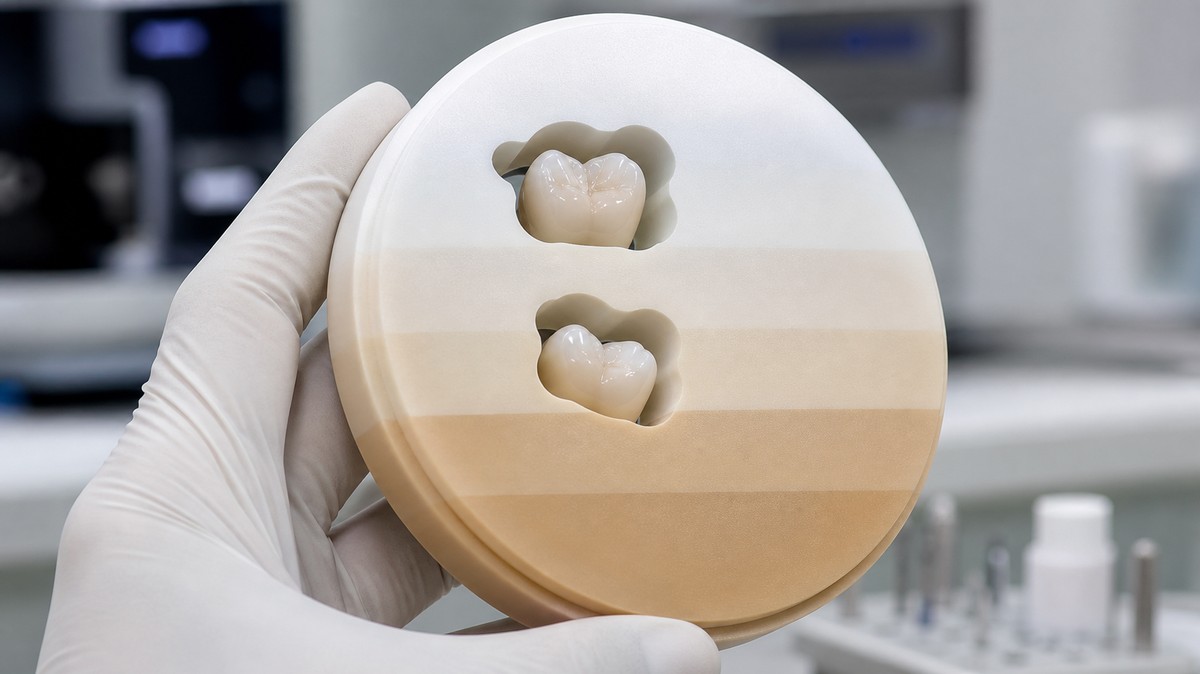
A pre-shaded zirconia disc removes the operator variability of dipping, but it does not guarantee the final shade. Sintering temperature and hold time affect value and chroma; over-firing can shift value and alter translucency. Wall thickness also matters because a thin crown normally reads brighter and less chromatic than a thick crown made from the same puck.
Nesting Position Is Your Shade Control
The crown's vertical position inside the disc determines how much cervical chroma and incisal translucency enters the restoration. Sink it lower and it becomes darker and more chromatic. Float it higher and it becomes brighter with a glassier incisal appearance. This is the practical core of zirconia shade matching.
Keep nesting height consistent across similar cases or the same A2 disc will produce visibly different A2 crowns. On bridges, inspect the position of every unit and the connectors rather than judging only the central crown. The guide to milling multilayer zirconia color gradients explains how placement changes the final result.
Practical Shade Workflow
- Verify the disc shade against a physical VITA tab after firing a test piece with your own furnace and sintering curve. Do not approve it from the box label.
- Keep one fired sample chip from every disc batch, marked with the lot number, curve, and furnace used.
- Photograph try-ins with a gray card and controlled lighting so value changes are not hidden by automatic white balance.
- Do not mix disc brands within one bridge case. Different gradients and firing responses can create obvious unit-to-unit variation.
Buying Checklist: What to Verify Before You Order
- System fit: Open systems from Roland, VHF, imes-icore, and similar manufacturers commonly take a 98 mm disc with a 10 mm step. Zirkonzahn generally uses 95 mm, while Amann Girrbach uses 89 mm. Check the available zirconia blocks and confirm your holder in the zirconia disc compatibility guide before ordering.
- Thickness range: Common thicknesses run from 10 to 25 mm. Buy for your actual case mix, not simply the largest puck available. Using a 25 mm multilayer zirconia block only for single crowns wastes material and often leaves every crown nested in the middle layers, defeating the gradient you paid for.
- Shrinkage factor per batch: The factor should be printed on the disc or linked through a traceable QR code. Enter it correctly in the CAM software. A supplier using one generic shrinkage factor for every batch will eventually give you marginal and contact fit problems.
- Documentation: Look for ISO 13485 manufacture, applicable CE or FDA registration, a published sintering curve, and indication-specific instructions. For a claimed 4D product, request flexural-strength data for individual layers and ask which test standard was used.
- Shade range: A useful range includes all 16 VITA classical shades plus bleach options. Batch-to-batch consistency matters more than a long shade menu, so keep lot records and compare fired control chips whenever a new shipment arrives.
- Bur condition: Burs matter too. A worn tool leaves rough margins and micro-chipping that becomes obvious after sintering. Track tool life, inspect margins under magnification, and use suitable zirconia milling burs instead of stretching one more full-arch case from a tired set.
Frequently Asked Questions
What is the difference between 3D and 4D multilayer zirconia?
3D has color and translucency gradients with uniform strength, while 4D adds a strength gradient by changing yttria content. Because the names are not standardized, verify the composition and layer-specific test data before buying.
Is multilayer zirconia strong enough for bridges?
Yes, for a three-unit bridge when the cervical and connector zone is 3Y- or 4Y-class material rated at 1,000 MPa or more. Pure 5Y multilayer is not appropriate for long spans, and every bridge must follow the manufacturer's connector and indication limits.
Which translucency should I choose for anterior crowns?
Choose 5Y-class material or a 4D disc's incisal zone at roughly 49% translucency. The lower strength is usually acceptable because anterior loading is lower, provided preparation thickness and occlusion are controlled.
Do multilayer zirconia blocks need a special sintering program?
No special program is required, but you must follow the manufacturer's curve exactly. Speed sintering can shift shade and translucency in multilayer discs, so use it only when the specific product is validated for that cycle.
Buy one disc from a candidate brand and run your own posterior, anterior, and bridge test cases before committing to volume. Verify fit and shade after your sintering curve, in your furnace, with your nesting strategy; those results matter more than any product label.