
CAD CAM Milling Bur Selection Guide: How to Choose the Right Bur for Your Machine
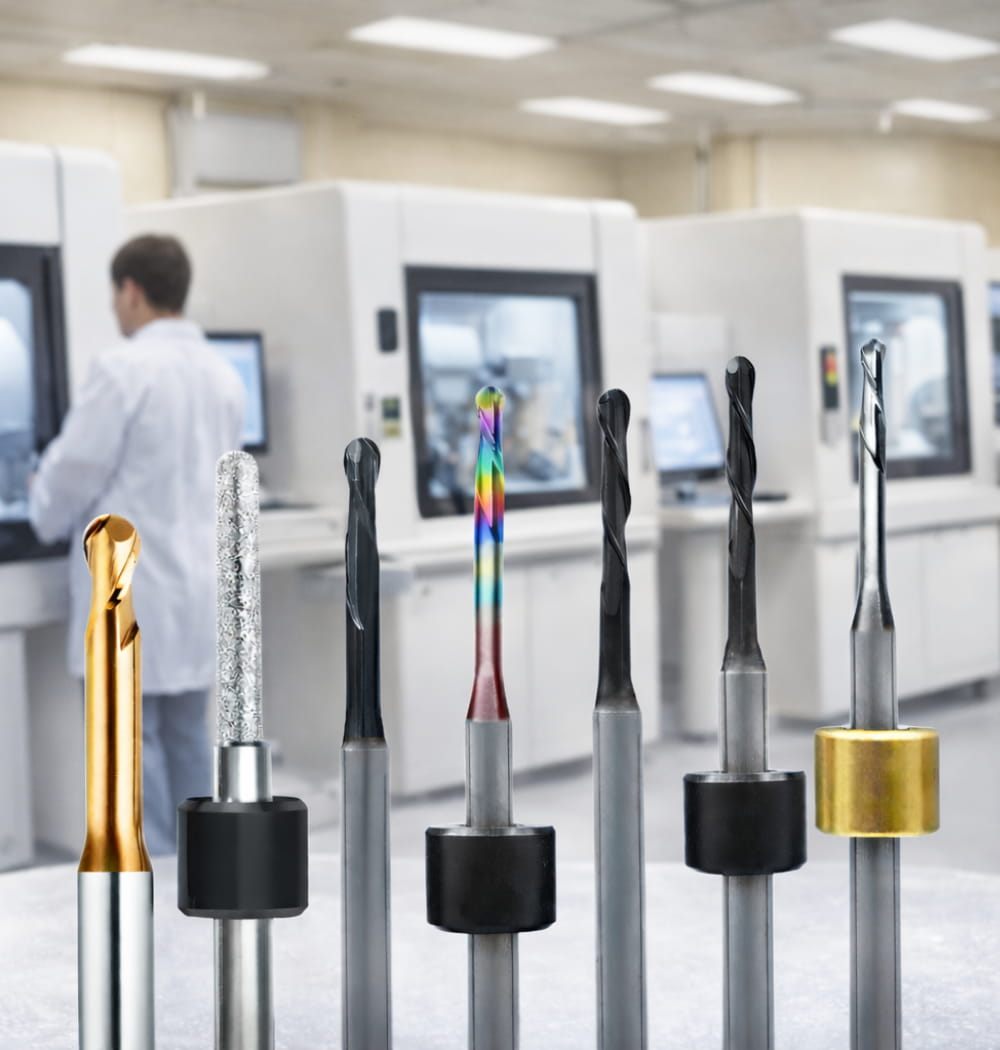
Choosing the Right Milling Bur Starts with Your Machine
Every dental milling machine has specific bur requirements — shank diameter, overall length, and cutting geometry all vary between brands. Picking the wrong bur wastes money and risks damaging your spindle or ruining a restoration mid-mill. This guide walks through how to match burs to your machine and material, step by step.
Step 1: Identify Your Machine's Bur Specifications
Before browsing bur catalogs, pull three numbers from your machine's documentation:
- Shank diameter — typically 3mm, 4mm, or 6mm. The wrong shank won't seat in your collet, or it'll wobble during milling and damage the spindle bearings.
- Overall length (OAL) — ranges from 35mm to 65mm depending on the machine. Too short and the bur can't reach the workpiece; too long and it collides with the tool changer.
- Tool magazine capacity — some machines hold 6 tools, others 16+. This determines whether you can keep roughing and finishing burs loaded at the same time.
For example, XTcera machines like the XMill 520 DC use 4mm shank burs with 50mm OAL. Amann Girrbach Ceramill systems also take 4mm shanks but with different effective lengths per model. Yenadent machines vary between 3mm and 4mm shanks depending on the series. Always confirm with your machine manual — guessing leads to broken spindles.
For a full list of shank sizes and OAL values across 30+ machine brands, see our milling bur compatibility chart.
Step 2: Match Bur Coating to Your Material
The material you're cutting determines which bur coating will hold up and which will fail within hours.
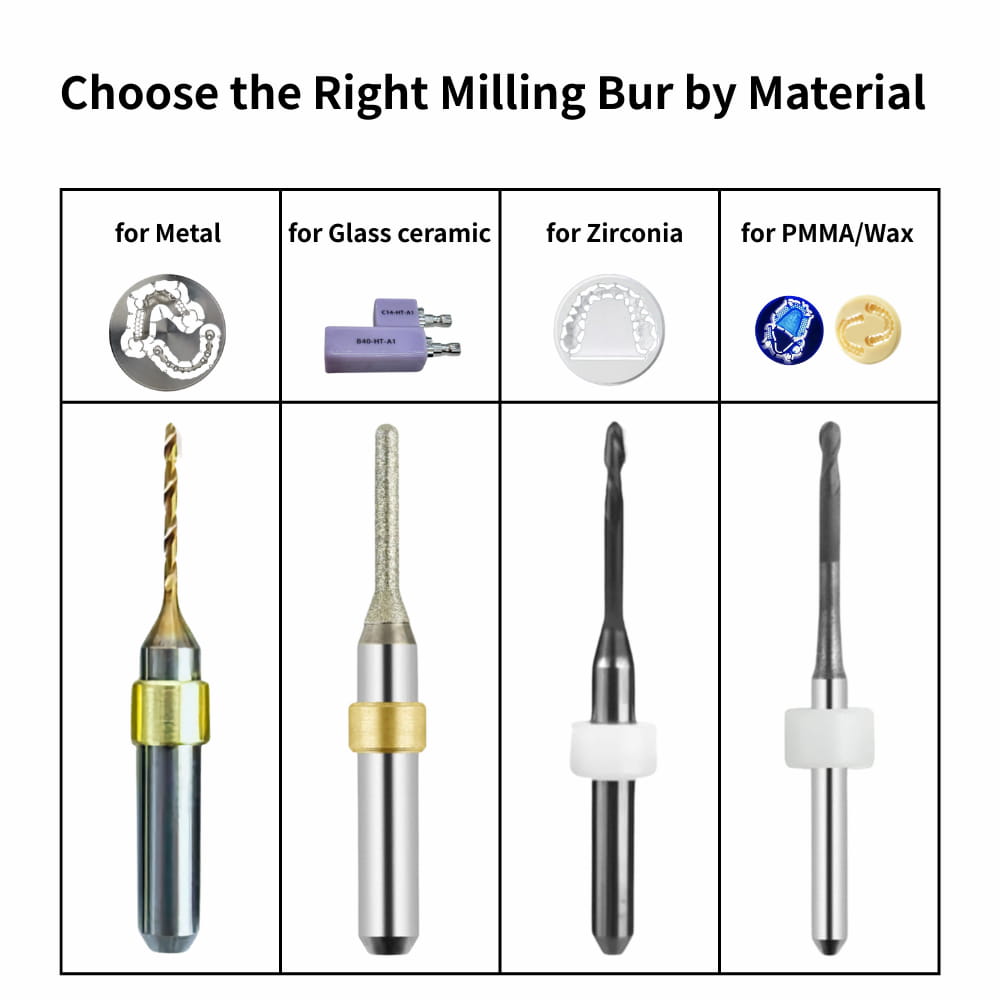
Zirconia (Dry Milling)
Pre-sintered zirconia is abrasive but relatively soft. Diamond-coated (DC) burs are the standard choice. For labs milling 20+ units daily, diamond-like carbon (DLC) coated burs last 2-3x longer at a higher upfront cost. Typical bur life: 80-150 units for DC, 200-400 for DLC. For a deeper dive on zirconia parameters, read our zirconia milling burs guide.
Use a 1.0mm or 2.0mm diameter for most crown and bridge work. Switch to 0.6mm for detailed anatomy on anterior cases. Always rough with a larger diameter first to reduce load on the finishing bur.
PMMA and Wax (Dry or Wet)
PMMA and wax are soft enough that uncoated carbide burs work fine. These materials don't wear burs quickly — the main concern is chip evacuation. Burs with fewer flutes and open geometry clear chips better, preventing heat buildup that warps PMMA provisionals.
A single set of PMMA burs can last 500+ units at moderate RPM (30,000-40,000) with proper step-down values. See our CAD/CAM materials guide for detailed speed parameters by material.
Glass Ceramic and Lithium Disilicate
Hard and brittle — these materials need diamond-coated burs with fine grit for finishing. Wet milling is mandatory. Without coolant, the bur overheats and the restoration cracks. Expect shorter bur life: 30-60 units is normal.
Metals (CoCr, Titanium)
Metal milling demands the most from your burs. You need high-quality carbide with geometries designed specifically for metal cutting. Most 4-axis machines can't handle metal — you need a 5-axis machine with adequate spindle torque. Bur life varies based on feed rate and cooling, but budget for 15-40 units per bur.
Step 3: Plan Your Bur Kit
A basic starter kit for zirconia milling typically includes:
| Bur Type | Diameter | Purpose |
|---|---|---|
| Flat end mill | 2.0mm | Roughing — removes bulk material fast |
| Ball end mill | 1.0mm | Finishing — shapes crown anatomy |
| Ball end mill | 0.6mm | Detail finishing — anteriors, tight margins |
| Drill / Step bur | 1.5-2.0mm | Sprue cutting and disc drilling |
If you also mill PMMA for temporaries, add a separate set of uncoated carbide burs. Don't use your zirconia burs on PMMA — the diamond coating isn't needed, and cross-use shortens the life of your DC tools.
Step 4: Extend Bur Life with Proper Habits
Burs are consumables, but small habits make a real difference in how many units you get per bur. For a complete maintenance routine, see our bur lifespan guide. The short version:
- Separate roughing and finishing passes. Rough with a larger bur at higher feed rates, then switch to a smaller bur for finishing at lower feeds. One-bur-does-all cuts bur life by 40-60%.
- Check concentricity monthly. A bur 0.02mm off-center vibrates during milling, causing uneven wear and rough margins. Test with a dial indicator.
- Protect cutting edges. Store burs in their original cases, tips covered. A chipped edge from bouncing around a drawer makes the whole bur scrap.
- Track units per bur. Log usage and replace proactively. Waiting for a failed restoration to signal a worn bur costs more than the bur itself.
- Clean after each session. Compressed air to clear dust, then inspect under magnification. Zirconia residue baked onto diamond coating accelerates wear.
Frequently Asked Questions
Can I use the same bur for zirconia and PMMA?
Technically yes, but don't. PMMA clogs diamond coating and shortens bur life for both materials. Keep separate sets.
How do I know when a milling bur needs replacing?
Visible edge wear, rough restoration surfaces, louder milling noise, or margins that stopped fitting accurately. Most labs swap zirconia burs after 100-150 units, but inspect regularly rather than relying on count alone.
Does shank diameter affect milling quality?
Not directly — shank diameter matches your machine's collet. What matters is precise fit. A loose shank causes runout (wobble), which degrades surface finish and shortens bur life.
Are more expensive burs always better?
Not necessarily. Cheap burs often have inconsistent diamond coating that wears unevenly. Mid-range burs from established suppliers deliver the best cost-per-unit. The real savings come from proper usage habits, not premium burs treated carelessly.
What RPM should I use for different materials?
Zirconia: 25,000-35,000 RPM. PMMA: 30,000-40,000 RPM. Glass ceramic: 20,000-30,000 RPM with wet coolant. Metal: 8,000-15,000 RPM with heavy coolant. Always check your machine's recommended parameters — these are starting points.
Finding Compatible Burs for Your Machine
The fastest way to find the right burs is to start with your machine brand. We organize all burs by machine compatibility — select your brand, pick your model, and you'll see only the burs confirmed to fit. If you're unsure about specs for your particular machine, contact us and we'll help identify the correct burs before you order.