
CAD/CAM Milling Materials: Zirconia, PMMA, Glass Ceramic, Wax & Metals Compared
What Are CAD/CAM Milling Materials?
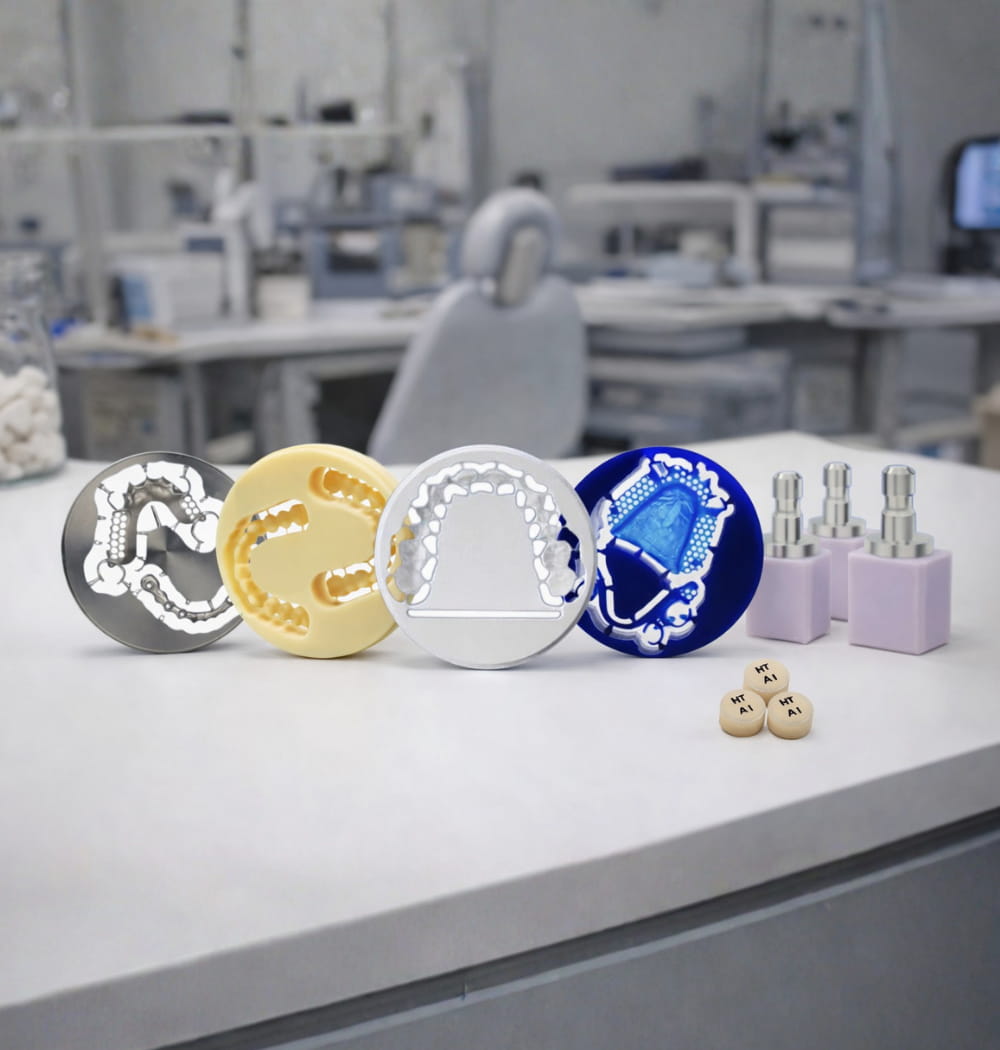
CAD/CAM milling materials are pre-fabricated blocks, discs, and blanks that dental milling machines cut into crowns, bridges, implant abutments, and other restorations. The material you pick determines how long the bur lasts, what spindle speed you run, whether you mill wet or dry, and how the restoration performs in the patient's mouth.
Below is a practical breakdown of every major material category used in dental CAD/CAM milling — from zirconia and glass ceramics to PMMA, wax, PEEK, and metals. For each, you'll find milling parameters, bur recommendations, and tips from real lab workflows.
Zirconia: The Workhorse Material
Zirconia accounts for roughly 60-70% of all CAD/CAM milling in dental labs. It's the default for posterior crowns, bridges, implant abutments, and full-arch frameworks. Choosing the right zirconia milling burs — and matching them to your zirconia grade — makes a measurable difference in surface finish and tool life.
Material Grades
| Grade | Translucency | Flexural Strength | Best For |
|---|---|---|---|
| 3Y-TZP (High Strength) | Low (35-40%) | 1,100-1,200 MPa | Posterior crowns, bridges, implant abutments |
| 4Y-PSZ (Balanced) | Medium (42-48%) | 800-1,000 MPa | Anterior/posterior crowns, long-span bridges |
| 5Y-PSZ (Translucent) | High (49-55%) | 600-800 MPa | Anterior crowns, veneers |
| Multilayer (4D Pro) | Gradient (40-60%) | 800-1,150 MPa | Full-contour restorations with natural gradient |
Milling Parameters for Zirconia
Zirconia is always milled in its pre-sintered (green) state — a chalk-like consistency that becomes fully dense only after sintering at 1,450-1,550°C.
- Milling method: Dry milling (standard) or wet milling (some 5-axis systems)
- Spindle speed: 12,000-20,000 RPM for roughing; 15,000-30,000 RPM for finishing
- Feed rate: 800-2,000 mm/min depending on bur diameter and machine rigidity
- Bur coating: Diamond Coated (DC) is standard; Diamond-Like Carbon (DLC) extends life 30-50%
- Tool life: 80-150 units per bur set with proper parameters
Disc Sizes
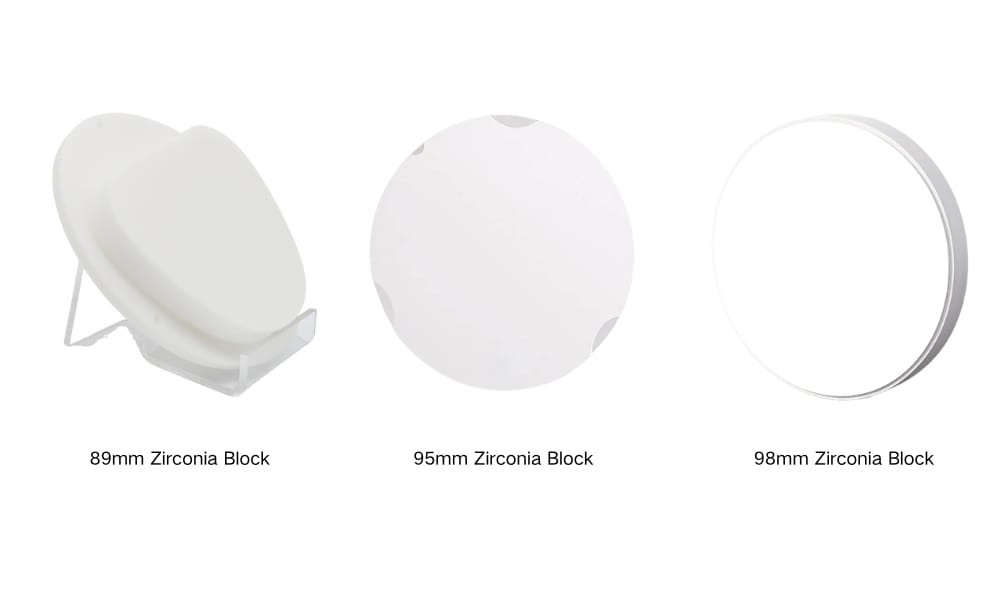
Zirconia discs come in standardized diameters matched to specific milling systems:
- 98mm: Open systems (Roland, VHF, IMES ICORE, Aidite, and most Chinese brands)
- 95mm: Zirkonzahn proprietary system
- 89mm: Amann Girrbach proprietary system
- 71mm / 40mm blocks: Sirona MCXL, Ivoclar PM7 chairside systems
Glass Ceramics: Lithium Disilicate and Beyond
Glass ceramics — primarily lithium disilicate (IPS e.max CAD) and lithium silicate reinforced with zirconia (Celtra Duo, VITA Suprinity) — are the material of choice for highly aesthetic anterior restorations.
Key Properties
| Material | Flexural Strength | Milling State | Post-Processing |
|---|---|---|---|
| IPS e.max CAD | 530 MPa (crystallized) | Blue (pre-crystallized) | Crystallization firing |
| Celtra Duo | 210 MPa (as-milled) | Fully crystallized | Optional glaze firing |
| VITA Suprinity | 540 MPa (crystallized) | Pre-crystallized | Crystallization firing |
Milling Considerations
Glass ceramics are brittle. They chip if your parameters are off or your burs are worn.
- Milling method: Wet milling strongly recommended (coolant prevents thermal cracking)
- Spindle speed: 30,000-60,000 RPM (higher than zirconia)
- Feed rate: 500-1,500 mm/min (slower than zirconia)
- Bur coating: Textured Coated (TC) burs designed specifically for glass ceramics
- Tool life: 30-60 units per bur (shorter than zirconia due to abrasive glass content)
PMMA: Provisionals and Dentures
PMMA (polymethyl methacrylate) is the standard material for temporary crowns, bridges, and removable dentures. It mills fast, costs a fraction of zirconia, and gives patients a functional restoration while the final piece is in production.
PMMA Variants
- Monolayer PMMA: Single shade, 22+ colors. Used for simple provisionals and diagnostic wax-ups.
- Multilayer PMMA: Natural gradient from cervical to incisal. Better aesthetics for anterior provisionals.
- Flexible PMMA: Impact-resistant variant for patients who grind or clench. Reduces fracture risk in long-term provisionals.
- Denture PMMA: Formulated for removable partial and full dentures, with enhanced polishability.
Milling Parameters
- Milling method: Dry milling (standard); wet milling optional for improved surface finish
- Spindle speed: 15,000-25,000 RPM
- Feed rate: 1,500-3,000 mm/min (PMMA cuts fast)
- Bur type: Uncoated carbide or DLC-coated burs
- Tool life: 200-400 units per bur (soft material = low bur wear)
PMMA discs are available in 98mm for open systems, 95mm for Zirkonzahn, and 89mm for Amann Girrbach. For a deeper look at speeds, feeds, and common pitfalls, read our PMMA milling guide.
Wax: The Lost Wax Workflow Goes Digital
Dental wax discs serve one purpose: milling wax patterns for the press-and-cast workflow. You mill the wax restoration, invest it, burn out the wax, and press or cast the final ceramic or metal piece.
Milling Parameters
- Milling method: Dry only (coolant damages the wax surface)
- Spindle speed: 8,000-15,000 RPM (keep it slow to prevent melting)
- Feed rate: 1,000-2,000 mm/min
- Bur type: Standard uncoated carbide — do NOT use diamond-coated burs (they clog with wax)
- Tool life: 500+ units (wax barely wears the bur)
Metals: Titanium, CoCr, and Pre-Sintered Alloys
Metal milling in dental labs falls into two categories: fully dense metals (titanium, CoCr) that need powerful 5-axis wet mills, and pre-sintered metal blanks that mill like zirconia and sinter afterward.
Fully Dense Metals
| Metal | Applications | Milling Challenge |
|---|---|---|
| Grade 5 Titanium (Ti6Al4V) | Implant abutments, bars | High heat generation, rapid bur wear |
| CoCr (Cobalt-Chrome) | Frameworks, RPD clasps | Very hard, requires rigid machine |
- Milling method: Wet milling mandatory (prevents work-hardening and bur failure)
- Spindle speed: 8,000-15,000 RPM (much lower than ceramics)
- Bur coating: TiSiN (Titanium Silicon Nitride) or CrN (Chromium Nitride) coated carbide
- Tool life: 15-40 units for titanium; 10-25 for CoCr
For detailed titanium speeds, feeds, and coolant strategies, see our titanium milling guide.
Pre-Sintered Metal Blanks
Pre-sintered CoCr blanks (e.g., Soft Metal) open up metal milling for labs without 5-axis wet capability. These blanks have a porous, chalk-like structure similar to pre-sintered zirconia. After milling, they're sintered in an argon-atmosphere furnace to reach full density.
- Milling method: Dry milling (same as zirconia)
- Spindle speed: Standard zirconia parameters work
- Bur type: Standard diamond-coated zirconia burs
- Tool life: 60-100 units (comparable to zirconia)
PEEK and Composite Resins
PEEK (polyether ether ketone) is gaining ground for implant-supported frameworks and metal-free RPD clasps. It's biocompatible, lightweight, and has some flex — distributing occlusal forces to the underlying bone rather than concentrating stress at the implant-bone interface.
- Milling method: Dry or wet (both work; wet gives smoother surface)
- Spindle speed: 15,000-30,000 RPM
- Bur type: Uncoated carbide burs with sharp flutes — avoid diamond coating (excessive heat in polymers)
- Tool life: 150-300 units
Composite resin blocks (hybrid ceramics like VITA ENAMIC, Shofu HC Block) combine ceramic filler with resin matrix. They mill similar to glass ceramics but with less chipping risk, making them forgiving for chairside workflows.
Material Selection Cheat Sheet
| Restoration Type | Recommended Material | Milling Method | Bur Type |
|---|---|---|---|
| Posterior crown | Zirconia (3Y/4Y) | Dry | Diamond Coated |
| Anterior crown | Glass ceramic or 5Y zirconia | Wet | TC (glass) / DC (zirconia) |
| Long-span bridge | Zirconia (3Y) | Dry | Diamond Coated |
| Temporary crown/bridge | PMMA | Dry | Carbide / DLC |
| Press-and-cast pattern | Wax | Dry | Carbide (uncoated) |
| Implant abutment | Titanium | Wet | TiSiN / CrN carbide |
| RPD framework | CoCr or PEEK | Wet (CoCr) / Dry (PEEK) | TiSiN (CoCr) / Carbide (PEEK) |
| Full denture | Denture PMMA | Dry | Carbide / DLC |
Frequently Asked Questions
What is the strongest CAD/CAM dental material?
3Y-TZP zirconia, with flexural strength of 1,100-1,200 MPa. It's the standard for posterior crowns, long-span bridges, and implant abutments where mechanical load is the primary concern.
Can I use the same milling burs for zirconia and glass ceramics?
No. Zirconia burs use coarse diamond grit for fast removal of soft pre-sintered material, while glass ceramic burs use fine textured coatings to prevent chipping. Using the wrong bur damages both the bur and the restoration.
What is the difference between wet milling and dry milling?
Dry milling uses no coolant and works for pre-sintered materials (zirconia, PMMA, wax). Wet milling sprays coolant onto the bur to prevent heat buildup — required for titanium, CoCr, and glass ceramics.
How many dental restorations can I mill from one 98mm zirconia disc?
A standard 98mm disc (18mm thick) yields 20-30 single crowns depending on nesting efficiency and crown size. Multi-unit bridges reduce yield to 8-15 per disc due to larger footprints and sprue placement.
What CAD/CAM materials can a 4-axis machine mill?
Zirconia, PMMA, wax, and composite blocks. A 4-axis machine struggles with titanium and CoCr (which need 5-axis wet capability) and complex implant abutments requiring undercut access from multiple angles.
Choosing the right material starts with the clinical case and works backward to the machine and burs. If you're setting up a new lab or expanding your material range, start with zirconia (highest volume), add PMMA for provisionals, then branch into glass ceramics and metals as your case mix demands. Browse our full CAD/CAM milling materials catalog to match materials to your machine.