
Glass Ceramic & e.max Milling: Complete Bur Selection Guide
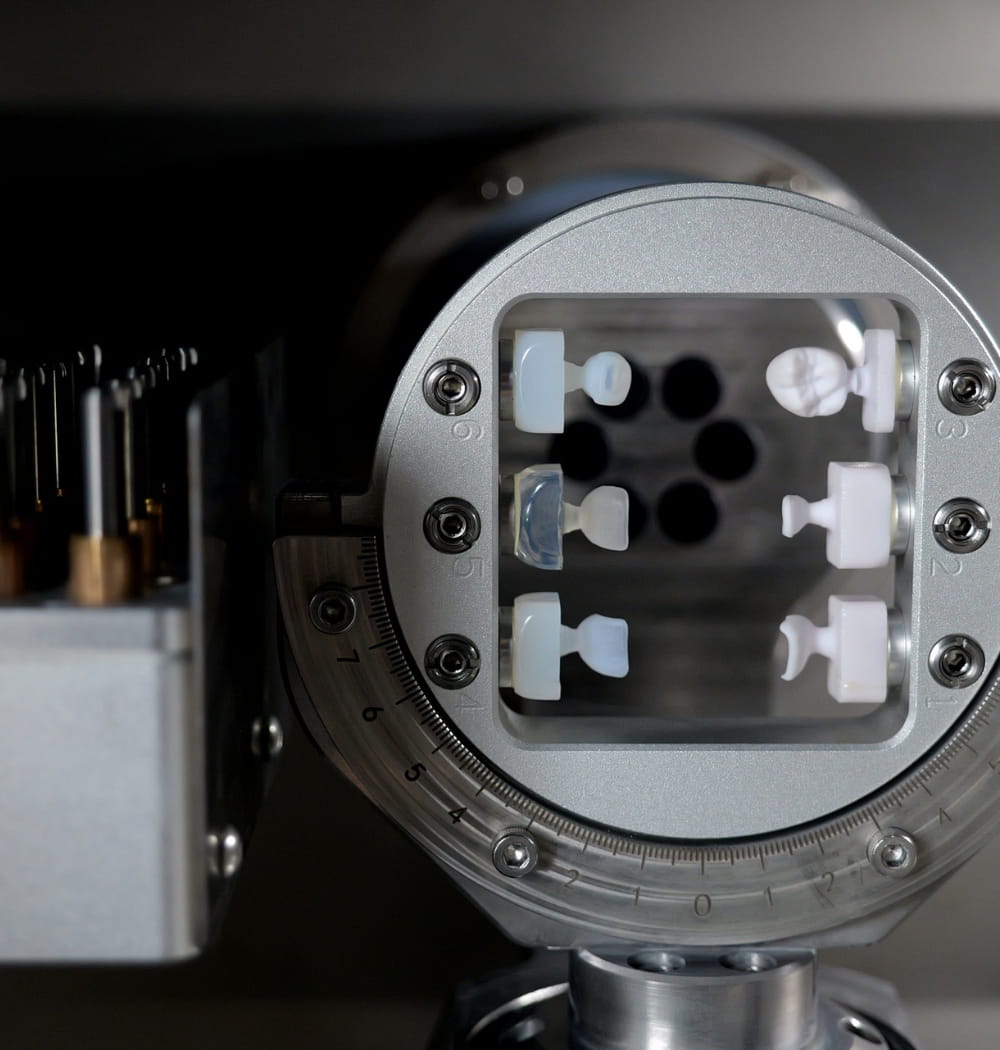
e.max chips. A lot. And 90% of the time, it's the bur setup, not the material. I've seen techs blame the block, blame the furnace, blame the cement — when the real problem was a worn-out finishing bur they'd been running for 30+ restorations. Glass ceramics are unforgiving. They'll punish dull edges, aggressive feed rates, and lazy toolpath choices every single time. But get your bur selection and parameters dialed in, and e.max mills like butter. Here's what actually works.
Blue Phase vs. Crystallized: Why It Matters for Bur Selection
If you're new to e.max, the first thing to understand is that you're milling a material in its "pre-crystallized" or blue phase — IPS e.max CAD. In this state, it's a lithium metasilicate with roughly 130 MPa flexural strength. After crystallization in the furnace, that jumps to 530 MPa as it converts to lithium disilicate. You cannot mill the crystallized form on a standard dental mill. The hardness would destroy your burs in minutes and the cutting forces would fracture the restoration.
The blue phase is softer, yes — but it's also more brittle than you'd expect. Think of it like chalk versus concrete. Chalk is soft, but snap a piece and look at the edge: it's ragged and unpredictable. That's what happens at your margins if your burs aren't sharp or your step-down is too aggressive. The material doesn't deform and absorb energy like zirconia does. It just fractures. This means your glass ceramic milling burs need to be genuinely sharp — not "still cutting okay" sharp, but fresh-edge sharp. Low cutting forces are everything with this material.
e.max vs. VITA Suprinity vs. Celtra Duo: Not All Glass Ceramics Mill the Same
Techs often assume that if a bur works for e.max, it works for all glass ceramics. That'll cost you restorations and burs. Here's the practical breakdown:
IPS e.max CAD
The most forgiving of the three in the blue phase. Lithium metasilicate, moderate hardness, mills cleanly with sharp carbide burs. Your baseline. If you can't get clean margins on e.max, your setup has a fundamental problem.
VITA Suprinity
Zirconia-reinforced lithium silicate. That ~10% zirconia content makes it noticeably harder on burs — expect roughly 20–30% shorter bur life compared to e.max. Suprinity also generates more heat during milling, so if your machine allows coolant flow adjustment, bump it up. Use the same bur geometry as e.max but replace burs more frequently. Techs who track bur life by number of units often find the sweet spot is around 15–20 Suprinity restorations per bur set versus 25–30 for e.max.
Celtra Duo
Also zirconia-reinforced lithium silicate, but with a twist: Celtra Duo can be self-glazed or conventionally fired. If you're going the self-glaze route, your milled surface finish is the final surface. That means your finishing bur quality directly affects the clinical result. A bur that leaves visible tool marks on e.max (which you'd polish out after crystallization anyway) will leave those same marks visible on a self-glazed Celtra Duo crown. For Celtra, I always use a finishing bur with fewer than 10 units on it.
| Property | e.max CAD | VITA Suprinity | Celtra Duo |
|---|---|---|---|
| Composition | Lithium metasilicate (pre-cryst.) | ZLS (zirconia-reinforced) | ZLS (zirconia-reinforced) |
| Relative bur wear | Baseline | 1.3× faster | 1.2× faster |
| Chipping risk | Moderate | Moderate-high | Moderate |
| Surface finish sensitivity | Standard | Standard | High (if self-glazing) |
| Coolant demand | Standard | Higher | Standard |
The Bur Setup That Actually Works
After running thousands of glass ceramic units across CEREC MC XL, Planmeca PlanMill, Roland DWX-52D, and imes-icore machines, here's the bur configuration I keep coming back to:
Roughing: Carbide 2-Flute, 2.0 mm or 1.0 mm Shank-Matched
Two-flute carbide is the workhorse for glass ceramic roughing. The wider chip channel clears material efficiently without packing debris back into the cut — which is exactly what causes micro-fractures along the margin during roughing. You're not trying to achieve a finished surface here. You're trying to remove bulk material with minimal stress on the block. A 2.0 mm diameter for the main roughing pass, stepping down to a 1.0 mm for detail roughing if your machine runs a two-bur roughing strategy.
Finishing: Carbide 4-Flute Ball End, 1.0 mm or 0.6 mm
The finishing bur is where your margin quality lives or dies. Four flutes give you a finer cut with lower chip load per tooth — exactly what brittle glass ceramics need. A ball end nose geometry follows the contours of the occlusal anatomy and margin line without the aggressive corner engagement you get from flat end mills. For most single-unit crowns, a 1.0 mm ball end handles the finishing pass. Drop to 0.6 mm if you're milling inlays, onlays, or thin veneers where the margin geometry is tighter.
If you're running a machine that accepts standard Ivoclar PM7 burs, make sure you're using the glass ceramic-specific variants, not the zirconia set. I've seen techs grab the wrong bur holder and wonder why their e.max margins look like they were cut with a hacksaw. The coating, geometry, and edge prep are different.
When to Replace
Here's a rule I give every new tech: hold the bur under a loupe or digital microscope after every 20 units of e.max (15 for Suprinity). If you can see any rounding on the cutting edge or chipped flutes, it's done. Don't push it. A $15 bur is cheaper than a remade crown, a rescheduled patient, and your reputation.
Speed and Feed Parameters for Glass Ceramics
These are starting points I've verified on actual machines. Your CAM software may auto-set some of these, but knowing the targets helps you troubleshoot when results are off.
| Machine | Operation | Spindle Speed (RPM) | Feed Rate (mm/min) | Step-Down (mm) |
|---|---|---|---|---|
| CEREC MC XL | Roughing | 42,000 | 2,000–2,500 | 0.5 |
| CEREC MC XL | Finishing | 42,000 | 1,200–1,500 | 0.1 |
| Planmeca PlanMill | Roughing | 40,000 | 1,800–2,200 | 0.5 |
| Planmeca PlanMill | Finishing | 40,000 | 1,000–1,400 | 0.1 |
| Roland DWX-52D | Roughing | 30,000 | 1,200–1,500 | 0.4 |
| Roland DWX-52D | Finishing | 30,000 | 800–1,000 | 0.08 |
| imes-icore 250i | Roughing | 40,000 | 2,000–2,400 | 0.5 |
| imes-icore 250i | Finishing | 40,000 | 1,200–1,600 | 0.1 |
Key point: if your machine doesn't hit at least 30,000 RPM, glass ceramics are going to be a struggle. Lower spindle speeds mean higher cutting forces per tooth, and that's exactly what causes chipping. Some older 4-axis machines in the 15,000–20,000 RPM range were designed for composites and soft materials — they'll chew through burs and leave rough margins on glass ceramics.
The Chip-Free Margin Technique
This is the section that'll save you the most remakes. Marginal chipping on glass ceramic restorations almost always happens during the finishing pass, and it almost always happens because of one of three things: too much material left for the finishing bur, conventional milling direction at the margin, or a dull finishing bur. Here's the fix.
Step-Down Approach
Don't leave more than 0.2 mm of stock for your finishing pass on glass ceramics. If your roughing pass leaves 0.5 mm (a common default), add a semi-finishing pass or adjust your roughing offset. When the finishing bur has to remove too much material, the cutting forces spike and the margin chips. Think of it this way: your finishing bur should be skimming, not cutting.
Climb Milling at the Margins
If your CAM software lets you control milling direction — and on open systems like imes-icore or Amann Girrbach, it usually does — use climb milling (also called "down milling") for the finishing pass around margins. In climb milling, the bur engages the material from the thick side and exits at the thin edge. This pushes the material into the bulk of the restoration rather than pulling it away from the margin. Conventional milling does the opposite: the bur exits by pulling away from the margin edge, which is exactly the force direction that causes chips. On closed systems like CEREC, the software handles this automatically — but it's worth understanding why it works.
Your Finishing Bur Should Be Newer Than Your Roughing Bur
This sounds counterintuitive. The roughing bur does the hard work, right? Yes, but the roughing bur can tolerate more wear before it causes problems. A slightly dull roughing bur just takes a bit longer. A slightly dull finishing bur causes margin chips. If you're rotating burs, demote your finishing burs to roughing duty when they're halfway through their life, and put fresh burs in the finishing position. Your glass ceramic blocks are expensive — don't gamble with a worn finishing bur.
Common Failures: Diagnosis and Fixes
Marginal Chipping
What you see: Small chips along the preparation margin, especially on thin areas like facial margins of anterior crowns or the proximal box of inlays.
Causes:
- Finishing bur past its useful life — the most common cause by far
- Too much stock left for the finishing pass (over 0.2 mm)
- Feed rate too high on finishing pass
- Conventional milling direction at the margin exit
- Block not properly seated in the holder — even 0.1 mm of play introduces vibration
Fix: Replace the finishing bur, reduce finishing stock allowance, slow the finishing feed rate by 20%. If it persists, check your block clamping. For more on this topic, see our guide on avoiding cracks in lithium disilicate.
Cloudy Surface After Crystallization
What you see: The restoration comes out of the furnace with a hazy, matte surface instead of the characteristic translucent appearance — even in areas that should show depth.
Causes:
- Surface micro-damage from aggressive milling parameters transferred into the crystallized state
- Residual coolant contamination baked into the surface (especially with oil-based coolants on machines not designed for glass ceramics)
- Overheating during milling caused localized phase transformation before the furnace cycle
Fix: Clean the restoration ultrasonically before crystallization. If the problem is parameter-related, reduce your feed rate and check spindle speed — you may be generating too much heat. Switch to water-based coolant if you're using oil. If the cloudiness is only on one side, the bur is likely engaging asymmetrically due to runout in the spindle collet.
Bur Snapped in the Block
What you see: The bur shaft is broken and the tip is embedded in the glass ceramic block. The restoration is ruined, and you might have spindle damage.
Causes:
- Bur was cracked or fatigued from overuse — glass ceramic dust is abrasive and weakens carbide over time
- Collet wasn't tightened properly and the bur pulled down during the cut, effectively increasing engagement depth
- Step-down or step-over was too aggressive for the bur diameter — a 0.6 mm bur taking a 0.5 mm step-down is asking for trouble
- Coolant nozzle was blocked, causing heat buildup and thermal stress on the carbide
Fix: Never exceed a step-down of 60% of your bur diameter for roughing in glass ceramics. Keep it under 30% for finishing. Inspect bur shanks for hairline cracks under magnification. If you're running a lot of glass ceramic work, consider dedicated bur sets — don't use the same burs you run zirconia burs through, because zirconia accelerates carbide wear and that weakened bur will snap in your next e.max block.
Putting It Together
Glass ceramic milling isn't difficult — it's just unforgiving. The material gives you zero warning before it chips. There's no plastic deformation, no gradual degradation, no "it's getting worse" signal. One unit comes out perfect, the next one has a chipped margin because the bur crossed an invisible wear threshold. Track your bur usage. Count your units. Replace burs on schedule, not on failure. Keep your finishing burs fresh, your feed rates conservative, and your step-downs modest. Do that consistently, and e.max becomes one of the most predictable materials in your workflow. For a broader overview of bur types across all materials, check out our complete milling bur guide.