
PMMA Milling for Temporary Restorations: Speeds, Burs, and Common Mistakes
Why PMMA Temps Still Run Through Every Lab (and Why You Mill Them Dry)
PMMA milling is one of those things you do so often it becomes invisible. Temporaries aren't glamorous. Nobody posts their temp crowns on Instagram. But a bad temp will get a patient back in the chair faster than almost anything else, and that phone call from the dentist is never pleasant.
In chairside workflows, a well-milled PMMA temporary buys time. Could be two weeks while the lab finishes a zirconia case, could be six months on a complex implant reconstruction where the doctor wants to test-drive the occlusion. Either way, the temp needs to fit, look halfway decent, and absolutely cannot fracture at the margins three days in.
On the lab side, PMMA provisionals are bread and butter. Long-term temps for implant cases, diagnostic wax-up verifications, surgical guides. Some labs mill 30-40 PMMA units a day without thinking twice. The material is forgiving compared to zirconia or lithium disilicate, but that's exactly why people get sloppy with it. And sloppy PMMA milling shows.
Dry Milling Is the Standard
PMMA is a thermoplastic. It softens around 100-130°C depending on the formulation. That sounds like a problem, and it can be, but it also means the material cuts easily at room temperature without generating the kind of heat that requires coolant.
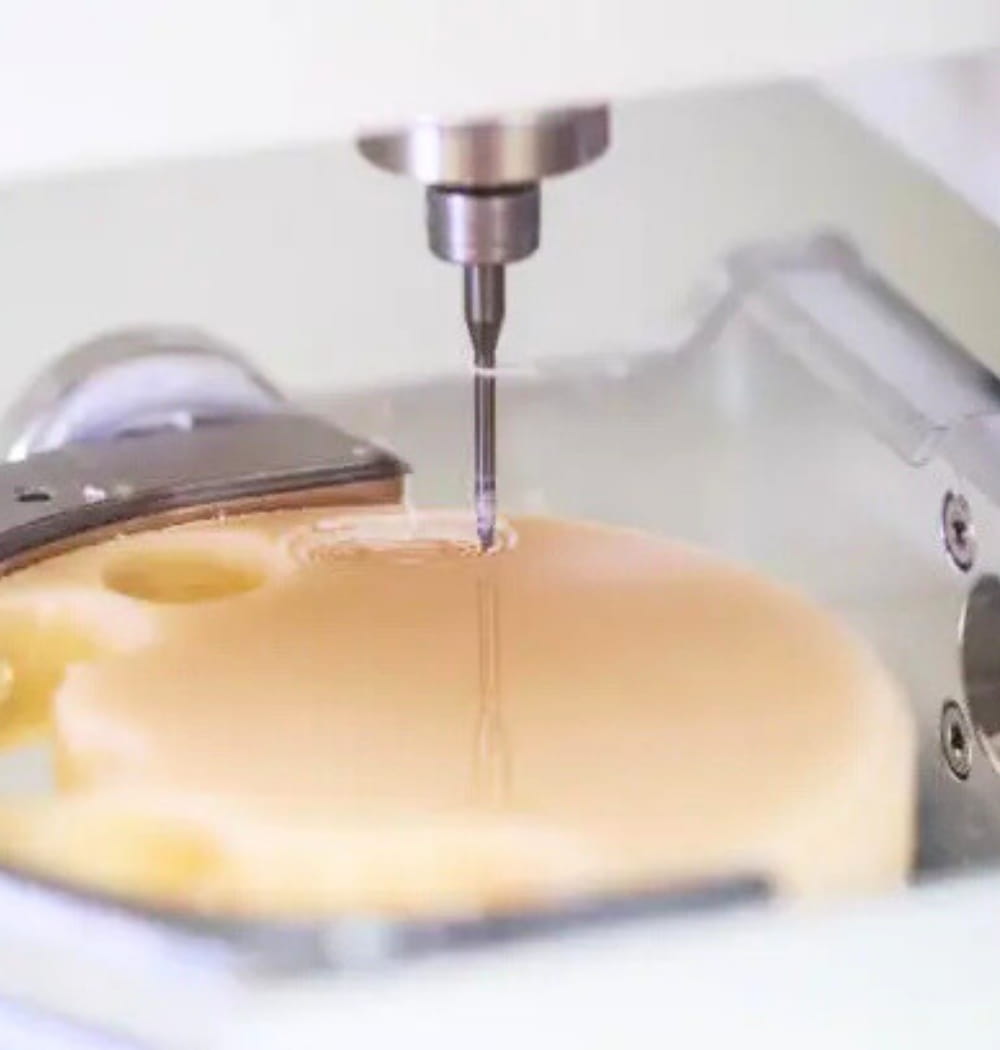
Dry milling is standard for PMMA. Almost every mill that handles PMMA does it dry:
- No coolant means no cleanup, no clogged nozzles, no waterlogged spindle bearings.
- PMMA chips evacuate cleanly with air blast or vacuum. Wet PMMA chips turn into sticky paste that gums up everything.
- Dry-milled PMMA surfaces are smoother out of the machine. Coolant can cause micro-chatter on thermoplastics.
- Most 4- and 5-axis mills with dedicated PMMA strategies assume dry cutting. The CAM parameters are built around it.
Can you wet-mill PMMA? Sure, especially on machines without a dry milling chamber. But you're adding complexity for minimal benefit. The heat management issue in PMMA is solved by correct speeds and feeds, not by throwing water at it. For a deeper comparison, see our breakdown of wet vs dry milling across different materials.
Speeds, Feeds, and Step-Down: The Numbers That Actually Matter
This is where most of the damage happens. People run their PMMA programs with wax parameters (too aggressive) or zirconia parameters (way too conservative -- you'll melt the acrylic from friction heat before you chip it).
Roughing Parameters
| Parameter | Recommended Range | Notes |
|---|---|---|
| Spindle Speed (RPM) | 12,000 - 18,000 | Lower end for roughing, higher for finishing |
| Feed Rate (Roughing) | 1,500 - 2,500 mm/min | Depends on bur diameter and flute count |
| Axial Step-Down | 0.5 - 1.0 mm | Keep it moderate. Deep cuts = heat buildup |
| Radial Step-Over | 40-50% of tool diameter | Roughing only. Drop to 10-15% for finishing |
Finishing Parameters
| Parameter | Recommended Range |
|---|---|
| Spindle Speed (RPM) | 15,000 - 25,000 |
| Feed Rate | 800 - 1,500 mm/min |
| Step-Over (Finishing) | 0.05 - 0.15 mm |
The key ratio: chip load. You want each flute taking a real bite of material, not just rubbing against it. Rubbing equals friction. Friction equals heat. Heat equals melted PMMA welded onto your bur. If you see white, stringy residue wrapping around the tool shank instead of clean chips flying off, your feed rate is too low relative to your RPM.
One thing people overlook: ramp-in angles. When the bur plunges into material, it's not cutting on the side flutes. A helical ramp entry at 3-5 degrees prevents that initial heat spike that softens the top layer of your disc.
Choosing the Right Bur Geometry for PMMA
PMMA punishes you for using the wrong bur. This isn't zirconia where you just need something diamond-coated and pray. Bur geometry matters here in ways that directly affect surface finish and margin integrity.
Single-Flute vs. Multi-Flute
Single-flute burs are the go-to for PMMA in most labs, and for good reason. One cutting edge means one big flute valley for chip evacuation. PMMA chips are large and lightweight. A single-flute tool at moderate RPM produces thick, clean chips that fly out instead of packing into flute valleys and re-cutting (which generates, you guessed it, heat).
Two-flute burs can work for finishing passes where you're taking minimal material and want a finer surface. The extra cutting edge gives you twice the cuts per revolution at the same RPM, which can improve finish quality. But for roughing? Stick to single-flute.
Three- and four-flute tools are almost always wrong for PMMA. Too many flutes, not enough chip clearance. You'll clog the tool and melt the material. These are metal-cutting geometries. Leave them for the machinists.
Browse our full selection of PMMA/wax milling burs matched to specific mill brands and spindle configurations.
Tool Coating and Material
Uncoated carbide works well for PMMA. Some labs prefer polished-flute carbide because the smoother surface reduces chip adhesion. Diamond-coated burs? Overkill and actually counterproductive. The diamond grit tears the acrylic instead of shearing it cleanly.
Common Mistakes (and the Evidence They Leave Behind)
The failure modes are predictable. Here are the ones that show up constantly.
Melting and Smearing
The number one PMMA milling problem. Shows up as a glossy, slightly discolored area on the surface, sometimes with bur marks that look smoothed over instead of crisp. The material melted during cutting and re-solidified.
Causes: RPM too high with feed rate too low. Dull bur (the tool rubs instead of cutting). Too many flutes for the material. No air blast to clear chips.
Fix: Increase feed rate, decrease RPM, or both. Check your bur under magnification. If the cutting edges are rounded or have built-up edge (material welded to the flute), replace it. Learn the bur wear signs so you catch this before it ruins a restoration.
Chipped Thin Margins
PMMA is tough in bulk but brittle at thin cross-sections. Margins under 0.5mm are vulnerable, especially anterior veneering surfaces and incisal edges.
This happens when:
- The finishing bur approaches thin sections with too much step-down.
- Climb milling direction pushes the tool into unsupported material.
- The disc has been sitting open in a humid environment and absorbed moisture (wet PMMA chips differently).
- The bur is worn. A dull tool pushes material instead of cutting it, and thin margins can't take the lateral force.
Fix: Reduce feed rate and step-down for final passes near margins. Some CAM software lets you define reduced-parameter zones for thin areas. Use it.
Wrong Bur Geometry Entirely
Seen this more times than I can count: someone loads a zirconia bur and mills PMMA with it. A shape comes out, but the surface is rough, margins are ragged, and fit is off by 50-100 microns because the cutting forces were all wrong. Zirconia burs are designed for high-RPM grinding of ceramics. PMMA needs low-helix, sharp-edged cutting tools. Different job, different tool.
Bur Sharpness and Surface Finish
This separates decent PMMA results from excellent ones. A brand new carbide bur produces a surface that needs almost no polishing. Run that same bur through 30-40 discs and the surface starts looking hazy, matte, with visible tool marks that should have been clean.
PMMA is softer than zirconia and glass ceramics, so people assume it's easier on tooling. It is, per unit. But labs mill a LOT of PMMA, and the cumulative wear adds up. The cutting edges develop micro-rounding that's invisible to the naked eye but obvious in the surface finish. If you're spending more than a minute or two polishing each temp, your burs are probably done.
Most single-flute PMMA tools are good for 20-40 discs depending on the brand and geometry. After that, they're costing you more in polishing time and remakes than a replacement bur would.
PMMA Discs and Where This Is All Heading
Quick word on the discs themselves since the material affects milling behavior. Pre-colored (multi-layer) PMMA discs have gradient color transitions built in, simulating the dentin-to-enamel shift. They mill the same as monochrome but require more precise positioning in the CAM software to place color bands correctly. Monochrome PMMA discs are uniform throughout. Easier to work with, consistent cutting behavior everywhere. For long-term temps where aesthetics matter, you'll stain and glaze after milling. For surgical guides or short-term provisionals, monochrome is fine as-is.
Check available options in our PMMA disc catalog, including A1-D4 shades and multi-layer configurations. Either way, store your discs sealed until use. PMMA is hygroscopic. A disc sitting open on a shelf for two weeks has absorbed enough moisture to affect cutting behavior and final fit.
PMMA isn't going anywhere. If anything, it's getting more important as implant workflows get more complex and doctors realize that three months in a well-made provisional tells you more about the final case than any digital simulation. Newer high-impact PMMA formulations and hybrid composite discs are blurring the line between temporary and semi-permanent.
The labs that do PMMA well treat it like any other precision milling job. Right bur, right parameters, fresh tooling. The ones that treat it as an afterthought are the ones calling their bur supplier asking why everything looks melted. Usually, it's not the bur.