
OEM vs Compatible Milling Burs: Is There Really a Difference?
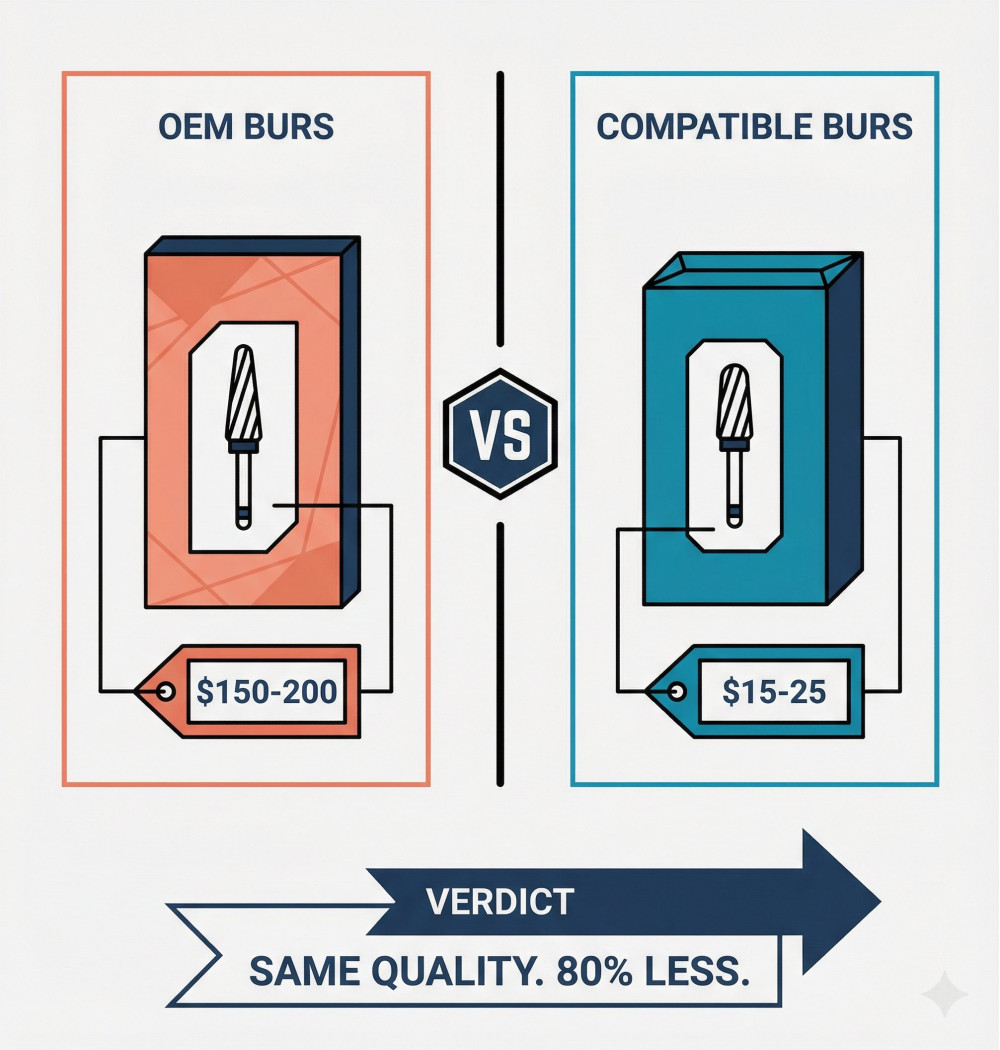
OEM milling burs cost $150-200 each. Compatible alternatives run $15-25. That's a 10x price gap for tools that do the same job.
So what's the real difference? Let's break it down.
What Are OEM Milling Burs?
OEM burs come from machine manufacturers like Roland, VHF, Amann Girrbach, and Sirona. They're marketed as "certified" or "approved" for specific machines.
The premium price covers:
- Brand licensing fees
- Authorized dealer margins
- Marketing overhead
Here's what most labs don't know: machine companies don't manufacture their own burs. They source from specialized tooling factories—often the same ones making compatible alternatives.
What Are Compatible Milling Burs?
Compatible burs match OEM specs exactly:
- Same shank diameters (3mm, 4mm, 6mm)
- Same cutting diameters (0.3mm to 3.0mm)
- Same overall lengths
- Same coatings (DLC, CVD Diamond)
The difference? No brand markup. No dealer margins. The savings go straight to your lab.
What Actually Determines Bur Quality?
Price doesn't equal quality. After years of feedback from labs worldwide, here's what actually matters:
1. Coating Type
| Coating | Best For | Lifespan | Cost |
|---|---|---|---|
| Uncoated | PMMA, Wax | Shortest | Lowest |
| DLC (Diamond-Like Carbon) | Zirconia, General use | Medium | Medium |
| CVD Diamond | Zirconia, High-volume | Longest (2x DLC) | Higher |
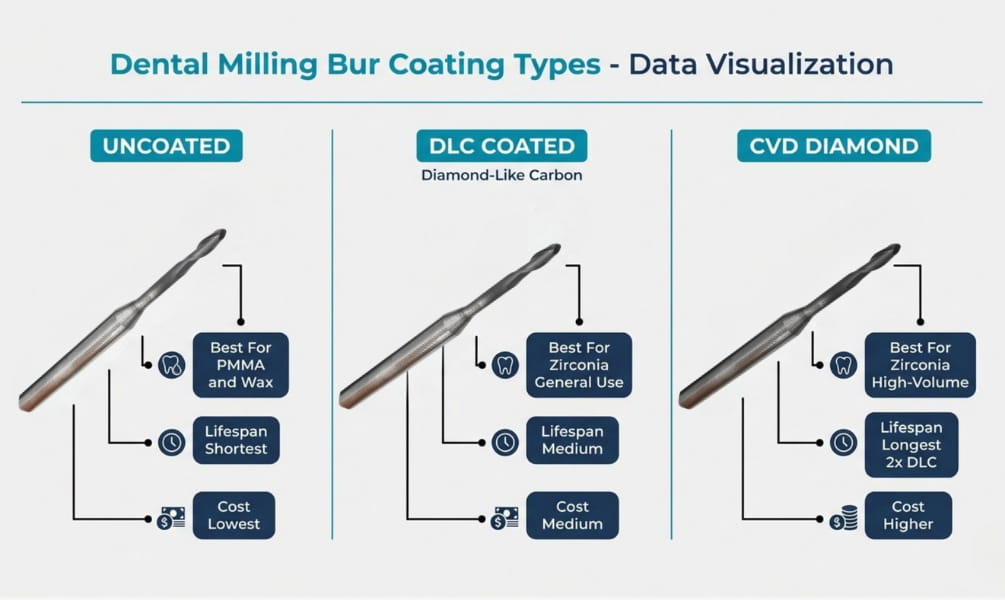
We stock all three coating options. Match the tool to your workflow—don't overpay for features you won't use.
2. Manufacturing Precision
Quality burs need tight tolerances:
- Shank diameter (proper collet fit)
- Cutting geometry (consistent results)
- Concentricity (prevents vibration and chipping)
Our burs hold ±0.005mm tolerance—same as premium OEM tools.
3. Material Grade
The carbide substrate matters. We use ultra-fine grain tungsten carbide (0.2-0.5μm grain size) for maximum hardness and edge retention.
The Real Cost Comparison
Here's the math for a typical lab running a Roland DWX-52D:
Standard tool set (6 burs):
| Bur Type | OEM Price | CADBURS Price |
|---|---|---|
| 0.6mm Zirconia (Diamond Coated) | ~$164 | $17.90 |
| 1.0mm Zirconia (Diamond Coated) | ~$164 | $17.90 |
| 2.0mm Zirconia (Diamond Coated) | ~$164 | $17.90 |
| 0.6mm PMMA | ~$59 | $14.90 |
| 1.0mm PMMA | ~$59 | $14.90 |
| 2.0mm PMMA | ~$59 | $14.90 |
| Total | ~$669 | ~$98 |
That's money back in your pocket—or reinvested in materials and equipment.
What Labs Are Saying
We've shipped to thousands of labs across 50+ countries. The feedback is consistent:
"Same performance as the $150 burs I was buying before. I wish I'd switched sooner."
"No difference in fit or surface quality. My technicians can't tell which burs we're using."
"Finally, a supplier that doesn't treat consumables as a profit center."
How to Evaluate Compatible Burs
Thinking about switching? Here's what to check:
- Coating options – Multiple coatings for different materials
- Precise specifications – Shank diameter, cutting length, overall length should match your machine exactly
- Return policy – Quality suppliers stand behind their products
- Global shipping – Established logistics = serious operation
- Technical support – Can they answer compatibility questions?
We check all these boxes—plus free worldwide shipping on orders over $99.
Compatible Burs for Every Major Brand
We stock compatible milling burs for all major CAD/CAM systems:
- Roland (DWX-4, DWX-52D, DWX-53DC)
- VHF (K4, K5, N4)
- Amann Girrbach (Ceramill Matik, Matron, Motion)
- Sirona (CEREC, MCX5, MCXL)
- Zirkonzahn (M1, M2, M4, M5, M6)
- XTCERA (X-mill 220, 300, 500, 600)
- UP3D (P42, P52, P53, P55D)
- Aidite (AMD-500, AMM-520)
- IMES ICORE (250i, 350i)
- Ivoclar (PM3, PM5, PM7)
The Bottom Line
The OEM vs compatible debate comes down to one question: Are you paying for quality, or paying for a logo?
Thousands of labs have made the switch. The carbide is the same. The coatings are the same. The precision is the same.
The only difference is the price tag.
Ready to cut your tooling costs by 80%+?
Browse our full range of compatible milling burs for Roland, VHF, Amann Girrbach, Sirona, Zirkonzahn, and 30+ other machine brands.
Shop All Milling Burs