
Wet Milling vs Dry Milling: How to Choose the Right Method for Your Dental Lab
What's the Actual Difference?
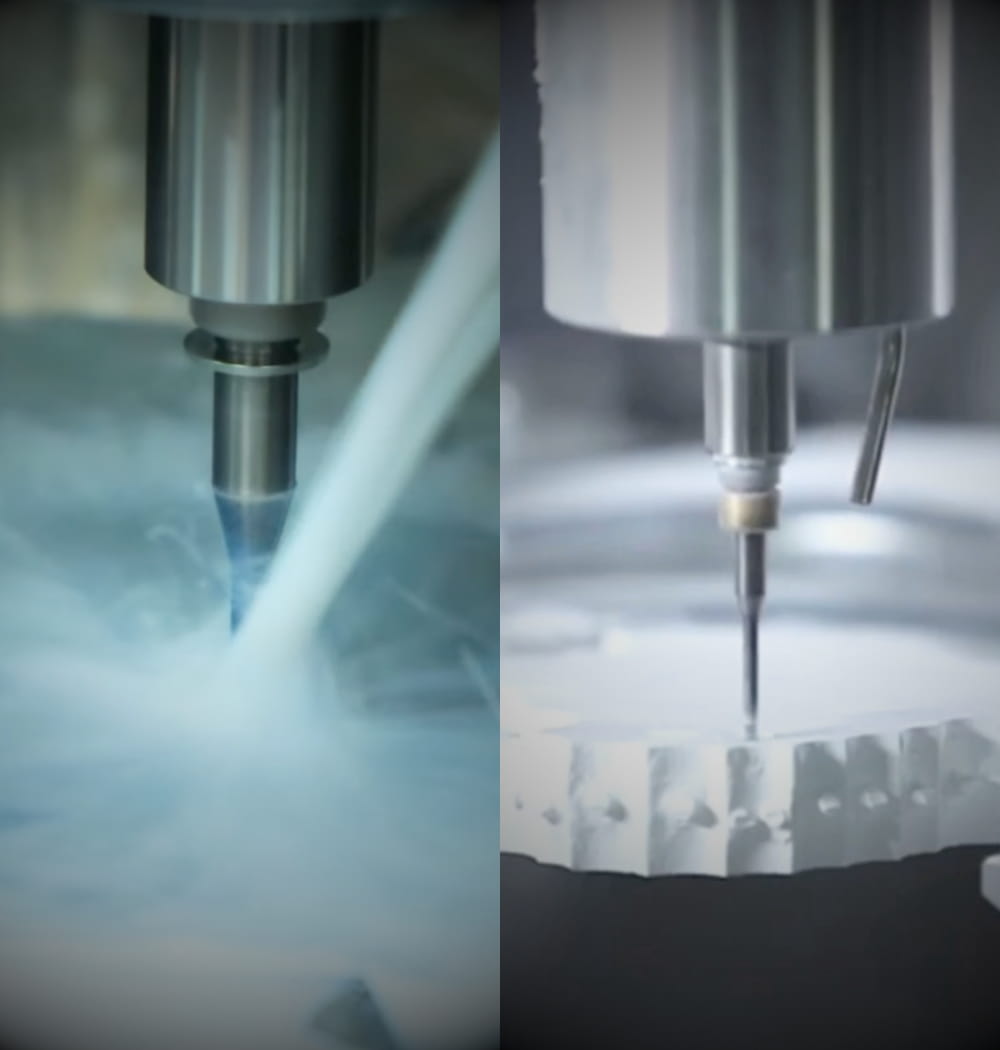
Wet milling uses a coolant stream — usually water or an emulsion — to cool the bur and flush debris during cutting. Dry milling runs without any liquid, relying on air blasts or vacuum suction to clear chips.
That one difference changes everything: which materials you can cut, how long your tools last, what kind of machine you need, and how much cleanup you deal with at the end of the day.
Wet Milling: When Coolant Earns Its Keep
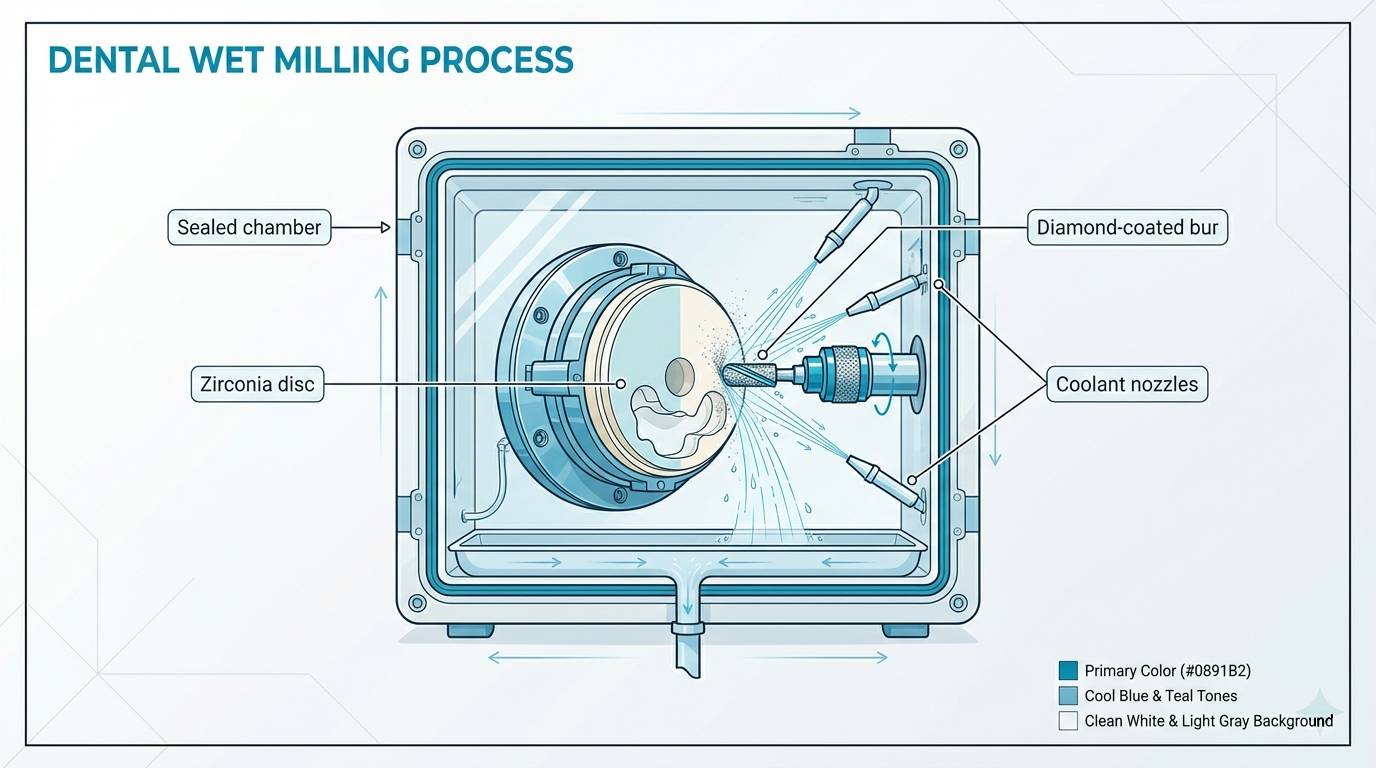
Wet milling shines with hard, heat-sensitive materials. The coolant does three jobs at once: it pulls heat away from the cutting zone, washes chips out of the flute path, and reduces friction between the bur and the workpiece.
Best Materials for Wet Milling
- Zirconia (pre-sintered and fully sintered) — Pre-sintered zirconia can technically be dry-milled, but wet milling gives you cleaner margins and longer tool life. Fully sintered zirconia absolutely requires coolant. The heat generated during dry cutting will micro-crack the material and destroy your zirconia milling burs in a fraction of their normal lifespan.
- Glass ceramics (lithium disilicate, e.max) — Brittle and heat-sensitive. Dry milling glass ceramic is asking for chipping and fractures. Coolant keeps the temperature stable and supports cleaner chip evacuation.
- Titanium and CoCr metals — Metal milling without coolant is a non-starter. The heat buildup causes work hardening, tool welding, and terrible surface finish.
- Composite and hybrid ceramics — Materials like Vita Enamic or Shofu HC Block benefit from wet milling. The resin matrix softens with heat, leading to smearing and poor surface quality if milled dry.
Advantages
- Longer bur life — coolant reduces thermal wear and abrasive buildup. Expect 2–3× the tool life compared to dry milling on the same material.
- Better surface finish — flushing chips away prevents re-cutting, which causes micro-scratches and rough surfaces.
- Tighter tolerances — thermal expansion is minimized, so the fit stays accurate.
- Required for hard materials — there's simply no alternative for metals, fully sintered zirconia, and glass ceramics.
Downsides
- Messier workspace — coolant gets everywhere. You need proper drainage, filtration, and regular cleaning of the milling chamber.
- Coolant maintenance — filters need changing, concentration needs checking, and bacterial growth in the tank is a real issue if you neglect it.
- Higher machine cost — wet-capable machines need sealed chambers, pumps, filtration systems, and corrosion-resistant components.
- Material compatibility issues — some materials (like PMMA and wax) actually perform worse when wet-milled. The coolant can cause swelling or interfere with the cutting action.
Dry Milling: Clean, Simple, and Fast
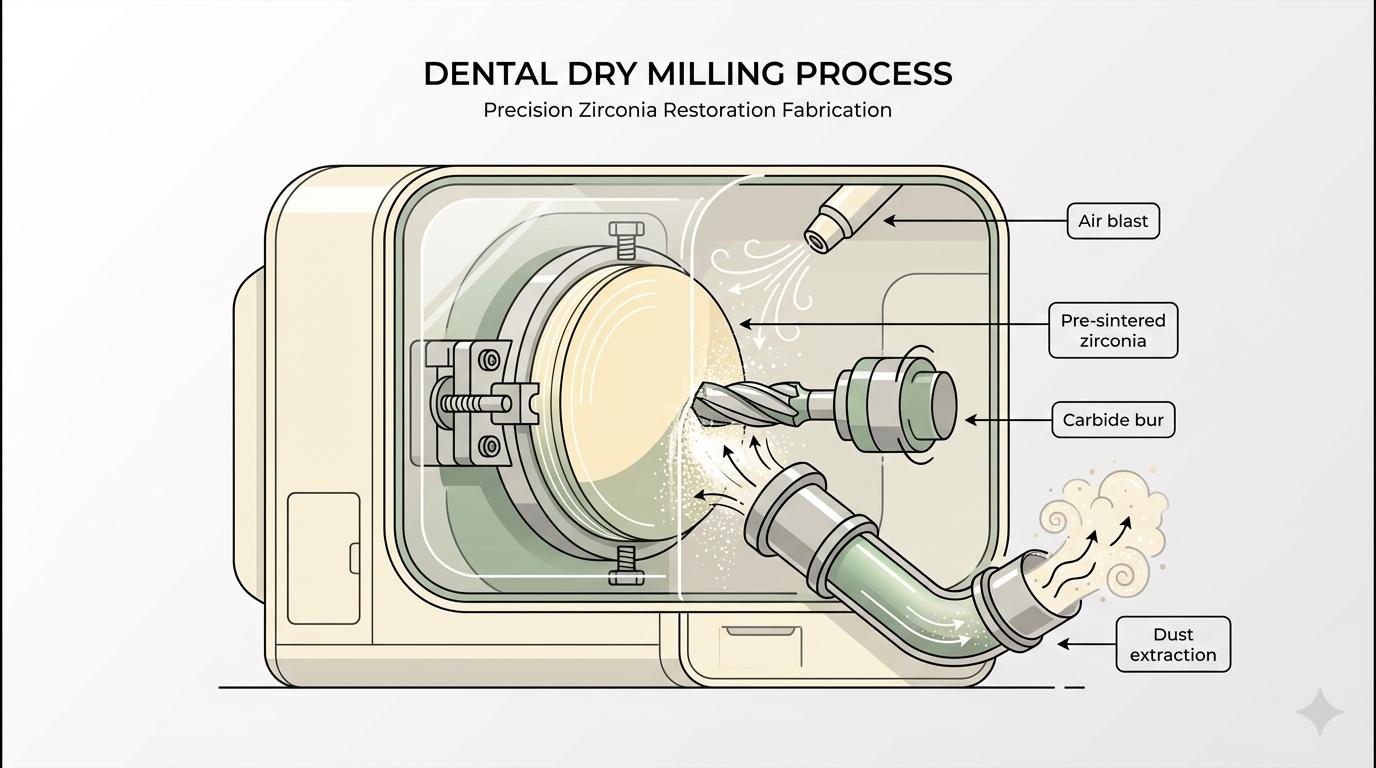
Dry milling keeps things straightforward. No coolant tank, no filters, no mess. The machine uses compressed air or built-in vacuum to blow chips away from the cutting zone.
Best Materials for Dry Milling
- Pre-sintered zirconia — The bread and butter of dry milling. Pre-sintered zirconia is soft enough (chalk-like consistency) that heat generation is minimal. Most dental labs mill zirconia blocks dry without any issues.
- PMMA (polymethyl methacrylate) — PMMA discs mill beautifully dry. Adding coolant actually causes problems — the material absorbs moisture, which can affect dimensional stability and bonding.
- Wax — Always milled dry. Coolant would ruin the material.
- PEEK — This thermoplastic mills well dry at the right feed rates and RPM settings.
Advantages
- Simpler machine design — no pumps, no plumbing, no sealed chamber required. Lower purchase cost and less maintenance.
- Cleaner operation — dust collection is easier to manage than coolant filtration. A good vacuum system keeps the workspace tidy.
- No coolant-related material issues — no moisture absorption, no swelling, no contamination.
- Lower running costs — no coolant to buy, no filters to replace, no water treatment.
- Faster material loading — no need to worry about sealing the chamber or priming the coolant system.
Downsides
- Limited material range — you can't dry-mill metals, glass ceramics, or fully sintered zirconia without destroying your tools and the workpiece.
- Dust management is critical — zirconia dust is a health hazard. You need proper extraction and filtration. Don't skimp on this.
- Shorter tool life on harder materials — without coolant, thermal wear accelerates. Even on pre-sintered zirconia, dry milling wears burs faster than wet milling would.
- Heat buildup risk — if your feed rates or RPM are off, dry milling can generate enough heat to cause micro-cracks in the restoration.
Material-Method Quick Reference
| Material | Recommended Method | Notes |
|---|---|---|
| Pre-sintered zirconia | Dry (preferred) or Wet | Dry is standard; wet adds tool life but isn't necessary |
| Fully sintered zirconia | Wet (required) | Dry milling will crack the material and kill your burs |
| Glass ceramic (e.max) | Wet (required) | Brittle material needs thermal control |
| PMMA | Dry (required) | Moisture causes swelling and dimensional issues |
| Wax | Dry (required) | Coolant destroys the material |
| Titanium / CoCr | Wet (required) | Metal milling without coolant is not viable |
| Composite / hybrid ceramic | Wet (preferred) | Resin matrix softens with heat |
| PEEK | Dry (preferred) | Wet is possible but unnecessary |
Machine Considerations
Your milling machine dictates your options more than anything else.
Dry-only machines (like the Roland DWX-52DCi) are designed for pre-sintered zirconia, PMMA, and wax. They're the workhorses of most dental labs. If 90% of your work is zirconia crowns and PMMA temporaries, a dry mill handles everything you need.
Wet-only machines are less common in dental. Most wet-capable machines can also run dry.
Dual-capability machines (like the Imes iCore 350i, VHF K5+, or Amann Girrbach Ceramill Matik) give you the most flexibility. You can switch between wet and dry depending on the material. These cost more upfront but open up your material range — metals, glass ceramics, and fully sintered zirconia become options.
When evaluating a machine, check these specifics:
- Spindle speed range — wet milling hard materials needs higher RPM with controlled feed rates
- Coolant system quality — cheap coolant systems clog constantly and create more problems than they solve
- Dust extraction — for dry milling, the vacuum system needs to handle fine zirconia particles effectively
- Chamber sealing — wet machines need proper sealing to prevent leaks and coolant spray escaping
How to Choose: Practical Recommendations
Tools and Materials for Your Milling Setup
Once you've settled on wet, dry, or both — you need the right burs and blanks to match. Here's what fits each method discussed above.
- Zirconia Milling Burs — The go-to for dry milling pre-sintered zirconia. Diamond-coated options also handle wet milling on fully sintered discs when your machine supports coolant.
- PMMA & Wax Milling Burs — Purpose-built for dry milling soft materials. Optimized flute geometry clears chips without coolant, exactly as described in the dry milling section above.
- Glass Ceramic Milling Burs — Designed for wet milling lithium disilicate and similar brittle materials. These need the coolant stream to prevent chipping and thermal fracture.
- Zirconia Blocks — Pre-sintered discs in 98mm, 95mm, and other sizes. The most common material you'll run through a dry mill — available in multilayer and solid options.
The right milling method isn't about which is "better" — it's about matching the method to the material and the work your lab actually does. Browse our full range of milling burs by material type to find the right tools for your setup.