
Wet vs Dry Milling: When to Use Each Method
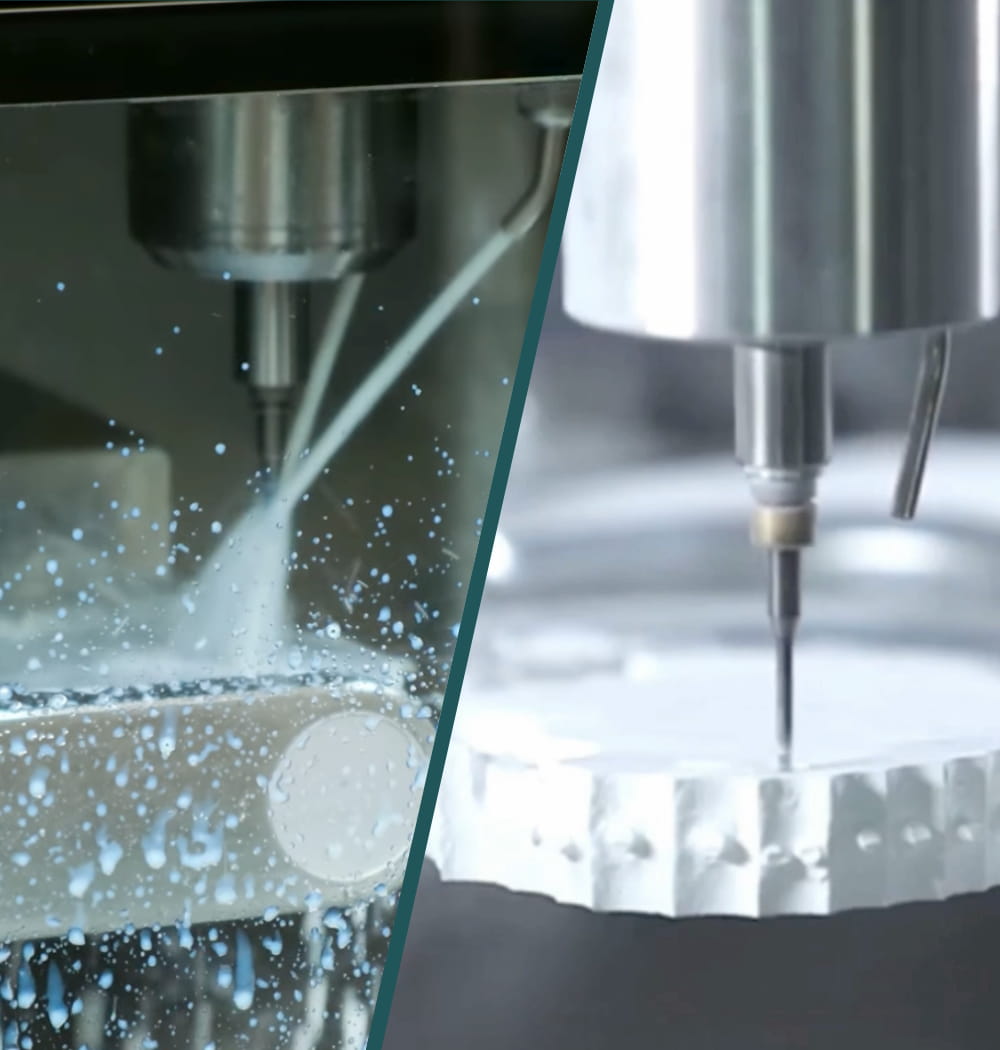
Every dental lab eventually faces this question: wet or dry? The answer depends almost entirely on the material you're cutting. Pick wrong and you'll burn through burs, crack blocks, or flood your spindle bearings with coolant they weren't designed for. Here's the material-by-material breakdown so you always know which method to use.
The Short Answer: Match the Method to the Material

If you only remember one thing from this article, make it this table:
| Material | Method | Why |
|---|---|---|
| Zirconia (pre-sintered) | Dry or Wet | Soft enough to mill dry; wet extends bur life |
| Zirconia (fully sintered) | Wet only | Extremely hard — heat destroys tools without coolant |
| PMMA | Dry | Absorbs moisture, coolant causes swelling and dimensional errors |
| Wax | Dry | Soft, low heat — coolant unnecessary and messy |
| Glass ceramic / Lithium disilicate | Wet only | Brittle and hard — dry milling causes microcracks |
| Titanium | Wet only | Low thermal conductivity traps heat at the cutting edge |
| CoCr (Cobalt-Chrome) | Wet only | Very hard alloy — generates extreme heat without coolant |
| Composite / Hybrid ceramic | Dry (preferred) | Resin matrix can absorb coolant; dust extraction handles waste |
| Peek | Dry | Thermoplastic — coolant causes surface issues |
The pattern is simple: hard materials (metals, glass ceramics, sintered zirconia) need coolant to manage heat. Soft materials (PMMA, wax, composites) mill dry because coolant introduces moisture problems or is simply unnecessary.
Dry Milling: When and Why
Dry milling relies on dust extraction instead of coolant to clear debris. The mill uses a vacuum or air blast to pull chips away from the bur.
Best materials for dry milling
Pre-sintered zirconia is the most common dry-milled material in dental labs. In its green state (before sintering), zirconia is chalky and relatively soft — around 50 HV hardness versus 1,200+ HV after sintering. Low cutting forces, minimal heat, predictable bur wear. Most labs mill 20-40 zirconia units per bur when cutting dry.
PMMA and wax must be dry-milled. PMMA is hygroscopic — it absorbs moisture from coolant, causing the disc to swell and throwing off your margins. Even small dimensional changes (0.02-0.05mm) from moisture absorption can ruin a temporary bridge fit. Wax is so soft that coolant just makes a mess with zero benefit.
Peek and composite materials also go dry. Their resin or polymer matrix reacts poorly to sustained moisture exposure during milling.
Dry milling advantages
- No coolant system to maintain, refill, or clean
- No risk of coolant contamination on the workpiece
- Simpler machine design — lower purchase and maintenance costs
- Faster setup between jobs
- No wet mess in the milling chamber
The catch
Dust. Pre-sintered zirconia produces fine silica-containing dust that's a real health hazard if inhaled. Your mill's dust extraction must work properly — check filters regularly and replace them before they clog. A clogged filter means dust escaping into your lab air. Some labs add a standalone HEPA filter near the mill as backup.
Wet Milling: When and Why
Wet milling floods the cutting zone with coolant — typically water or water-soluble oil — to manage heat, lubricate the cut, and flush chips. Every material that generates significant heat under cutting forces needs wet milling.
Best materials for wet milling
Metals (titanium, CoCr, and other alloys) absolutely require coolant. Titanium's low thermal conductivity concentrates heat at the cutting edge — without coolant, tools last minutes instead of hours. CoCr is even worse: hardness and heat generation will burn through uncoated carbide burs almost instantly dry. For more on titanium parameters specifically, see our titanium milling speeds and feeds guide.
Glass ceramics (IPS e.max, lithium disilicate) are hard and brittle. Dry cutting creates thermal gradients that cause microcracks — invisible during milling but devastating after cementation. Coolant keeps temperatures even and prevents these stress fractures.
Fully sintered zirconia is a different beast from pre-sintered. At 1,200+ HV, it demands diamond-coated burs and constant coolant flow. Some labs use sintered zirconia for chairside mills where time-to-patient matters more than bur cost, but coolant is non-negotiable.
Wet milling advantages
- 3-5x longer tool life on hard materials versus running dry
- Better surface finish — coolant prevents thermal damage marks
- No dust — chips are captured in coolant and filtered
- More consistent dimensional accuracy — thermal expansion controlled
- Required for metals, glass ceramics, and sintered zirconia
The catch
Maintenance. Wet mills need regular coolant changes (every 2-4 weeks depending on volume), filter cleaning, and drainage system checks. Coolant that goes stale breeds bacteria — you'll know by the smell. The machine itself costs more upfront and has more components that can fail (pumps, nozzles, filtration).
Pre-Sintered Zirconia: The One Material That Goes Both Ways
Pre-sintered zirconia is the only mainstream dental material where both methods work well, and the choice depends on your lab's priorities:
Dry milling zirconia is simpler, cheaper, and faster for most labs. If you're milling 10-30 units per day, dry works fine. Bur life is slightly shorter (maybe 20% less than wet), but you save on coolant costs and maintenance time. Most 4-axis and entry-level 5-axis mills are dry-only machines, and they handle pre-sintered zirconia without issues.
Wet milling zirconia makes sense for high-volume labs (30+ units daily) or when you need every last unit from your burs. The coolant extends tool life, produces marginally better surface finish before sintering, and keeps the milling chamber cleaner — no dust buildup on sensors or mechanical components.
One caveat: if you switch between wet zirconia and dry PMMA on the same machine, make sure the milling chamber and workholding are completely dry before loading PMMA. Residual coolant will absorb into the disc.
Choosing Burs for Wet vs. Dry
The milling method also affects your bur selection:
Dry milling burs for zirconia are typically uncoated or have a DLC (diamond-like carbon) coating. They rely on sharp geometry rather than heat resistance since cutting temperatures stay low in soft materials. Expect $8-15 per bur.
Wet milling burs for metals use TiSiN (Titanium Silicon Nitride) or CRN (Chromium Nitride) coatings that withstand the high temperatures of metal cutting even with coolant present. For glass ceramics, diamond-coated or sintered diamond burs are standard. Expect $19-28 per bur for metal-rated tools.
Don't cross-contaminate: a bur used for metal milling will have embedded metal particles that scratch zirconia. Keep separate bur sets for each material type. For more on how long burs last across different materials, check our guide on when to replace milling burs.
The Bottom Line
Wet vs. dry isn't a preference — it's a material requirement. Match the method to what you're cutting and you'll get predictable tool life, accurate margins, and clean surfaces. Force the wrong method and you'll waste materials, tools, and time.
For labs just getting started: if you only mill zirconia and PMMA, a dry mill handles both. The moment you add metals or glass ceramics to your workflow, you need wet capability. Plan your equipment purchases around the materials you'll be milling in the next 2-3 years, not just today.
Need burs for wet or dry milling?
Browse our zirconia burs for dry milling, TiSiN/CRN-coated metal burs for wet milling, or glass ceramic burs for your specific machine. Compatible with Roland, Zirkonzahn, IMES iCore, XTCERA, and more — from $8 per bur.