
VHF K5 Milling Bur Guide: Setup, Parameters, and Tool Life
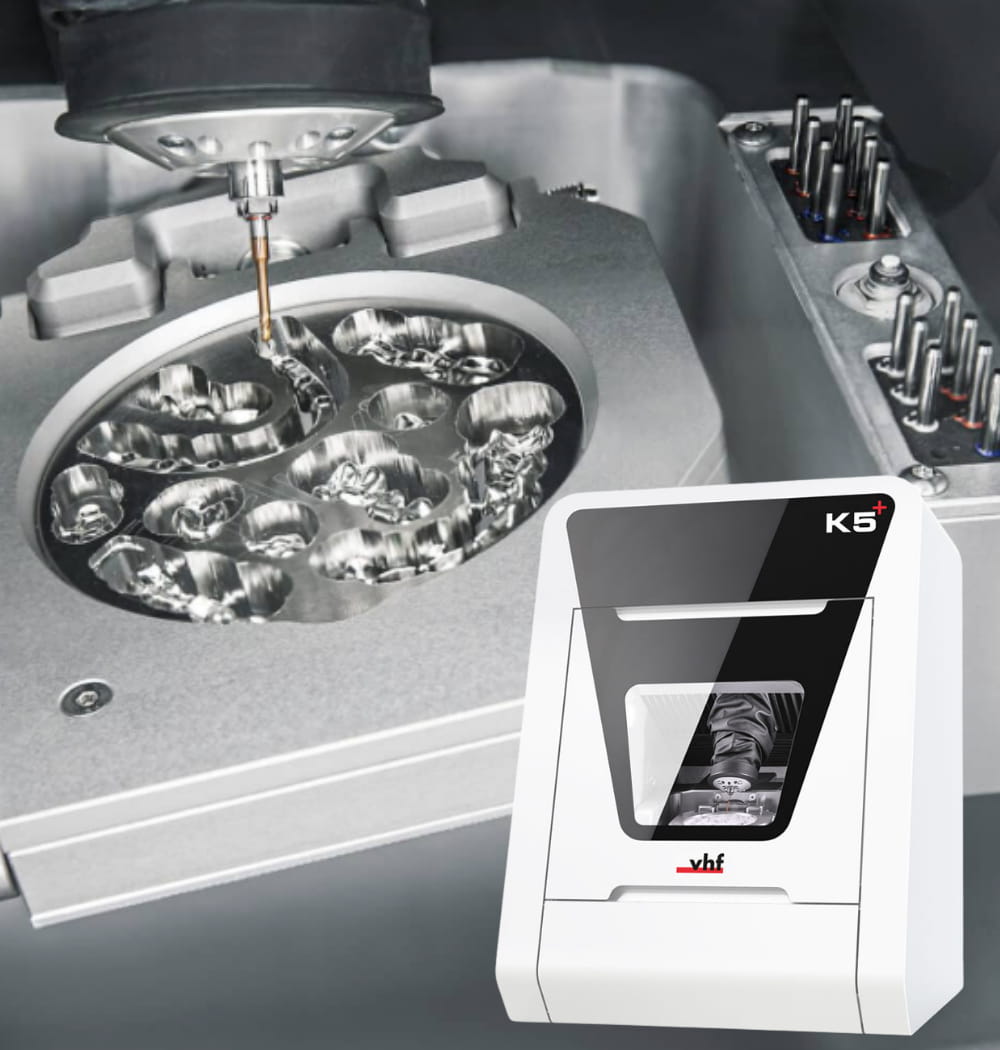
The VHF K5: Why Mid-Size Labs Keep Buying It
The VHF K5 has been a workhorse in dental labs for years now, and for good reason. It's a 5-axis dry milling machine with a 60,000 RPM spindle (500W on the standard K5, 820W on the K5+), pneumatic tool clamping, and a compact footprint that doesn't require reorganizing your entire lab. It handles zirconia, PMMA, wax, composites, PEEK, and even CoCr up to 18mm disc height. Not a jack of all trades—genuinely competent at all of them.
What makes it popular with mid-size labs? It hits a sweet spot. You get 5-axis simultaneous milling with real continuous path calculation, ± 35° B-axis tilt, and repetition accuracy of ± 0.003 mm. Serious precision without the six-figure price tag of the S-series machines. Full-contour crowns, bridges, abutments, surgical guides, occlusal splints—basically everything a modern lab needs. And the DentalCAM software, while not perfect, is straightforward once you stop fighting it.
One important detail: this is a dry milling machine. No coolant tank, no wet mess. Great for zirconia and PMMA. If you need wet milling for glass ceramics like lithium disilicate, you'll want the S5 or R5—or a separate wet setup.
The K5 uses a 3mm shank diameter with a maximum total tool length of 40mm. If you're coming from a Roland or Imes-Icore machine, your existing burs won't fit. The stainless steel collets with pneumatic clamping are specific to VHF's ecosystem. Good news: the same 3mm tools work across most of the VHF lineup—K5, K5+, S1, S2, R5, S5. So if you upgrade within the family, your bur inventory carries over.
Bur Kit Breakdown: What You Actually Need Per Material
Here's where labs either overspend or underspend. You don't need every bur VHF lists in their catalog, but you can't get away with two tools either.
Zirconia
Your bread and butter. For zirconia milling burs, you need a minimum of three tools:
- 2.0mm roughing bur — Bulk material removal. DLC or diamond coated. Wears fastest.
- 1.0mm finishing bur — Walls, margins, and most detail work.
- 0.6mm detail bur — Thin margins, narrow interdental areas, fine anatomy on full-contour work.
Diamond-coated burs last significantly longer on zirconia—400 to 500 units versus 150 to 200 for DLC. Higher upfront cost, but dramatically lower per-unit cost. If you're milling more than 10 units a day, diamond coating pays for itself within a month.
Glass Ceramic (Lithium Disilicate)
Tricky on the K5. The standard K5 is dry, and glass ceramic milling burs work best with coolant. Some labs mill pre-crystallized lithium disilicate blocks dry with dedicated diamond-coated burs, but you'll burn through tools faster and surface finish suffers. If glass ceramic is a big part of your workflow, seriously consider whether the K5 is the right machine for that material.
If you do mill it, all three burs (2.0mm, 1.0mm, 0.6mm) must be diamond-coated. Glass ceramic will destroy DLC tools. No shortcuts.
PMMA, Composite, and Wax
The easy stuff. PMMA mills like butter on the K5. You need a 2.0mm roughing, 1.0mm finishing, and 0.6mm detail bur—all uncoated carbide. Don't waste money on diamond coating for plastics. One set handles 500+ PMMA units easily.
For wax, a basic 2-tool setup (2.0mm and 1.0mm carbide) covers everything. Wax is so soft that bur wear is essentially zero. Your PMMA burs can double for wax once they start getting dull on acrylic.
Recommended Milling Parameters by Material
Starting points based on real-world use with the K5's 60,000 RPM spindle. Your results will vary depending on bur condition, blank brand, and machine calibration. Always verify with a test cut on a new material.
| Material | Operation | Spindle Speed | Feed Rate | Coolant | Notes |
|---|---|---|---|---|---|
| Zirconia | Roughing | 60,000 RPM | 1,500–2,000 mm/min | Off (dry) | Full speed, moderate feed. Let the bur do the work. |
| Zirconia | Finishing | 60,000 RPM | 800–1,200 mm/min | Off (dry) | Slower feed for surface finish and margin accuracy. |
| PMMA | Roughing | 40,000–50,000 RPM | 2,000–3,000 mm/min | Off (dry) | Reduce RPM to prevent melting. Higher feed is fine. |
| PMMA | Finishing | 40,000–50,000 RPM | 1,200–1,800 mm/min | Off (dry) | Watch for heat buildup on thin walls. |
| Glass Ceramic | Roughing | 60,000 RPM | 800–1,200 mm/min | Wet preferred | Slow and steady. High bur wear expected dry. |
| Glass Ceramic | Finishing | 60,000 RPM | 500–800 mm/min | Wet preferred | Prioritize surface quality. Replace burs frequently. |
| Wax | All | 30,000–40,000 RPM | 2,000–3,000 mm/min | Off (dry) | Low RPM prevents melting and sticking. |
| PEEK | Roughing | 50,000–60,000 RPM | 1,500–2,500 mm/min | Off (dry) | Similar to PMMA but tougher. Good chip evacuation critical. |
A note on PMMA: yes, you should dial back the spindle speed. Running at full 60,000 RPM generates enough friction heat to soften the material at the cutting edge. Gummy buildup on the bur, rough surfaces, sometimes the restoration fuses to the sprue. Drop to 40,000–50,000 RPM and increase feed rate. DentalCAM handles this well through material-specific tool paths.
Extending Bur Life on the K5
Burs are consumables, but "consumable" doesn't mean "disposable after Tuesday."
Tool Length Calibration
The K5 has an automatic tool length sensor. Use it. Every time. Thermal expansion alone can shift tool length enough to cause problems—if the machine thinks the bur is 0.05mm longer than it actually is, you're plunging deeper on every pass. Extra load on cutting edges, accelerated wear, worse fit. Run calibration at the start of every session, and again if your lab temperature swings significantly through the day.
Collet Maintenance
The pneumatic collet is great until it's not. Zirconia dust gets everywhere. Buildup inside the collet means inconsistent clamping force and increased runout—which means uneven bur wear, chatter marks, and premature tool failure. Clean with compressed air after every disc. Weekly, remove it completely, clean with isopropyl alcohol, and inspect the taper surfaces. A scored collet needs replacing. Don't nurse it along.
Don't Push Dull Burs
Every lab does this. When you notice rough surfaces or increased milling time, replace the bur. A dull tool puts extra stress on the spindle bearings. Replacing a $15 bur beats replacing a $2,000 spindle. Track unit counts and set thresholds—for diamond-coated zirconia tools, replace at 400 units or first sign of degradation.
OEM vs. Compatible Burs: The Real Conversation
VHF OEM burs work well. Nobody's arguing that. But at $25–$45 per tool, a full replacement set for multiple materials adds up fast. Especially when you're burning through zirconia roughing burs every few hundred units.
Compatible third-party burs—like VHF K5 compatible burs—typically run 40–60% less than OEM. The question every lab asks: is the quality difference real?
Based on feedback from labs running K5 machines daily: the gap has narrowed significantly. Good compatible burs use the same tungsten carbide grades, the same DLC and diamond coating processes. Shank tolerances are tight enough that runout differences disappear on a proper collet. Where you might notice a difference is absolute peak tool life—OEM sometimes squeezes out an extra 10–15%. But when the compatible bur costs half as much, the math works in favor of compatibles.
The real risk with cheap burs isn't cutting performance—it's dimensional consistency. A bur labeled 1.0mm that measures 0.97mm produces restorations with loose internal fit. Always verify new shipments with a micrometer, regardless of brand. For a deeper dive, check our full comparison of OEM vs compatible burs.
Where to Spend and Where to Save
- Zirconia roughing burs: Go compatible. These wear out regardless. No point paying premium for a tool getting replaced every 300–400 units.
- Finishing and detail burs: Quality matters most here for margin accuracy. If you notice fit issues with a compatible brand, switch to OEM for these specifically.
- PMMA/wax burs: Always compatible. Material is so soft that bur quality differences are irrelevant.
- Glass ceramic burs: Consider OEM or premium compatible. The material is punishing, and a marginal bur fails faster than the savings justify.
The K5 has been around long enough that the aftermarket bur ecosystem is mature. Labs that figured this out years ago have been quietly saving thousands annually on consumables while producing the same quality work. The ones still buying exclusively OEM are either locked into a service contract that requires it, or haven't bothered to test alternatives. Make the decision based on your own test results, not brand loyalty.