
5-Axis vs 4-Axis Dental Milling Machines: Which One Fits Your Lab?
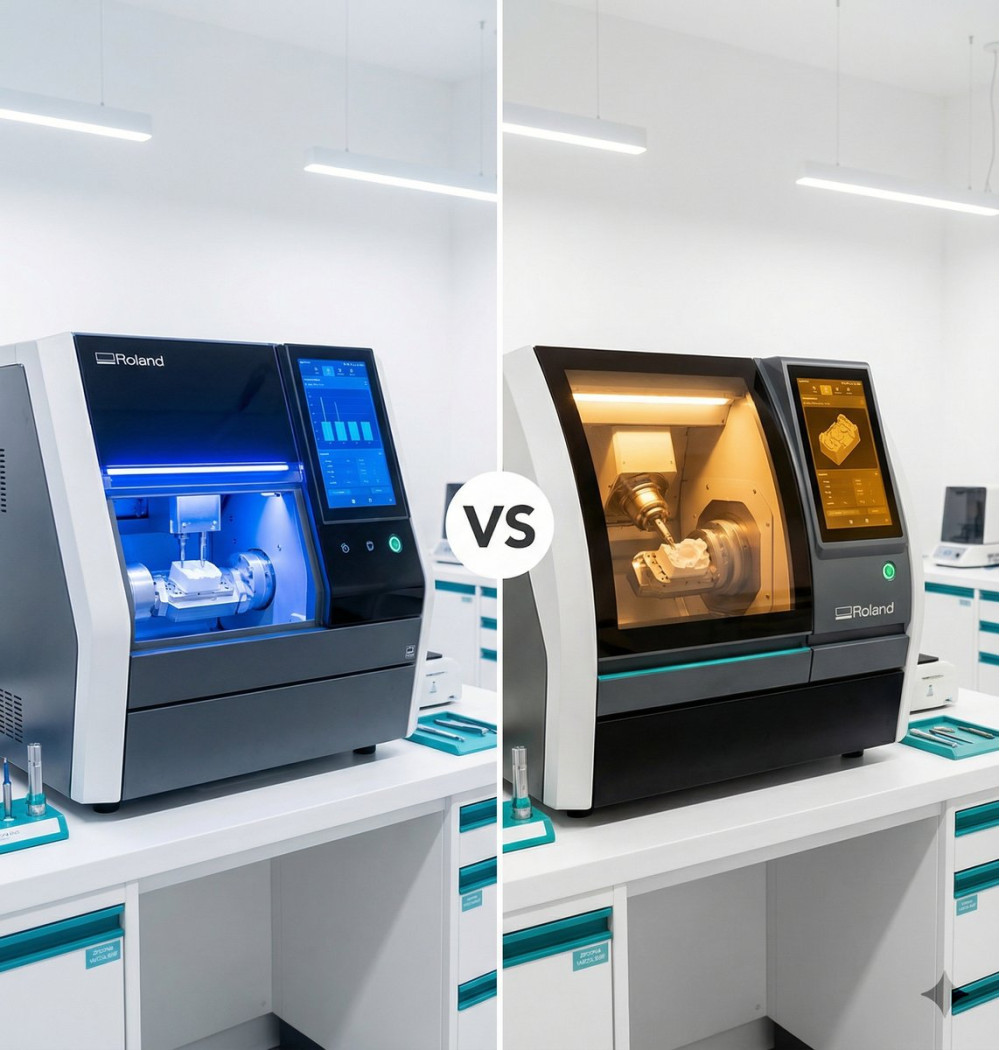
5-Axis vs 4-Axis Dental Milling Machines: Which One Fits Your Lab?
When you're investing $30,000 to $150,000 in a dental milling machine, the axis count matters more than the brochure suggests. In 2024 alone, 5-axis machine shipments jumped 34% year-over-year, and dental labs everywhere are asking the same question: do I really need that extra axis, or is 4-axis enough? The answer depends on what you mill, how complex your cases get, and whether you're planning to expand services.
What's the Difference, Really?
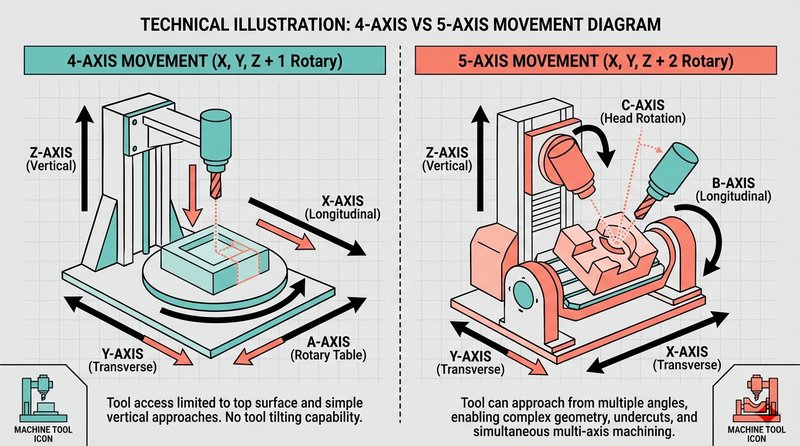
A 4-axis milling machine rotates the workpiece around the X and Y axes while the spindle moves along X, Y, and Z. That fourth axis is typically a rotary table that lets you mill from multiple angles without manually repositioning the restoration.
A 5-axis machine adds a tilt axis—usually the A or B axis—that angles the spindle or the workpiece. This means the tool can approach the material from virtually any angle, including undercuts and complex geometries that 4-axis machines simply cannot reach.
The practical difference? A 5-axis machine can mill a full-arch bridge with steep undercuts, divergent abutments, and intricate gingival margins in a single setup. A 4-axis machine might need two setups or custom block positioning for the same restoration, adding time and potential error.
When 4-Axis Is Actually Enough
Don't assume 5-axis is automatically better. For many dental labs, a quality 4-axis machine handles 90% of cases without breaking a sweat.
4-axis works fine if your lab focuses on:
- Single crowns and short bridges (up to 3-4 units)
- Standard zirconia copings and frameworks
- Screw-retained abutments with moderate angulation
- PMMA temporaries and wax pattern milling
- Labs with predictable, consistent case types
The cost savings are significant. A 4-axis Roland DWX-42W or similar runs $25,000–$40,000, while entry-level 5-axis systems start around $60,000 and climb to $120,000+ for production-grade machines. If your case mix doesn't demand complex geometries, that extra $30,000+ is money you could spend on materials, software, or hiring.
Milling time is another consideration. For simple geometries, 4-axis machines can actually be faster because they don't waste time on unnecessary rotational movements. A single crown in zirconia might take 12-15 minutes on a 4-axis versus 18-22 minutes on some 5-axis systems that over-complicate the toolpath.
When You Absolutely Need 5-Axis
There are situations where 4-axis machines hit a hard wall, and knowing when that happens prevents costly mistakes.
5-axis becomes essential for:
- Full-arch bridges with divergent abutments
- Titanium bar overdentures with complex geometries
- Glass ceramic inlays/onlays with deep undercuts
- Custom implant abutments requiring multi-angle machining
- Labs milling implant bars or hybrid restorations
- High-value cases where precision margins are non-negotiable
The ability to mill undercuts without repositioning is the game-changer. In a 4-axis setup, steep undercuts require flipping the block or using specialty long-shank burs that flex and compromise surface finish. A 5-axis machine tilts the workpiece or tool, maintaining optimal cutting angles and eliminating the need for secondary setups.
Surface finish improves noticeably. 5-axis machines maintain consistent tool-to-surface angles, reducing the stair-stepping visible on 4-axis milled glass ceramics. For lithium disilicate and other brittle materials, this translates to fewer microfractures and higher survival rates after cementation.
The Hidden Costs Nobody Talks About
Sticker price is just the beginning. Before upgrading to 5-axis, understand the full ownership picture.
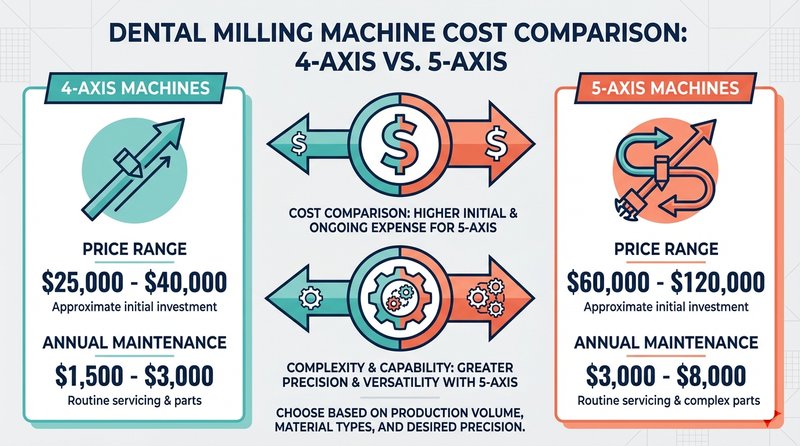
**Maintenance complexity increases.** 5-axis machines have more moving parts, more motors, and more calibration points. Annual maintenance contracts often run $3,000–$8,000 versus $1,500–$3,000 for comparable 4-axis systems. When something breaks, you're waiting for specialized technicians who understand simultaneous 5-axis motion control.
**Tooling costs rise.** 5-axis machines demand higher-quality tools because they're often used at compound angles that stress the tool more aggressively. A set of 5-axis dental milling burs might cost 20-30% more than standard 4-axis tooling, and you'll go through them faster on aggressive titanium or cobalt-chrome jobs.
**Software and training matter.** 5-axis CAM software has a steeper learning curve. Your technicians need to understand collision detection, tool tilt optimization, and rest material strategies. Budget 40-60 hours of training time per operator, plus ongoing support costs.
**Floor space and infrastructure.** 5-axis machines are physically larger and heavier. They often require dedicated electrical circuits, better compressed air systems, and climate-controlled environments to maintain the precision their extra axes deliver.
Popular 4-Axis vs 5-Axis Models Compared
| Feature | Roland DWX-42W (4-Axis) | vhf K5+ (5-Axis) | Imes-iCore CORiTEC 350i (5-Axis) |
|---|---|---|---|
| Price Range | $25,000–$35,000 | $65,000–$85,000 | $90,000–$120,000 |
| Wet/Dry | Wet & Dry | Wet & Dry | Wet & Dry |
| Max Block Size | 98mm discs | 98mm discs / pucks | 98mm discs / pucks |
| Best For | Crown & bridge, temps | Full arch, abutments | Production labs, implant bars |
| Spindle Speed | 30,000 RPM | 60,000 RPM | 60,000 RPM |
The Roland DWX-42W represents the gold standard for entry-level 4-axis production—reliable, fast for simple cases, and cost-effective. Labs running 20-30 units daily with straightforward crown-and-bridge work rarely outgrow it.
The vhf K5+ hits a sweet spot for growing labs. It handles 95% of cases a 4-axis can, plus the complex geometry work that justifies its higher price. Many labs see ROI in 18-24 months if they capture full-arch and custom abutment cases they previously outsourced.
The Imes-iCore CORiTEC 350i is built for production environments—labs milling 50+ units daily, running multiple shifts, or specializing in implant bars and hybrid dentures. The precision and throughput justify the premium for high-volume operations.
Making the Right Choice for Your Lab
Before pulling the trigger on either option, audit your current case mix honestly.
Ask these questions:
- What percentage of my cases involve undercuts, divergent abutments, or full-arch bridges?
- Am I currently outsourcing complex cases? How much revenue am I losing?
- Do I have technicians comfortable with advanced CAM software, or will training be a bottleneck?
- What's my realistic budget for the machine plus first-year maintenance and tooling?
- Am I planning to expand into implant bars or hybrid restorations within 2-3 years?
If under 10% of your cases need 5-axis capability, a quality 4-axis machine plus strategic outsourcing probably makes financial sense. You can always upgrade later when case complexity demands it.
If you're already outsourcing complex cases weekly, or if implant work is part of your growth strategy, the 5-axis investment pays for itself faster than the spreadsheets suggest. You're not just buying capability—you're capturing revenue that currently walks out the door.
Quick Tips for Either Machine
**Tool selection matters more than axis count.** Even a 5-axis machine produces garbage with dull or inappropriate burs. Match your tooling to the material—diamond-coated for zirconia blocks, carbide for PMMA discs and wax discs, specialized geometries for titanium and glass ceramic.
**Maintenance discipline separates productive labs from frustrated ones.** Clean your spindle weekly. Check air pressure daily. Calibrate monthly. Skipping maintenance on a $80,000 5-axis machine because "it's running fine" is how you turn a precision instrument into an expensive paperweight.
**Start with proven CAM strategies.** Both vhf and Imes-iCore publish recommended toolpaths for common restorations. Master these before experimenting. The difference between a standard strategy and an optimized one can be 30% faster cycle times and measurably better surface finish.
Final Verdict
4-axis machines remain the right choice for focused crown-and-bridge labs, startups watching cash flow, and operations with predictable case types. They're faster for simple work, cheaper to own, and easier to maintain.
5-axis machines earn their place in labs handling complex implant work, full-arch restorations, and cases where surface finish directly impacts clinical outcomes. The extra axis isn't a luxury—it's the difference between keeping complex cases in-house or watching that revenue go to competitors.
The 34% growth in 5-axis shipments isn't hype. It reflects a real shift toward complex digital dentistry and in-house manufacturing of restorations that labs previously outsourced. But more capability isn't automatically better capability. Match the machine to your actual work, not the work you think you might do someday.
Choose wisely. Your milling machine is a 5-10 year partnership, and the right choice keeps your lab competitive and profitable through whatever digital dentistry throws at you next.
Ready to upgrade your milling setup?
Browse our complete collection of dental milling burs compatible with Roland, vhf, Imes-iCore, and 30+ other machine brands.