
Roughing vs Finishing Passes: Milling Strategy That Saves Burs and Money
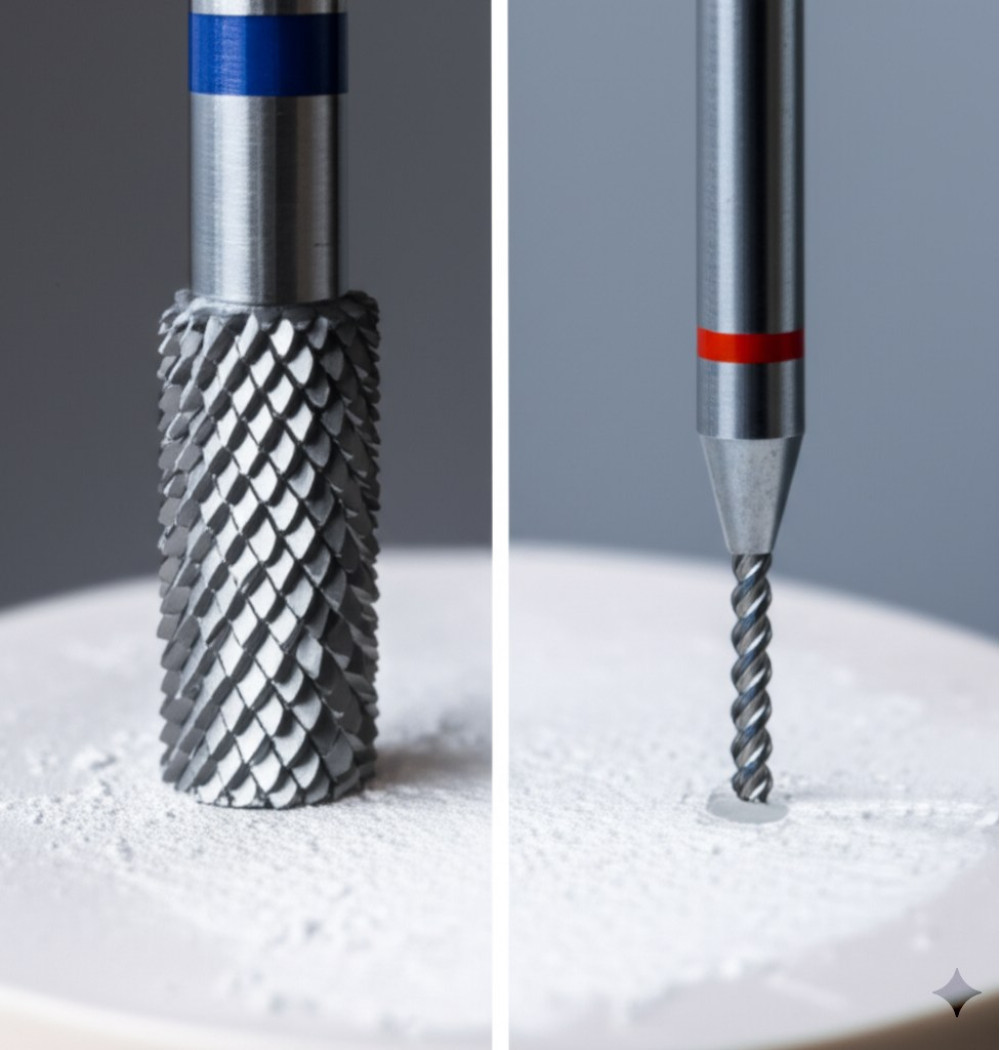
Roughing and Finishing Are Two Different Jobs
Here's something that seems obvious once you think about it but gets ignored constantly: roughing and finishing passes exist for completely different reasons. They have different goals, different tolerances, and they destroy burs in different ways. Treating them the same — or worse, trying to do both with one tool — is how you burn through burs twice as fast and still end up with garbage margins.
Roughing is about removing material. That's it. You're hogging out bulk stock as fast as the machine and material will tolerate. Nobody cares what the surface looks like after roughing. It's going to get machined again. The goal is speed and clearing volume so your finishing passes have a clean, predictable amount of stock left to work with.
Finishing is the opposite. Minimal material removal. Shallow passes. The entire point is surface quality and dimensional accuracy — especially at margins, connector areas, and occlusal anatomy. You're taking off maybe 0.1-0.3mm of remaining stock in controlled, precise passes.
When your CAM software generates a toolpath, it's already splitting the work this way. The question is whether your bur selection and strategy actually support what the software is trying to do.
Why Separate Burs for Roughing and Finishing Actually Saves Money
The single biggest false economy in dental milling: running one bur for both roughing and finishing to "save money on tools." Labs do this all the time. And it costs them more in every measurable way.
Think about what happens. A fresh bur starts roughing. It's sharp, cuts clean, runs cool. After 15-20 discs of roughing zirconia, that bur is still functional but the cutting edges have worn. Micro-chipping on the diamond coating. Slightly increased cutting forces. Still removes material fine — roughing is forgiving.
But now you send that same worn bur to do finishing passes. The margins need 20-micron accuracy. The bur is pushing material instead of cutting it cleanly. You get chipping at thin walls. Margins are rough or slightly oversized. Heat buildup increases because the dull edges create more friction. The restoration fits poorly or needs hand-finishing that eats your technician's time.
Alternatively: dedicate burs to their role. Roughing burs run until they can't remove bulk material efficiently anymore — which takes significantly longer than you'd think, because roughing tolerances are loose. When a roughing bur wears past the point of efficient cutting, you recognize the wear signs and retire it. Your finishing burs stay sharp much longer because they're only ever taking light passes on pre-roughed geometry. Less load, less heat, less wear per unit.
Net result: you buy more burs (two types instead of one), but each bur lasts longer in its dedicated role, your restorations come out better, and you spend less time on rework. Run the numbers on your cost per milled unit and it's not even close.
The math, roughly
Say a universal bur costs $35 and lasts 30 discs doing both jobs before margins suffer. That's $1.17 per disc in bur cost. Now take a $30 roughing bur that lasts 60 discs (roughing only) and a $35 finishing bur that lasts 80 discs (finishing only). That's $0.50 + $0.44 = $0.94 per disc. Cheaper per unit, better results. Every time.
Roughing Strategy: Get the Bulk Out Fast
Roughing is where your larger diameter burs earn their keep. You want the biggest tool your machine and part geometry will allow — typically 2.5mm for most 5-axis dental mills, sometimes 3.0mm on open systems.
Why bigger matters for roughing
- Higher material removal rate. A 2.5mm bur clears roughly 4x the volume per pass compared to a 1.0mm. Simple geometry.
- Better heat dissipation. Larger tool body means more thermal mass. The cutting edge doesn't overheat as quickly.
- Stiffer tool. Less deflection under load, which means more consistent stock-to-leave for the finishing pass.
- Longer life at aggressive parameters. The cutting forces distribute across more surface area.
For roughing, you're running higher step-down values — the axial depth of each pass. Instead of nibbling 0.2mm at a time, you might run 0.5-1.0mm step-down depending on material. Stepover (the radial engagement) stays moderate, typically 40-60% of tool diameter. Feed rates can be pushed higher since surface finish doesn't matter.
Stock-to-leave is critical. This is how much material the roughing pass leaves behind for finishing to clean up. Too much stock left and your finishing burs work too hard and wear prematurely. Too little and you risk the roughing pass cutting into final geometry if there's any tool deflection or positional error. For zirconia, 0.2-0.3mm stock-to-leave is typical. PMMA and wax can get away with 0.1-0.2mm.
One thing labs overlook: roughing bur condition directly affects finishing quality even though they're separate operations. A badly worn roughing bur leaves inconsistent stock. Some areas have 0.1mm remaining, others have 0.4mm. Your finishing bur then encounters wildly varying loads pass-to-pass. That's how you get milling errors that seem random but aren't.
Finishing Strategy: Margins Are Everything
Finishing is where you earn your money. Or lose it. A beautiful roughing pass that saves ten minutes means nothing if the margins are off by 80 microns.
Finishing burs are typically 0.6mm to 1.0mm diameter. The small size lets them reach into tight internal geometry — prep walls, connector undercuts, occlusal fissures. A 1.0mm ball-nose is the workhorse for most finishing operations. Drop to 0.6mm for fine detail work and deep, narrow anatomy.
Key finishing parameters
- Shallow axial depth. You're taking 0.05-0.15mm per pass. This isn't the place to be aggressive.
- Tight stepover. 5-15% of tool diameter for good surface finish. Wider stepover leaves visible scallop marks.
- Reduced feed rate. Let the bur cut cleanly. Pushing feed on a finishing pass just introduces vibration and chatter marks.
- Consistent tool engagement. This is why stock-to-leave from roughing matters so much. Finishing burs want to see the same amount of material everywhere.
For zirconia milling burs used in finishing, you absolutely need sharp tools. A worn finishing bur on pre-sintered zirconia will cause micro-chipping at margins that you might not even catch until after sintering — when the part shrinks and those tiny chips become visible gaps. Not fun explaining that to the dentist.
PMMA and wax burs are more forgiving on finish passes but still benefit from dedicated tools. PMMA especially tends to melt and re-weld onto dull cutting edges, building up material on the bur that then scratches the surface. Dedicated sharp finishing burs avoid this entirely.
Material-Specific Strategies
You can't mill zirconia and PMMA the same way. Different hardness, different chip formation, different thermal behavior. Your roughing and finishing split needs to account for material properties.
Zirconia (pre-sintered)
Zirconia is abrasive even in its green state. It wears diamond coatings steadily. Roughing burs in zirconia see the most abuse because you're pushing volume removal through a material that fights back. Use dedicated roughing burs and accept they'll wear faster than in softer materials. For finishing, keep spindle speeds moderate — excessive RPM generates heat that can cause micro-cracking at thin margins. Dry milling is standard for zirconia but monitor dust extraction; clogged suction means dust recirculates and accelerates bur wear.
PMMA and composite
Softer, but gummy. PMMA doesn't wear burs through abrasion — it kills them through material adhesion and heat. Roughing can be aggressive with high feed rates since the material cuts easily. The risk is melting. Keep the bur moving, don't dwell, and if your machine supports coolant for PMMA, use it. Finishing in PMMA benefits from single-flute or two-flute geometries that clear chips effectively instead of packing them into the cut.
Wax
Wax is the easiest to mill but the easiest to screw up through laziness. Labs often skip dedicated finishing passes on wax because "it's just wax." Then wonder why their pressed ceramics have flash lines from rough wax patterns. Treat wax finishing seriously. Light passes, sharp burs, moderate speeds.
Glass ceramics and lithium disilicate
These are hard and brittle. Roughing needs to be more conservative than zirconia — lower step-down, moderate feed. The material wants to chip, not cut. Finishing is critical because any subsurface micro-cracks from aggressive roughing will propagate during crystallization firing. Use the lightest finishing passes your cycle time can tolerate.
Roughing vs. Finishing Parameters by Material
| Parameter | Zirconia (Roughing) | Zirconia (Finishing) | PMMA (Roughing) | PMMA (Finishing) |
|---|---|---|---|---|
| Bur diameter | 2.5mm | 0.6–1.0mm | 2.5mm | 0.6–1.0mm |
| Spindle speed (RPM) | 10,000–14,000 | 12,000–16,000 | 15,000–20,000 | 18,000–25,000 |
| Feed rate (mm/min) | 1,500–2,500 | 800–1,200 | 2,500–4,000 | 1,000–1,800 |
| Step-down (mm) | 0.5–1.0 | 0.05–0.15 | 0.8–1.5 | 0.05–0.2 |
| Stepover (% of diameter) | 40–60% | 5–15% | 50–70% | 10–20% |
| Stock-to-leave (mm) | 0.2–0.3 | 0 (final) | 0.1–0.2 | 0 (final) |
| Coolant | Dry + suction | Dry + suction | Optional spray | Optional spray |
| Typical bur life (discs) | 40–60 | 60–100 | 80–120 | 100–150+ |
Values are approximate and vary by machine, bur quality, and specific material brand. Always start conservative and adjust based on results.
How CAM Software Handles the Split
Modern dental CAM software automates the roughing/finishing split, but the defaults aren't always optimal. Knowing what the software is doing — and when to override it — separates good results from great ones.
DentalCAM (bundled with vhf machines) handles toolpath generation automatically based on the material and disc you select. It does a decent job with stock-to-leave values for most materials. Where it can be limiting: the roughing strategy is fairly conservative by default. If you're comfortable with your machine, you can often push roughing parameters harder than DentalCAM suggests and save cycle time without affecting quality.
hyperDENT (FOLLOW-ME!) gives you significantly more control over toolpath strategy. You can define custom roughing patterns, adjust stock-to-leave per-surface, and fine-tune finishing passes independently. The learning curve is steeper, but labs running high volume benefit from the optimization flexibility. hyperDENT's "rest machining" — where it automatically creates additional passes to clean up material the larger roughing bur couldn't reach — is genuinely useful for complex geometries.
Millbox (CIMsystem) sits somewhere in between. Good automatic strategy generation with enough manual override capability for most needs. Its material database is solid and the recommended parameters are usually a reasonable starting point. The visual toolpath simulation helps you spot potential problems before you waste a disc.
Regardless of software: always verify the generated toolpath visually before milling. Every CAM package occasionally produces weird toolpath segments — a roughing pass that plunges too deep, a finishing pass that misses a critical surface. Five minutes of review beats thirty minutes of re-milling.
Stop Trying to Make One Bur Do Everything
The labs I see struggling with bur costs and restoration quality almost always have the same problem. They're running a single bur through the entire cycle — roughing, semi-finishing, finishing — and replacing it when margins start suffering. By that point, the bur has been suboptimal for finishing for the last 15-20 discs. They've been producing slightly worse work than they should for days without realizing it.
Split your burs by function. Track their usage separately. A roughing bur that's too worn for roughing might still have value — some labs demote worn roughing burs to pre-roughing passes on subsequent jobs before final retirement. That's smart lifecycle management.
The real cost of milling isn't burs. It's never been burs. It's remakes, hand-finishing time, and reputation. A lab that produces consistently accurate margins with proper roughing/finishing separation will spend more on tooling and make significantly more money. That's not a sales pitch — it's just how the math works out when you factor in everything downstream of the milling machine.
Dial in your roughing to clear material fast and leave consistent stock. Dial in your finishing to hit margins clean on the first pass. Use the right bur for each job. Your machine, your burs, and your bottom line will all thank you.