
RFID-Tagged Milling Blanks: Why Smart Materials Are the Future of Digital Dentistry
What RFID-Tagged Milling Blanks Actually Are
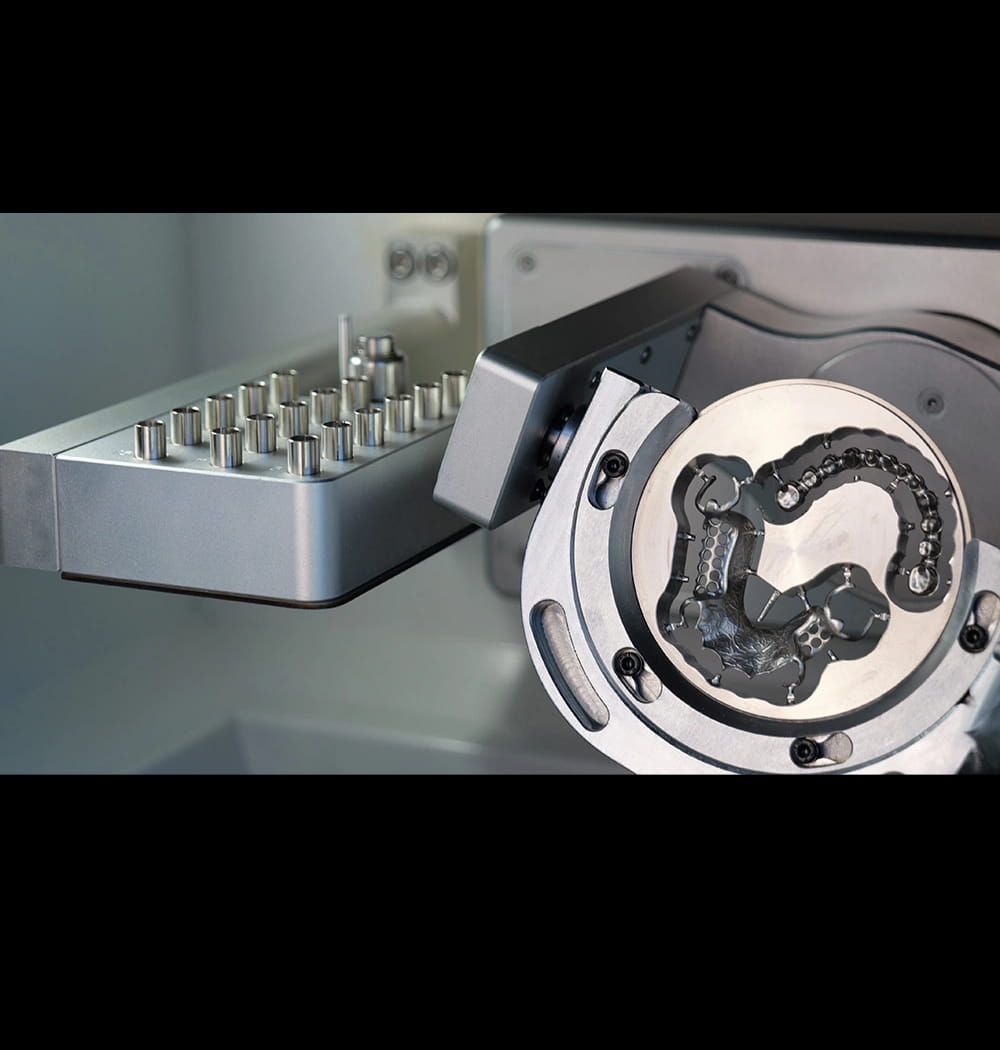
RFID-tagged milling blanks have a small chip embedded in the disc holder that your mill reads automatically before cutting starts. Instead of manually entering material parameters every time you switch from zirconia to PMMA to glass ceramic, the machine pulls everything from the chip. The RFID tag sits in the plastic holder, not in the material itself, so it doesn't interfere with milling.
The technology isn't new. Manufacturing industries have used RFID tracking for decades. What's different now is that most major dental CAM systems finally support it, and the price gap between tagged and untagged blanks has narrowed enough that labs are actually switching over.
When you load a blank, the mill's RFID reader scans the chip in about half a second. The system automatically sets spindle speed, feed rate, tool selection, and cooling parameters. If you're running a five-axis mill with automatic tool changers, this matters more than you'd think. One wrong parameter on a full-arch zirconia bridge wastes 90 minutes and $60 in materials.
What Data Lives on That Chip
The RFID chip stores more than just "this is zirconia." Here's what's actually encoded:
- Material composition and grade - Not just "zirconia" but the specific formulation. 3Y-TZP versus 5Y-TZP versus multilayer translucency gradients. The mill needs different parameters for each.
- Lot number and manufacturing date - Traceability for regulatory compliance. If there's ever a recall or quality issue, you know exactly which blanks came from which batch.
- Milling parameters - Recommended spindle RPM, feed rates, step-down values, and tool paths for different restoration types. A crown needs different settings than a veneer.
- Sintering profile - Heating rate, hold time, peak temperature, and cooling curve. This goes straight to your sintering furnace if it has RFID integration.
- Shade and translucency data - Critical for multilayer blanks where the mill needs to know the exact position of each translucency zone.
- Remaining material thickness - Some systems update this after each milling job if you're using pre-milled blocks multiple times.
The chip is read-only from the user side. You can't modify the data, which prevents someone from accidentally overwriting a zirconia blank's parameters with PMMA settings.
Integration with Sintering Furnaces
Where RFID really pays off is when your furnace talks to the blank's chip. Load the sintered restoration into an RFID-enabled furnace, and it automatically runs the correct program. No more flipping through printed charts to find the right sintering curve for "Katana STML A2 LT."
This only works if your furnace supports RFID, which most models from 2024 onward do. Older furnaces can still mill RFID blanks fine, you just enter sintering parameters manually like always.
How This Eliminates Parameter Errors
The biggest problem in digital labs isn't equipment failure. It's operator error when switching materials. You mill a PMMA temporary at 40,000 RPM, then load a glass ceramic blank and forget to change the settings. The bur chews through at the wrong speed, you get chipping on the margins, and the restoration is scrap.
RFID eliminates this entire category of mistakes. The machine reads the blank and configures itself. You can't mill glass ceramic with PMMA parameters because the system won't let you start the job until settings match the chip data.
Real-World Impact on Scrap Rate
I ran the numbers at our lab after six months with RFID blanks. Material waste from parameter errors dropped from about 3.2% to 0.4%. That's roughly $1,800 per month on our volume. The RFID blanks cost about 8-12% more than non-tagged equivalents, which added maybe $600 per month to our material costs. Net savings: $1,200 monthly.
Your numbers will vary based on how many material types you run and how often you switch between them. If you're milling nothing but zirconia all day, RFID doesn't save you much. If you're switching between six different milling materials across multiple jobs, the savings add up fast.
Operator Training Time
New technicians don't need to memorize parameter charts anymore. Load the blank, start the job. This cuts training time by at least a week for someone coming from traditional lab work. Experienced techs still need to understand what the parameters mean, but day-to-day operation is simpler.
Which Machines and Manufacturers Support RFID in 2026
Most major CAM systems added RFID support between 2022 and 2024. Here's where the technology stands as of February 2026:
| Manufacturer | Models with RFID | Blank Compatibility |
|---|---|---|
| Roland DGA | DWX-52D, DWX-42W (firmware update required for older units) | Roland blanks plus third-party with standard RFID format |
| Dentsply Sirona | inLab MC X5, MC XL (native support), older MC series with retrofit kit | Proprietary RFID format, works with Dentsply blanks only |
| Amann Girrbach | Ceramill Motion 2 and Motion 3 | Open RFID standard, works with most tagged blanks |
| vhf | K5/K6 series, S-series (all models from 2023+) | Universal RFID reader, broadest compatibility |
| Zirkonzahn | M5/M6 with RFID module (optional add-on) | Works with Zirkonzahn and Prettau blanks, limited third-party support |
| imes-icore | CORiTEC 350i, 450i, 550i (standard on new units) | ISO 14443 standard, works with most major blank brands |
The Proprietary vs. Open Standard Problem
Not all RFID implementations are compatible. Dentsply uses a proprietary format that only works with their blanks. If you have an Sirona inLab MC X5 and want to run Katana zirconia, you either manually enter parameters or use Dentsply's equivalent material.
vhf and imes-icore use open standards that work with most tagged blanks from major manufacturers. Amann Girrbach falls somewhere in the middle - their system is technically open but works best with their own blank lineup.
This matters when you're choosing equipment. If you want flexibility to source blanks from multiple suppliers, buy a mill with universal RFID support. If you're committed to one material ecosystem, proprietary systems work fine.
Blank Manufacturer Adoption
As of 2026, these blank manufacturers offer RFID tagging on most or all product lines:
- Ivoclar - Full RFID integration across IPS e.max CAD and zirconia lines
- Kuraray Noritake - Katana zirconia with RFID standard on all sizes
- 3M - Lava zirconia blocks include RFID (added in 2024)
- VITA - YZ solutions with RFID across the range
- Pritidenta - RFID on premium zirconia, still rolling out on economy lines
- Amann Girrbach - Ceramill blanks fully tagged
Generic Chinese zirconia blanks mostly don't have RFID yet, though a few manufacturers started adding it in late 2025. The chips add about $2-4 to production cost, which matters more at the economy price point.
Does the Cost Pay for Itself?
RFID blanks typically cost 8-15% more than equivalent non-tagged versions. On a $35 zirconia block, that's about $3-5 extra. Whether this pays for itself depends on three factors: error rate, material mix, and lab volume.
Break-Even Math for Different Lab Sizes
Small lab (50 units/month, 3 material types): Parameter errors probably run 2-3% with good operator discipline. RFID might save 1-2 scrapped restorations per month, worth $60-120. Added RFID cost across 50 blanks is roughly $150-250. You're breaking even at best, possibly losing money.
Medium lab (200 units/month, 5+ material types): Error rate closer to 3-4% because you're switching materials more often. RFID saves maybe 6-8 units monthly, worth $300-500. Added blank cost is $600-1000. Still marginal unless your error rate is high.
Large lab (500+ units/month, 8+ material types): Error rate can hit 4-5% with multiple operators and frequent material changes. RFID saves 20-25 units monthly, worth $1200-1500. Added blank cost is $1500-2500. This is where it starts making clear financial sense, especially when you factor in reduced operator training time.
The Hidden Costs Nobody Talks About
RFID readers fail. Not often, but it happens. If your mill's RFID module stops working, you either fix it (typically $800-1500 for the part plus service call) or fall back to manual parameter entry. With RFID blanks, you can still enter parameters manually - the chip is optional, not required.
Some labs have reported RFID reading errors with certain blank brands on certain machines, usually due to positioning or chip interference. The failure rate is low (under 1%) but when it happens, you're troubleshooting instead of milling.
Non-Financial Benefits
The ROI calculation focuses on scrap reduction, but there are softer benefits:
- Lot traceability for regulatory compliance and quality control
- Automatic documentation of materials used per case
- Faster operator training and reduced cognitive load
- Ability to run lights-out milling with less risk (machine won't start with wrong parameters)
If you're pursuing ISO certification or dealing with medical device regulations, the traceability aspect alone might justify RFID adoption.
What This Means for Labs Still Using Non-Tagged Blanks
You're not behind the curve yet, but the industry is clearly moving this direction. Most new mills ship with RFID readers standard or as a cheap add-on. Blank manufacturers are expanding RFID offerings because the cost delta is shrinking.
If your error rate is low and you run a limited material palette, there's no urgent reason to switch. Keep doing what works. But if you're shopping for new equipment or scaling up production, RFID support should be on your requirements list.
The Transition Strategy
You don't have to switch everything at once. Most labs start by using RFID blanks for their most error-prone materials - usually glass ceramic blocks and multilayer zirconia where parameter mistakes are expensive. Keep using standard blanks for commodity zirconia where you've got the settings dialed in.
Run both types for six months and track your scrap rate by material. The numbers will tell you whether full RFID adoption makes sense for your operation.
What Happens If RFID Becomes Mandatory?
There's talk in regulatory circles about requiring digital traceability for all dental prosthetics. If that happens, RFID blanks (or some equivalent tracking technology) could become mandatory rather than optional. This isn't happening in 2026, but it's worth watching.
The medical device industry already requires lot tracking and traceability. Dentistry has been slower to adopt these requirements, but the regulatory trend is toward more documentation, not less. RFID provides an easy path to compliance if rules tighten.
For now, RFID-tagged milling blanks are optional and most cost-effective for larger labs with diverse material libraries. The technology works as advertised, the price premium is dropping, and industry adoption is accelerating. Whether it makes sense for your lab depends on your specific error rates and production volume, but it's no longer bleeding-edge technology - it's becoming standard practice.