
Chairside Milling vs Lab Milling: What It Means for Dental Technicians
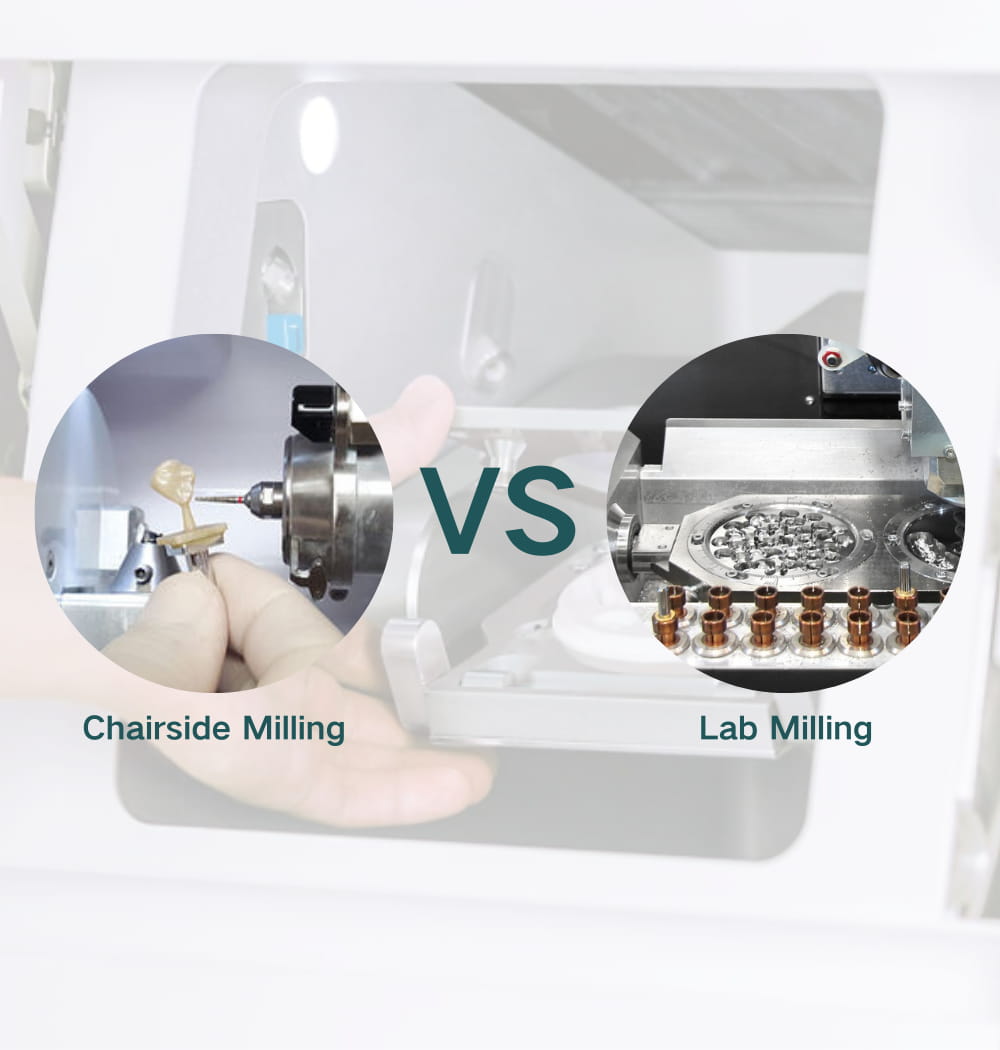
Chairside milling has been around for over a decade now, but it's picking up speed. CEREC, Planmeca, and a handful of other systems let dentists scan, design, and mill a crown while the patient sits in the chair. One appointment, no temporary, no lab involved.
If you're a dental technician, you've probably wondered: is this the beginning of the end for lab work?
Short answer — no. But the longer answer is worth understanding, because chairside milling is changing what kinds of cases come through your door and what skills you'll need going forward.
What Chairside Milling Actually Does Well
Let's give credit where it's due. For single-unit restorations — crowns, inlays, onlays, veneers — chairside milling works. Patients love the convenience of walking out with a finished restoration in 60-90 minutes. Dentists love skipping the impression, the temporary, and the second appointment.
The machines themselves (CEREC MC XL, Planmeca PlanMill, a few others) are compact 4-axis mills designed for the operatory. They handle a focused range of materials: mostly lithium disilicate (e.max), hybrid ceramics like VITA ENAMIC, and some feldspathic blocks. The software does the design work with minimal input — scan the prep, set margins, click "mill."
For a straightforward posterior crown on a molar with good clearance and no shade-matching headaches, the result is perfectly acceptable. Some of these restorations are genuinely good.
Where Chairside Falls Short
Here's where the picture changes. Chairside mills are 4-axis machines with small envelopes. They physically cannot produce:
- Multi-unit bridges — anything beyond a three-unit bridge is out of scope, and even three-unit work is marginal on most chairside systems
- Implant-supported work — custom abutments, screw-retained crowns, implant bars, and All-on-X frameworks need precision that chairside machines don't offer
- Full-arch restorations — full dentures, hybrid prosthetics, and long-span zirconia arches require 5-axis milling capability that simply doesn't exist in chairside form
- Metal frameworks — titanium, CoCr, and other metals need serious spindle power, coolant systems, and tool paths that operatory machines can't handle
- Complex esthetics — anterior cases where shade gradients, translucency, and surface texture matter still need a technician's eye and hand
The software is another limitation. Chairside CAD is designed for speed, not precision. It auto-generates anatomy based on algorithms, which works fine for a second molar but produces mediocre results in the esthetic zone. A skilled technician designing in exocad or 3Shape can control every cusp tip, contact point, and emergence profile — that level of detail isn't available chairside.
The Lab Advantage Is Real
Lab-based milling equipment operates in a different league. A machine like the Sirona MCX5 or a high-end 5-axis system runs with tolerances and material capabilities that chairside machines can't match.
The differences that matter most:
- 5-axis precision — undercuts, thin walls, screw channels, and complex geometries that 4-axis chairside mills simply can't reach
- Material range — labs mill zirconia (pre-sintered and fully sintered), glass ceramics, PMMA, wax, PEEK, titanium, and CoCr. Chairside is limited to a handful of ceramic and hybrid blocks.
- Surface finish — higher spindle speeds, better coolant delivery, and longer tool paths produce smoother surfaces that need less manual finishing
- Multi-unit capability — the build envelope and axis freedom to handle bridges, bars, and full-arch work
- Tool life and consistency — lab burs with standard 4mm and 6mm shanks last longer and produce more predictable results across hundreds of units
There's also the human factor. A dental technician brings judgment that no chairside algorithm replicates — choosing between monolithic and layered approaches, adjusting connector dimensions based on the clinical situation, matching shades across multiple units, and understanding how a restoration will perform over years of function.
How This Plays Out in Bur Demand
The bur market splits along this same line. Chairside machines use small, proprietary burs — specific to each manufacturer, sold in kits, and replaced on a fixed schedule. It's a closed ecosystem. If you're running a CEREC, you buy CEREC burs. Period.
Lab milling is different. Standard shank sizes (4mm and 6mm) mean you can source burs from multiple suppliers. Tool life matters more because you're running higher volumes. Bur geometry and coating quality directly affect your output and cost per unit.
This is the market CADBURS serves — lab-grade milling burs for production environments where you need consistent performance across hundreds or thousands of restorations. Chairside's growth doesn't shrink this market. If anything, as CAD/CAM technology advances and more complex cases shift to digital workflows, demand for quality lab burs keeps climbing.
What Smart Lab Technicians Are Doing Right Now
The technicians who are thriving aren't worried about chairside taking their jobs. They're adapting. Here's what the successful ones have in common:
They specialize in what chairside can't do. Implant work, full-arch cases, complex esthetic restorations, combination cases with multiple materials — these are growing segments that require lab expertise. A dentist who mills their own single crowns still needs a lab for the hard stuff, and they're often willing to pay more for it.
They compete on turnaround when it makes sense. Some labs now offer same-day or next-day turnaround on simple cases. This takes away chairside's biggest selling point (speed) while still delivering lab-quality results. It requires investment in workflow — fast scanning intake, automated nesting, efficient milling schedules — but it works.
They invest in 5-axis capability. If you're still running a 4-axis mill in your lab, you're competing directly with chairside systems on capability. Moving to 5-axis milling opens up implant work, undercut geometries, and the precision jobs that justify higher fees.
They learn implant workflows cold. Digital implant dentistry is booming — guided surgery, custom abutments, screw-retained prosthetics, and full-arch immediate load. None of this can be done chairside. Every dentist placing implants needs a lab partner who knows these workflows inside out.
They build relationships, not just restorations. The best labs are clinical partners. They consult on case planning, suggest design modifications, and help dentists achieve results that a scan-and-click chairside workflow never will. That kind of collaboration keeps cases flowing to your bench.
The Bigger Picture
Chairside milling isn't killing lab work. It's absorbing the simplest cases — the straightforward single crowns that were already the lowest-margin work in most labs. Meanwhile, the overall CAD/CAM market keeps expanding. More dentists are going digital, which means more implant cases, more full-arch work, more complex restorations that need lab involvement.
The pie is getting bigger. Chairside takes a slice of the simple stuff, but the complex slice — where the real skill, real margins, and real job satisfaction live — keeps growing.
If you're a lab technician reading this: your skills matter more than ever. The work is shifting, not disappearing. Focus on what you do that a box in a dental office can't, and you'll stay busy for a long time.