
Lithium Disilicate Milling: Avoiding Cracks and Chips
Lithium disilicate looks great on the screen. Translucency, shade match, strength — it checks every box for anterior single units. Then you pull it off the mill and find a hairline crack running through the margin.
Sound familiar? You're not alone. Glass ceramic milling is one of the most unforgiving processes in a dental lab. The material is brittle, the blanks are expensive, and the margin for error is basically zero. But most cracking problems trace back to a handful of fixable causes.
Why Lithium Disilicate Cracks (and Zirconia Doesn't)
Zirconia is forgiving. Push the wrong parameters, run a dull bur, skip coolant maintenance — you'll get a rough surface, maybe some chipping, but rarely a catastrophic crack. Lithium disilicate doesn't give you that second chance.
The difference comes down to fracture toughness. Zirconia sits around 5-10 MPa·m½. Lithium disilicate? About 2.5. Half the resistance to crack propagation. Once a micro-crack starts, it runs.
This means everything that's "good enough" for zirconia needs to be dialed in tighter for glass ceramic. Same machine. Same software. Completely different mindset.
The Three Things That Actually Cause Cracks
1. Worn Burs
This is the big one. A dull bur doesn't cut lithium disilicate — it pushes it. The material flexes microscopically under the lateral force, and micro-cracks form below the surface. You won't see them until after crystallization, when the piece shatters in the furnace or — worse — in the patient's mouth three months later.
For zirconia burs, you might push 500+ units before swapping. For lithium disilicate, cut that in half. Maybe less. The moment surface finish starts looking chalky instead of glassy, the bur is done. Don't negotiate with it.
Use sharp, fine-grit diamond burs. Carbide works for roughing PMMA, but lithium disilicate needs diamond. Period. For more on reading bur wear, check our guide on visual signs it's time to replace.
2. Wrong Speeds and Feeds
Too fast: heat buildup, thermal shock, crack. Too slow: the bur dwells, pushes instead of cutting, crack. There's a sweet spot, and it's narrower than you think.
General starting points for pre-crystallized lithium disilicate:
- Spindle speed: 25,000–35,000 RPM
- Feed rate: 800–1,200 mm/min for roughing, 400–600 mm/min for finishing
- Depth of cut: 0.5mm max for roughing, 0.1–0.2mm for finishing
- Step-over: 50% of bur diameter for roughing, 20–30% for finishing
These are starting points. Every machine behaves differently. A Roland DWX-52D at 30,000 RPM feels different from an Imes-icore 350i at the same setting. Trust your ears — if the cut sounds strained, back off the feed rate 10% and see if the surface improves.
3. Coolant Problems
Lithium disilicate must be milled wet. Not optional. Not "recommended." Must.
But "wet" isn't just "coolant is on." Check these:
- Are all nozzles actually hitting the cutting zone? One clogged nozzle means one dry side of the bur. That's where cracks start.
- Is the coolant fresh? Old coolant loses its lubricating properties. Change it weekly, minimum.
- Is the flow rate adequate? A thin trickle won't cut it. You need enough volume to flush chips away from the cut.
Most cracking issues that "come out of nowhere" trace back to a partially blocked coolant nozzle. Takes 30 seconds to check. Do it before every glass ceramic job.
Chipping Is Different From Cracking
Cracks run through the restoration. Chips break off edges. Different problem, different cause.
Chipping usually means:
- Too aggressive finishing pass. The bur catches a thin edge and snaps it off. Fix: reduce finishing depth of cut to 0.1mm and slow the feed rate.
- Bad toolpath strategy. Climb milling produces less chipping than conventional milling on brittle materials. Check your CAM software settings.
- Margins too thin in the design. If the margin is 0.3mm in the CAD, it won't survive milling. Minimum 0.5mm for lithium disilicate. Preferably 0.6mm. The dentist might not like the extra reduction, but a chipped margin helps nobody.
Connector areas on small bridges are another weak spot. Anything under 16mm² cross-section in lithium disilicate is asking for trouble. Three-unit bridges in LD? Possible, but barely. Full-arch? Not a chance.
Pre-Crystallized vs Fully Crystallized
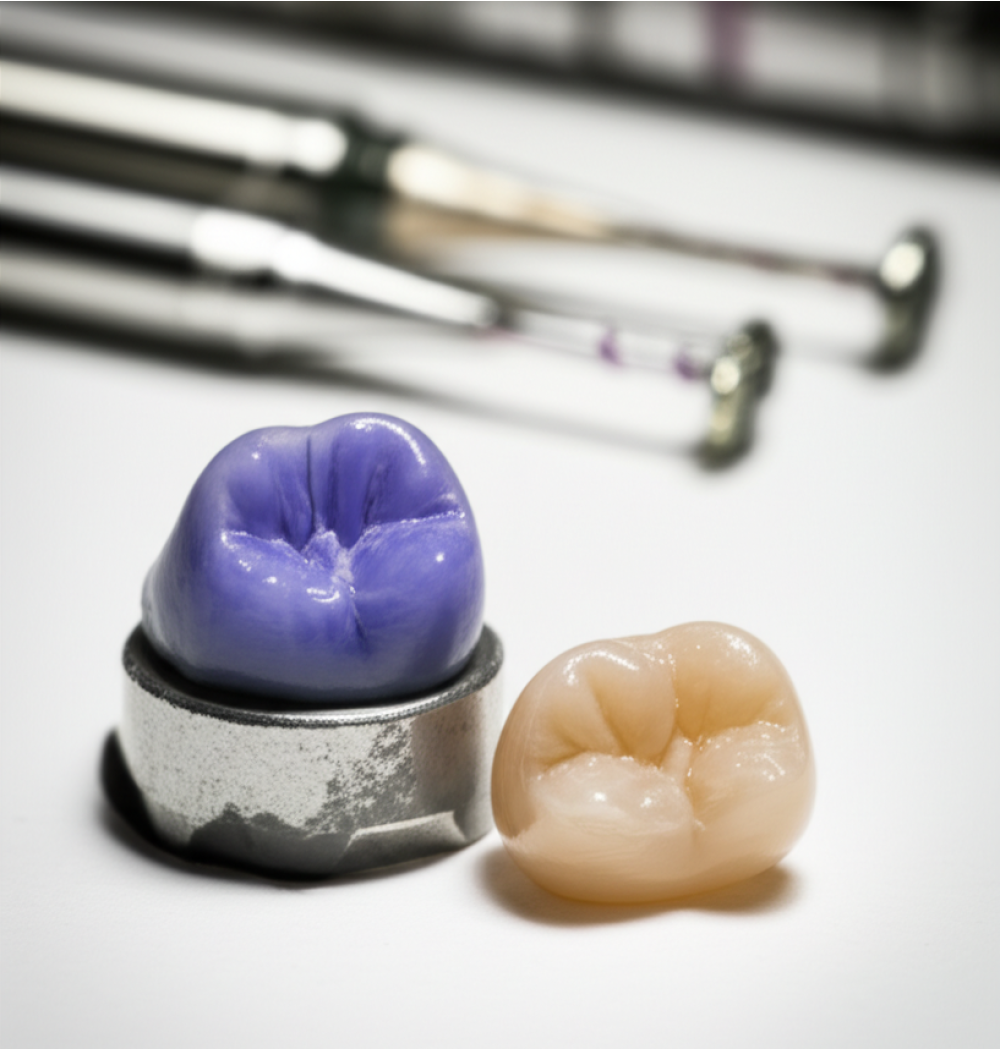
Always mill lithium disilicate in the pre-crystallized (blue/purple) state. This isn't a suggestion — it's how the material is designed to work.
Pre-crystallized LD has about 40% of its final hardness. It mills more like a dense plaster than a glass. Bur life is dramatically better, surface finish is smoother, and cracking risk drops by an order of magnitude.
After milling, you crystallize in a furnace (typically 840°C for 25 minutes, depending on the brand). This is where the material reaches full strength — 400+ MPa flexural strength — and develops its final translucency.
If someone is selling you "pre-milled" or "fully crystallized" LD blanks for your standard mill: pass. You'll destroy burs, crack restorations, and spend more time on remakes than you save on skipping the crystallization step.
Making It Work Consistently
Lithium disilicate milling isn't hard once the variables are controlled. The checklist is short:
- Fresh diamond burs — swap at half the interval you'd use for zirconia
- Speeds and feeds in the sweet spot — start conservative, adjust by ear
- Coolant flowing properly — check nozzles before every job
- Minimum wall thickness — 0.5mm margins, 16mm² connectors
- Pre-crystallized blanks only
Get these right and lithium disilicate becomes the most rewarding material to mill. The translucency is unmatched for anteriors. Patients notice the difference. So do dentists — and that's what keeps them sending cases to your lab instead of milling chairside.
The material isn't the problem. The process is. Fix the process, and the cracks stop.