
Hybrid Ceramic Milling: Bur Selection and Parameters for Resin Nano Ceramics
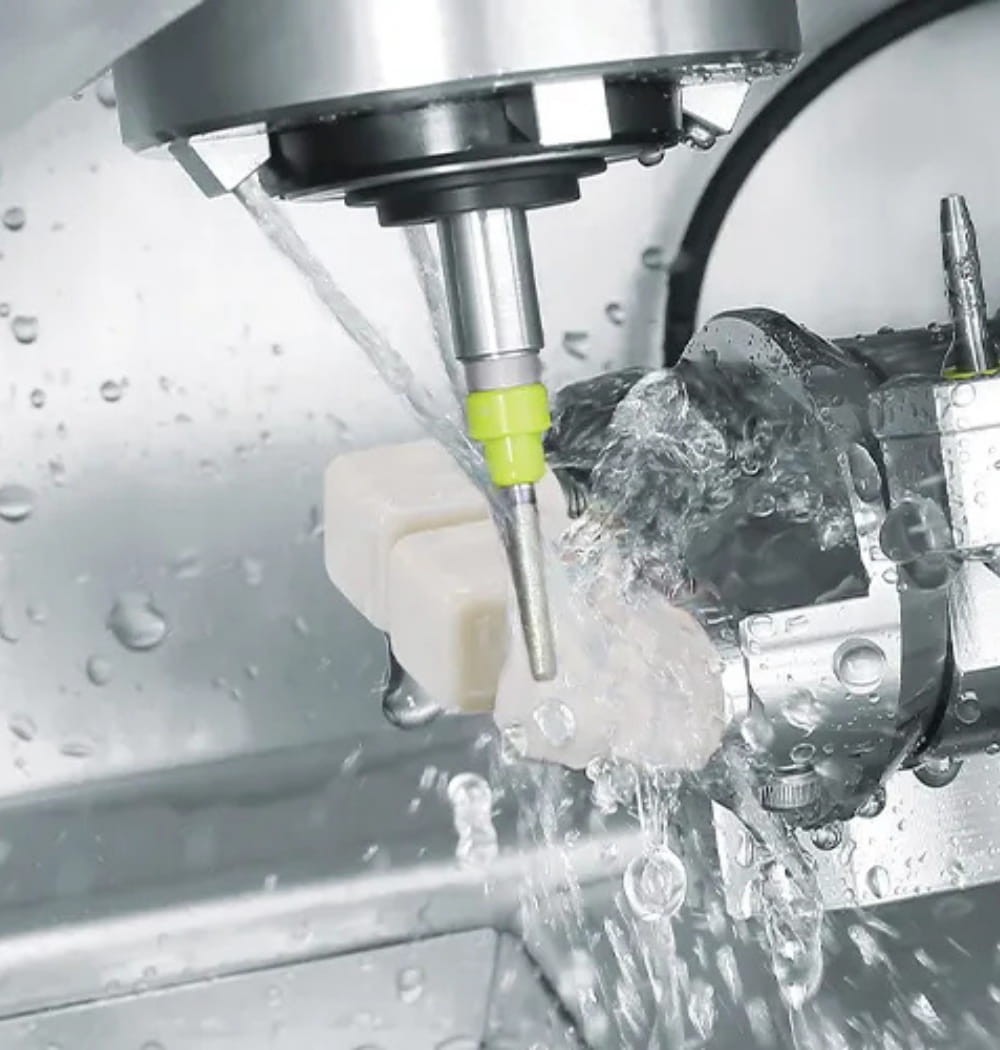
Why Hybrid Ceramics Are Gaining Ground
Resin nano ceramics — Lava Ultimate, CERASMART, Shofu HC Block — sit between glass ceramics and composites. They mill faster than lithium disilicate, produce less bur wear than zirconia, and skip the sintering step entirely. For temporaries, inlays, onlays, and single crowns in low-stress areas, they're hard to beat on turnaround time.
The catch: they're softer than ceramics and more brittle than PMMA. Mill them with the wrong parameters and you'll get chipping at margins or fractures at thin walls.
Material Properties That Affect Milling
Hybrid ceramics have a flexural strength of 220-260 MPa — roughly half of lithium disilicate (400+ MPa) but stronger than PMMA (120 MPa). Their Vickers hardness falls around 200-250 HV. They cut easier than glass ceramics but chip more readily than pure resin blocks.
The resin matrix absorbs vibration better than pure ceramics. Good news for bur life — expect 30-40% more units per bur compared to glass ceramic blocks. But the material flexes under cutting forces, so aggressive feeds cause deflection and rough surfaces.
Thermal Sensitivity
Hybrid ceramics are heat-sensitive. Excessive RPM without adequate coolant creates resin smearing — a gummy residue on the bur that ruins surface quality and accelerates wear. Dry milling is not an option. Always run wet.
Bur Selection: What Works and What Doesn't
Use diamond-coated burs for roughing and fine-grit diamond or polished carbide for finishing. Standard carbide burs designed for zirconia are too aggressive — they tear the material rather than cutting cleanly.
Roughing
Medium-grit diamond burs (107-126 μm) work best. They remove material efficiently without overloading the resin matrix. Avoid coarse-grit diamonds — the large grain size creates subsurface cracks that show up after polishing.
Finishing
Fine-grit diamond burs (46-75 μm) or polished carbide end mills deliver the smoothest margins. Two-flute carbide end mills at low feed rates produce near-polished surfaces straight off the machine. A pointed finishing bur with 0.3mm tip radius picks up fine occlusal details without chipping.
What to Avoid
CVD diamond burs are overkill. Their extreme hardness and aggressive cut are designed for full-contour zirconia. On hybrid ceramics, they remove material too fast and leave a rough, pitted surface. Stick with standard diamond-coated or carbide tools from your existing glass ceramic milling bur set.
Milling Parameters by Machine Type
| Parameter | 4-Axis Mill | 5-Axis Mill |
|---|---|---|
| Spindle Speed (Roughing) | 15,000-20,000 RPM | 18,000-25,000 RPM |
| Spindle Speed (Finishing) | 20,000-30,000 RPM | 25,000-35,000 RPM |
| Feed Rate (Roughing) | 800-1,200 mm/min | 1,000-1,500 mm/min |
| Feed Rate (Finishing) | 400-600 mm/min | 500-800 mm/min |
| Step-Over (Roughing) | 50% of bur diameter | 40-50% of bur diameter |
| Step-Over (Finishing) | 10-15% of bur diameter | 8-12% of bur diameter |
| Coolant | Wet, medium flow | Wet, medium-high flow |
Start conservative. Hybrid ceramics respond well to higher spindle speeds with moderate feed rates — the opposite of zirconia, where you want lower RPM and higher feed. If you see resin smearing on the bur, increase coolant flow first, then reduce RPM by 10-15%.
Troubleshooting Common Issues
Chipping at Margins
Reduce feed rate by 20%. Check that your finishing bur isn't worn — hybrid ceramics are less forgiving of dull tools than PMMA. A bur that still works on PMMA will chip hybrid ceramic margins.
Resin Smearing on Bur
Cut the RPM and check coolant nozzle alignment. If the coolant stream misses the cutting zone, the resin heats up and smears. Clean affected burs with isopropyl alcohol — once the residue hardens, the bur is done.
Rough Occlusal Surface
Tighten your finishing step-over to 8-10% of bur diameter. Hybrid ceramics need finer step-over than glass ceramics because the resin component tears if passes are too far apart.
Fracture at Thin Walls
Keep minimum wall thickness above 1.2mm. Unlike zirconia (0.5mm) or lithium disilicate (0.8mm), the resin matrix can't support razor-thin walls under milling forces. Thinner margins? Switch material.
When Hybrid Ceramics Make Sense
Hybrid ceramics aren't replacing zirconia or lithium disilicate in high-stress restorations. They work best for: chairside single crowns where speed matters, long-term temporaries (12+ months), inlays and onlays where tooth structure handles most of the load, and implant-supported provisionals.
The real advantage is workflow speed. No sintering, minimal polishing, faster milling times. A single crown that takes 25 minutes in zirconia plus 8 hours sintering takes 12-15 minutes in hybrid ceramic and goes straight to the mouth. For labs running same-day cases, that difference pays for itself.